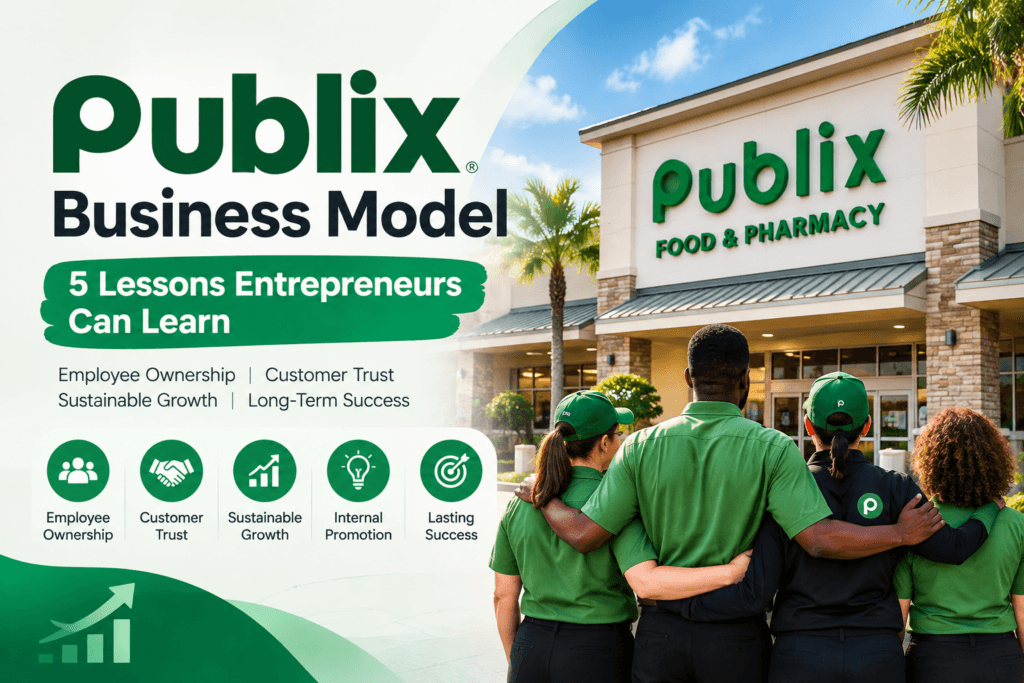
If you’ve been anywhere near social media or the news this week, there’s a good chance you’ve seen the name Publix pop up. It’s not a tech startup, it’s not a UAE free zone, and it’s definitely not something you’d expect to find on a site about business setup in Dubai or Riyadh — it’s a Florida-based grocery store chain. But Publix keeps trending for a reason that has nothing to do with milk prices or weekly BOGO deals. It’s quietly one of the most studied business models in America, and there’s a lot buried in that model that any entrepreneur — whether you’re opening a retail shop in Dubai, a consultancy in Riyadh, or a small trading company anywhere in the Gulf — can actually learn from. This article breaks down what makes Publix different, pulls out the business lessons that translate outside the US grocery aisle, and shows you exactly how to apply them if you’re building something in the UAE or Saudi Arabia right now.
Table of Contents
What Is Publix, and Why Is Everyone Suddenly Talking About It?
Publix Super Markets is a regional grocery chain founded in 1930 by George W. Jenkins in Winter Haven, Florida. Today it operates well over 1,300 stores across Florida, Georgia, Alabama, Tennessee, South Carolina, North Carolina, and Virginia, employing roughly 260,000 people. On paper, that’s just another large American retailer. What makes Publix genuinely unusual — and what keeps pulling it back into trending lists — is who owns it.
Publix is not publicly traded on the stock market. It’s almost entirely owned by its own employees through an Employee Stock Ownership Plan, commonly known as an ESOP. No hedge fund controls it. No founder-family holding company calls the shots from a boardroom disconnected from daily operations. The people restocking shelves, running the deli counter, and managing the stores are, quite literally, part-owners of the business. That single structural decision — made decades ago — is the thread that connects almost everything people admire about the company: the customer service, the low staff turnover, the steady (not explosive) growth, and the brand loyalty that borders on obsession in the Southeastern US.
None of this is directly relevant to opening a company in Dubai or Riyadh. But the underlying principles absolutely are. Ownership culture, sustainable growth, trust-building, and internal promotion aren’t American concepts — they’re business fundamentals that apply whether you’re running a grocery chain in Florida or a small trading company in a Dubai free zone.
A Quick History: How a Single Florida Grocery Store Became a $50 Billion Company
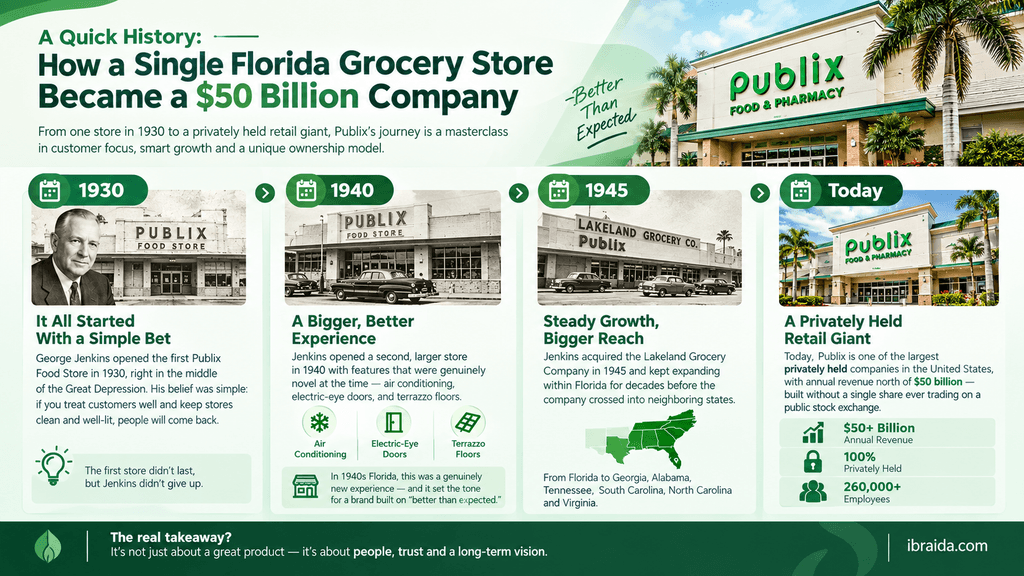
George Jenkins opened the first Publix Food Store in 1930, right in the middle of the Great Depression, with a simple bet: if you treat customers well and keep stores clean and well-lit, people will come back. That store closed within a few years, but Jenkins didn’t give up on the concept — he opened a second, larger store in 1940 with features that were genuinely novel at the time, including air conditioning, electric-eye doors, and terrazzo floors. It sounds almost quaint today, but in 1940s Florida, walking into an air-conditioned grocery store was a genuinely new experience, and it set the tone for a brand built on “better than expected” retail.
From there, growth was steady rather than explosive. Jenkins acquired the Lakeland Grocery Company in 1945 and kept expanding within Florida for decades before the company crossed into neighboring states. Today, Publix is one of the largest privately held companies in the United States, with annual revenue north of $50 billion — built without a single share ever trading on a public stock exchange. That’s the part that keeps resurfacing in business commentary: a company this large, competing directly against publicly traded giants with far deeper marketing budgets, has managed to out-retain and out-trust nearly all of them using a structure most competitors have never bothered to copy.
The Employee-Ownership Model That Makes Publix Different
Here’s the simple version of how it works. Instead of a company being owned by outside shareholders who trade its stock on an exchange, an ESOP holds shares in trust on behalf of employees. As workers put in time with the company — typically after they cross a minimum number of hours per year — they start accumulating stock allocations, usually tied to their pay. Over years, that stock grows in value alongside the company’s performance, and when an employee eventually leaves or retires, they cash out their shares.
For Publix specifically, this has meant that longtime associates — people who started as baggers or cashiers decades ago — have retired as millionaires purely from stock accumulated through years of steady employment. That’s not a marketing story; it’s a well-documented outcome of the model, and it’s the single biggest reason Publix shows up so often in “best places to work” rankings and employee-ownership case studies.
Why does this matter to someone setting up a business overseas? Because the mechanism itself (ESOPs, in the specific US tax-code sense) won’t transfer to the UAE or Saudi Arabia — but the underlying idea of giving your team a real stake in outcomes absolutely can, whether that’s through profit-sharing, performance bonuses, equity in a smaller company, or simply building a culture where staff feel ownership even without literal shares.
It’s worth being clear-eyed about what this structure is not. It isn’t a magic fix that automatically produces a great company culture, and it isn’t free money for employees — the value of the shares is directly tied to how well the company actually performs, so a badly run employee-owned business is still a badly run business. What the model does reliably do is align incentives: when the people doing the day-to-day work benefit directly from the company doing well, they tend to make decisions with the long term in mind rather than just clocking out at 5pm. That single alignment is the real export here, not the specific American tax mechanism that makes it legally possible.
5 Business Lessons From Publix’s Model That Apply Anywhere
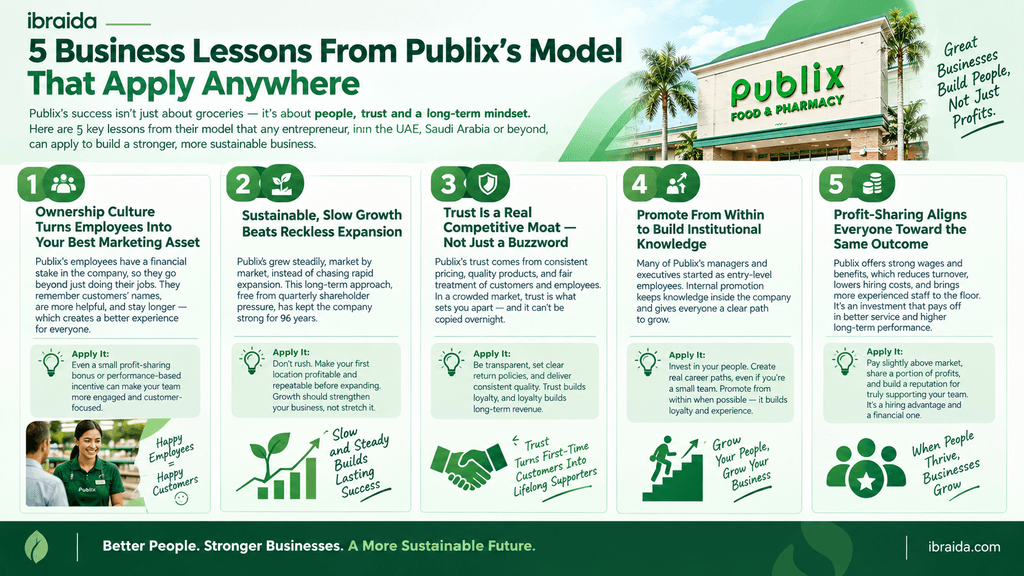
Lesson 1: Ownership Culture Turns Employees Into Your Best Marketing Asset
Publix consistently ranks near the top of customer satisfaction surveys for US grocery chains, and it’s not because of flashy advertising. It’s because employees who have a financial stake in the company’s success behave differently than employees who are simply clocking hours. They remember regular customers’ names. They go out of their way to help someone find a product. They stay longer at the company, which means customers deal with familiar faces instead of a rotating cast of new hires.
For a small business owner setting up in the UAE or Saudi Arabia, you’re very unlikely to be running a 260,000-person ESOP any time soon. But the principle scales down perfectly. If you’re hiring your first two or three employees for a retail shop, a consultancy, or a service business, structuring even a small profit-sharing bonus tied to store or company performance — rather than a flat salary alone — changes how people show up to work. Ownership, even in a small dose, changes behavior.
Lesson 2: Sustainable, Slow Growth Beats Reckless Expansion
Publix has been in business for nearly a century and has expanded deliberately, market by market, rather than chasing rapid nationwide expansion the way some competitors have. It’s still concentrated primarily in the Southeastern US, decades after chains a fraction of its age have already gone national — and often gone bankrupt trying. That patience is a direct byproduct of not answering to shareholders demanding quarterly growth numbers. Employee-owners tend to prioritize long-term stability over short-term stock price spikes.
This is one of the most transferable lessons in this entire article for anyone reading it from Pakistan or the wider Gulf region. A huge number of first-time founders — especially after reading a few viral “how I scaled to 7 figures” posts — try to expand into multiple cities, multiple product lines, or multiple countries before their first location or first product is even properly profitable. If you’re in the process of starting a business in the UAE, resist the urge to open your second branch before your first one has a stable, repeatable customer base. Publix took decades to expand past Florida. You don’t need to move that slowly, but the underlying discipline — grow only once the current stage is genuinely solid — is exactly why the company is still around after 96 years while flashier competitors have folded.
Lesson 3: Trust Is a Real Competitive Moat — Not Just a Buzzword
Publix routinely ranks as one of the most trusted retail brands in America, and that trust wasn’t bought with a single ad campaign. It was built through decades of consistent pricing, consistent product quality, and a reputation for treating both customers and employees fairly. In a market as saturated as US grocery retail, trust is the actual differentiator — price and product selection are largely commoditized, but a customer’s belief that “this company won’t rip me off” is not something a competitor can copy overnight.
This is directly relevant if you’re setting up any consumer-facing business in the Gulf, where trust signals matter enormously — arguably more than in mature Western markets, because customers are often choosing between an established international brand and a new local entrant. Whether you’re applying for a UAE Golden Visa as part of a longer-term relocation and business plan, or simply opening your first shop, transparent pricing, clear return policies, and consistent quality from day one will do more for your brand over five years than any single marketing push.
Lesson 4: Promote From Within to Build Institutional Knowledge
A striking number of Publix’s store managers and regional executives started their careers as entry-level baggers, cashiers, or stock clerks. The company has a deep, well-documented culture of internal promotion rather than hiring outside executives to run stores they’ve never worked a shift in. This does two things: it keeps institutional knowledge inside the company instead of walking out the door with every departing manager, and it gives every entry-level employee a visible, realistic path upward — which is one of the strongest retention tools any business can offer.
If you’re building a team for a new company in Dubai or Riyadh, this is worth designing into your hiring process from the start rather than retrofitting it later. Small businesses often default to hiring externally for every management gap because it feels faster. But an employee who started as your first hire and worked their way up to managing a location understands your systems, your customers, and your standards in a way an outside hire simply can’t replicate in the first six months.
Lesson 5: Profit-Sharing Aligns Everyone Toward the Same Outcome
Beyond the ESOP itself, Publix has historically offered strong wages and benefits relative to the retail industry average, reducing the financial pressure that typically drives high turnover in grocery and retail work. Lower turnover means lower hiring and training costs, more experienced staff on the floor, and a better customer experience — a cycle that reinforces itself over time.
For a founder running the numbers on a new venture, it’s tempting to treat staff costs purely as a line item to minimize. Publix’s long-term results suggest the opposite approach can be more profitable: paying slightly above market and sharing a portion of profits reduces the hidden costs of constant rehiring and retraining, which are often invisible in a basic spreadsheet but very real in a company’s actual performance over several years.
There’s also a recruiting advantage that compounds over time. In competitive job markets — and Dubai’s retail, hospitality, and services sectors are extremely competitive for good staff — a reputation for genuinely sharing success with employees becomes a hiring tool in itself. Word travels fast in any industry cluster about which employers actually follow through on what they promise, and that reputation ends up reducing your future hiring costs just as much as it reduces turnover among people you’ve already hired.
AI Business OS — Notion Dashboard
A complete 12-module Notion system to run your entire business from one place — clients, projects, finances, and content, fully linked and ready to use.
- Clients CRM & Projects tracker
- Finance, Invoices & Subscriptions Tracker
- AI Prompt Vault & SOP Library
- Goals, OKRs & Content Planner
- Instant Gumroad delivery — duplicate and start today
Common Mistakes Founders Make When Trying to Copy This Model
Every year, a new wave of founders reads a case study like this one and tries to bolt “Publix-style culture” onto their business overnight — usually by announcing a vague profit-sharing promise with no structure behind it. That almost never works, and it can actually damage trust faster than having no program at all, because employees remember exactly what was promised even if the founder doesn’t write it down. If you’re going to borrow any part of this model, borrow it properly:
- Don’t promise equity or profit-sharing without a written, specific formula. “We’ll share profits when things are good” is not a policy — it’s a source of future disputes. Define the percentage, the trigger, and the payout schedule before you tell anyone about it.
- Don’t try to replicate the full model with two employees. A five-decade-old, 260,000-person ESOP structure isn’t the template for a three-person startup. Take the principle — shared upside builds loyalty — and scale it down to something as simple as a quarterly cash bonus tied to a clear metric.
- Don’t confuse “promoting from within” with “never hiring anyone experienced.” Publix still hires specialists and experienced managers for roles that genuinely require outside expertise. The lesson is to build a real internal growth path, not to refuse external hires on principle.
- Don’t expand faster than your systems can support just because a competitor is moving fast. Publix’s patience wasn’t passivity — it was discipline. Copying the growth speed of a well-funded competitor without copying their capital base is one of the fastest ways to run out of cash.
Pros and Cons of the Employee-Ownership Business Model
| ✓ Pros | × Cons |
|---|---|
| Higher employee retention and lower turnover costs | Slower decision-making since ownership is distributed rather than concentrated |
| Stronger customer service from motivated, invested staff | Harder to raise fast external capital compared to a traditional shareholder structure |
| Long-term thinking instead of pressure for quarterly results | Complex to set up and administer (trusts, valuations, compliance) |
| Built-in succession planning as employees become owners over time | Not a recognized legal structure in the UAE or Saudi Arabia — needs to be adapted |
| Strong brand trust built through consistency over decades | Slower geographic expansion by design, which isn’t ideal for every business model |
How Gulf and Pakistani Entrepreneurs Can Actually Apply This
An ESOP in the exact American legal sense doesn’t exist as a standard structure when you’re setting up a business in the UAE or registering a company in Saudi Arabia. But the strategic ideas behind it map cleanly onto smaller businesses if you adapt them intentionally:
- Build profit-sharing into your compensation structure early. Even a simple quarterly bonus tied to revenue or margin targets creates ownership-style behavior without needing a formal equity structure.
- Choose your legal structure with growth discipline in mind. Whether you go with a Dubai mainland license or a free zone setup, pick the structure that matches how you actually plan to grow — not the one that sounds the most impressive on paper.
- Budget realistically before you scale. Run your numbers through a proper Dubai business setup cost calculator before committing to a second location or hire, the same way Publix expanded market by market only once each one was proven.
- Promote your first hires instead of always hiring externally. Build a simple internal growth path into your team structure from month one, not year three.
- If you’re a Pakistani founder building in the region, the fundamentals are the same whether you’re looking at Dubai or Riyadh — our guide on business setup in Dubai for Pakistani citizens and the walkthrough on how Pakistanis can start a business in Saudi Arabia both cover the practical registration steps once you’ve settled on your model.
- Understand your tax exposure before you set compensation structures. Profit-sharing and bonus structures interact with your obligations under the UAE corporate tax rules for small businesses, so it’s worth checking this before finalizing how you pay your team.
- If you’re still deciding what to build, our list of best business ideas in Dubai is a good starting point for finding a model where a lean, trust-driven, employee-first approach like Publix’s can realistically work at a small scale.
Publix’s Approach vs. How Most New Businesses in the Gulf Actually Operate
It’s worth being honest about the gap between Publix’s approach and how a lot of new companies in the UAE and Saudi Arabia actually get built. Many first-time founders in the region — especially solo entrepreneurs and small teams — end up running lean by necessity, which usually means minimal staff, no formal bonus structure, and a hiring approach built around “whoever’s available and cheap” rather than “whoever will grow with the company.” That’s not a criticism; early-stage cash flow genuinely doesn’t allow for much else in year one. But it does mean that as soon as revenue stabilizes, there’s an opportunity most founders skip: formalizing even a basic version of the incentive structures that made Publix’s staff retention so strong, well before the business is large enough to need it.
The founders who do this early tend to have an easier time when they’re ready to open a second location, hire their first manager, or step back from day-to-day operations themselves. The ones who wait until they’re managing ten or fifteen people with no structure in place usually end up retrofitting a system under pressure, which is a much harder way to do it. If you’re currently at the stage of comparing a free zone setup against a mainland license, this is a good moment to think about your staffing philosophy at the same time as your legal structure — not six months after you’ve already hired your first few people informally.
Make Your Business Setup Smarter
Use Ibraida’s free tools and calculators to validate ideas, plan your setup, and make better business decisions.
Free Zone or Mainland Dubai — Which Is Right for You?
Answer a few simple questions and discover which Dubai business setup option may better match your goals.
AI Business Idea Validator
Test your business idea and get AI-powered insights.
AI Prompt Optimizer
Turn basic prompts into clearer, more effective AI prompts.
Dubai Business Setup Cost Calculator
Estimate the potential cost of setting up a business in Dubai.
AI Tool Stack Builder
Find AI tools that fit your business workflow and needs.
AI Blog Outline Generator
Create structured blog outlines faster with AI.
Explore Ibraida Tools
More practical tools are available to help you plan smarter.
Publix in Saudi Arabia? Not Exactly — But the Model Still Applies
There’s no Publix store in Saudi Arabia, and there won’t be one anytime soon — it’s a US regional chain with no international expansion plans. But the retail and service sectors in Saudi Arabia are growing quickly under Vision 2030, and the same trust-and-retention principles apply to any founder entering that market. If you’re going the formal investment route, our breakdown of the MISA investment license covers what foreign founders need before registering, and our full walkthrough of how to start a business in Saudi Arabia as a foreigner lays out the entire process from company type to bank account. Once you’ve got the legal side sorted, checking the realistic cost of starting a business in Saudi Arabia will help you plan a Publix-style measured expansion instead of overcommitting capital in year one.
Where to Go From Here
Reading a case study is easy — the harder part is turning it into an actual decision this month. If Publix’s model resonates with you, don’t try to implement all five lessons at once. Pick the one that fits your current stage: if you haven’t registered yet, start with the growth-discipline lesson and run your numbers properly before committing to a location or license. If you’re already operating and hiring, start with the profit-sharing lesson and write down a simple, specific bonus formula this week rather than leaving it as a vague future promise. Either way, the goal isn’t to become a copy of a Florida grocery chain — it’s to borrow the one or two principles that will actually move the needle for the business you’re building right now, whether that’s in the UAE or Saudi Arabia.
If you want to keep exploring the practical side of business setup rather than the case-study side, our free business tools and digital products pages cover everything from cost calculators to compliance checklists built specifically for the UAE and Saudi markets.
UAE Business Setup Cluster
Thinking About the UAE Instead? Read Our Complete Guide
If you’re comparing Saudi Arabia against the UAE, start with our full step-by-step guide covering free zones, mainland licensing, costs, visas, and everything else you need to launch in Dubai in 2026-2027.
Read the UAE Step-by-Step Guide →More From Our UAE Business Setup Series
- How to Start a Business in UAE: Complete Step-by-Step Guide (Pillar)
- Dubai Free Zones Guide 2026-2027: Complete List & Comparison
- Dubai Mainland License Guide 2026-2027
- Dubai Business Setup Cost Calculator & Comparison 2026-2027
- How to Open a Business Bank Account in Dubai 2026-2027
- UAE Corporate Tax Guide for Small Businesses 2026-2027
- UAE Golden Visa Guide 2026-2027: Requirements & Process
- Dubai Freelance Visa & Permit Guide 2026-2027
- Business Setup in Dubai for Pakistani Citizens: Complete Guide
- How to Start a Business in Dubai from the USA
- Best Business Ideas in Dubai 2026-2027
Frequently Asked Questions
Why is Publix trending online right now?
Publix regularly resurfaces in trending topics due to its weekly BOGO ad cycles, its consistent top rankings in customer trust and employee satisfaction surveys, and periodic viral moments involving individual store locations. Its unusual employee-ownership structure also gets rediscovered frequently in business and finance content.
Is Publix a publicly traded company?
No. Publix is privately held and majority-owned by its own employees through an Employee Stock Ownership Plan (ESOP), which is unusual for a company of its size.
Can I open a Publix franchise in the UAE or Saudi Arabia?
No. Publix does not franchise and has no stores or expansion plans outside the southeastern United States. It is not an international brand.
What is an ESOP, in simple terms?
An Employee Stock Ownership Plan is a US benefit structure where a company sets up a trust that holds and allocates company shares to employees over time, typically based on tenure and pay, giving workers a real ownership stake in the business.
Does the UAE or Saudi Arabia have an equivalent to an ESOP?
Not as a standardized legal structure. Founders in the region typically replicate the underlying benefits through profit-sharing arrangements, performance bonuses, or direct equity grants in smaller companies, structured around local labor and commercial law.
What’s the single biggest takeaway from Publix’s model for a new founder?
Give your earliest employees a genuine stake in the outcome — financially or through a real path to growth within the company — and prioritize steady, proven expansion over rapid, capital-heavy growth.
How long did it take Publix to expand outside Florida?
Publix opened its first store in 1930 and didn’t expand into a second US state until decades later, growing market by market inside Florida first before moving into Georgia and beyond. That deliberate pace is a large part of why it has avoided the overexpansion problems that have sunk faster-growing competitors.
Is a profit-sharing model realistic for a small business in Dubai or Riyadh?
Yes. It doesn’t require the legal complexity of a US-style ESOP — a simple, clearly written bonus structure tied to revenue, margin, or another measurable target can achieve the same alignment effect for a team of any size, as long as the terms are specific and consistently honored.
Does employee ownership guarantee a company will succeed?
No. The structure aligns incentives, but it doesn’t replace a viable product, solid unit economics, or good management. A poorly run employee-owned company will still struggle — the model amplifies good management rather than substituting for it.
References
- ESOP.org — What Is an ESOP (Employee Stock Ownership Plan)?
- NCEO — The Employee Ownership 100: America’s Largest Employee-Owned Companies
- Progressive Grocer — Publix Tops Employee Ownership 100 List
- Wikipedia — Employee Stock Ownership Plan
- Publix Corporate Newsroom
- Publix Stockholder — Financial News Releases
Disclaimer: This article is for general informational purposes only and does not constitute legal, financial, or tax advice. Business setup requirements in the UAE and Saudi Arabia change frequently — always confirm current rules with the relevant government authority or a licensed consultant before making decisions.

Awesome
Thanks For your comment <3