Free Zone or Mainland?
Find Your Perfect Match
Answer 8 quick questions about your business and get a personalized recommendation — Free Zone, Mainland, or Hybrid — with cost estimate and next steps.
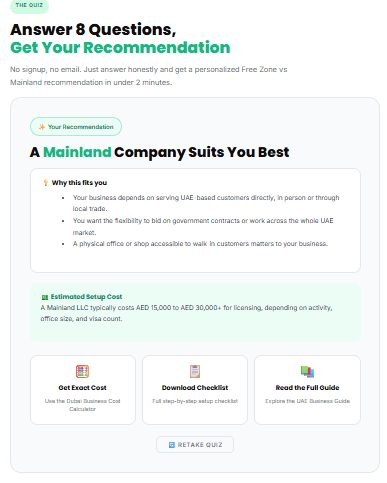
Answer 8 Questions,
Get Your Recommendation
No signup, no email. Just answer honestly and get a personalized Free Zone vs Mainland recommendation in under 2 minutes.
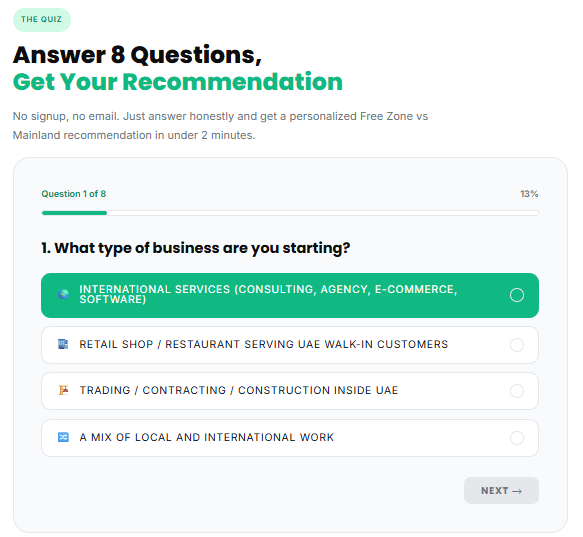
1. What type of business are you starting?
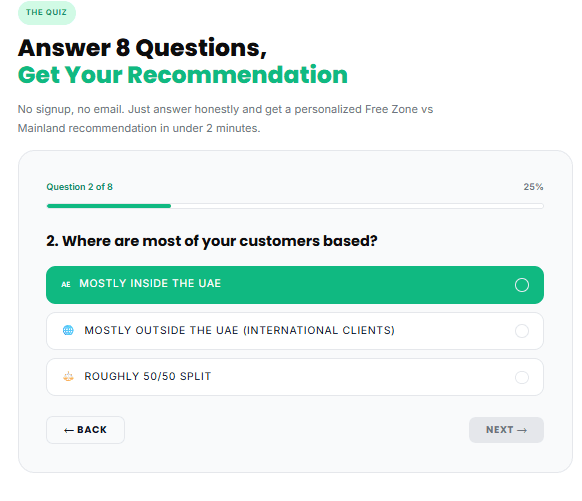
2. Where are most of your customers based?
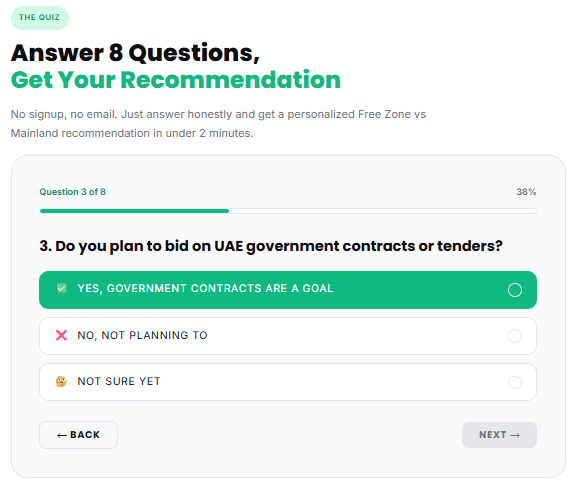
3. Do you plan to bid on UAE government contracts or tenders?
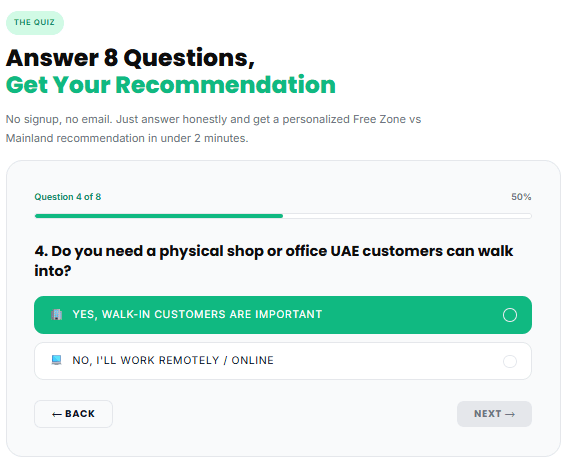
4. Do you need a physical shop or office UAE customers can walk into?
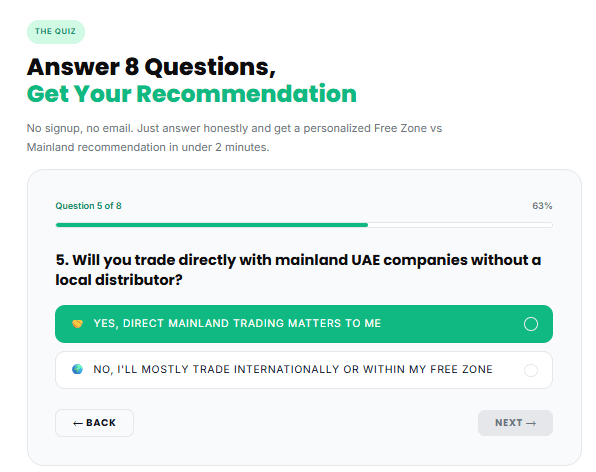
5. Will you trade directly with mainland UAE companies without a local distributor?
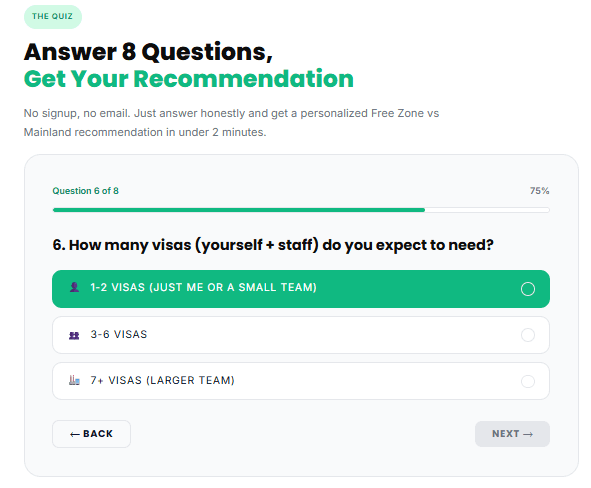
6. How many visas (yourself + staff) do you expect to need?
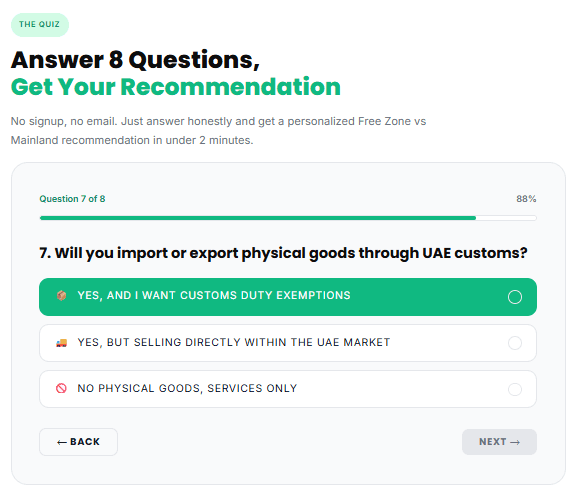
7. Will you import or export physical goods through UAE customs?
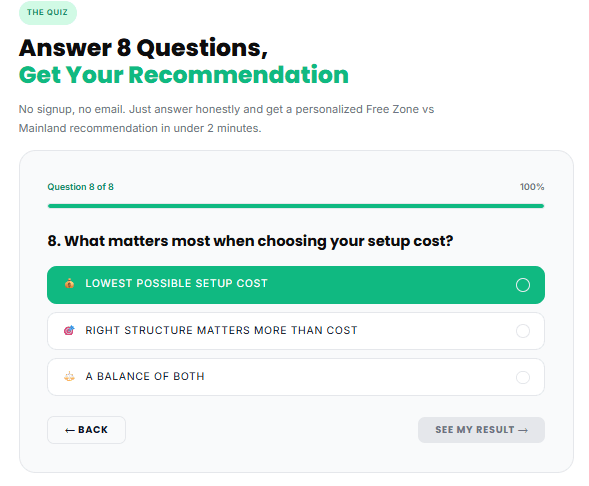
8. What matters most when choosing your setup cost?
Loading...
💡 Why this fits you
💵 Estimated Setup Cost
3 Steps to Total Clarity
No jargon, no sales calls. Just honest answers to honest questions, and a clear recommendation you can act on today.
Answer 8 Questions
Tell us about your business type, customers, budget, and goals. Takes under 2 minutes.
Get Your Match
Our logic scores your answers instantly and recommends Free Zone, Mainland, or a Hybrid setup.
Take Action
See an estimated cost range, then jump to the Cost Calculator, checklist, or full guide to move forward.
See How the Quiz Works — Step by Step
Take a quick look inside the Free Zone vs Mainland Quiz before you begin. In less than two minutes you'll answer eight carefully designed questions and receive a personalized recommendation based on your business goals, customers, budget, and future plans.
Choose Your Business Type
The quiz starts by understanding what type of business you're planning to launch. Whether you're starting an agency, software company, consultancy, retail shop, restaurant, or trading business, this answer forms the foundation of your recommendation.
Tell Us Where Your Customers Are
Next, we identify whether your customers are mainly inside the UAE, outside the UAE, or a combination of both. This helps determine if a Free Zone or Mainland company structure is better suited to your target market.
Government Contracts & Tenders
This question checks whether winning UAE government contracts is part of your future business plan. Since government tenders usually require a Mainland company, this answer has a major impact on your final recommendation.
Do You Need a Physical Office or Shop?
Some businesses need walk-in customers, while others can operate completely online. This step helps determine whether a physical commercial presence is essential for your business model.
Mainland Trading Requirements
Here we determine whether you plan to trade directly with Mainland UAE companies or mainly work with international clients. This is one of the biggest factors when comparing Free Zone and Mainland company formation.
Estimate Your Visa Requirements
Whether you're starting solo or planning to build a larger team, your visa requirements affect both licensing costs and the most suitable company setup. This step helps us recommend the right package for your future growth.
Import & Export Plans
If your business involves importing, exporting, or customs duty benefits, this question helps identify whether a Free Zone license or a Mainland company will better support your international trade activities.
Balance Cost with Long-Term Goals
The last question focuses on what matters most to you. Whether you're looking for the lowest setup cost or the best long-term business structure, this final answer fine-tunes your personalized recommendation.
Receive Your Personalized Recommendation
After analyzing all eight answers, the quiz instantly recommends the business setup that best matches your goals. You'll also receive an estimated setup cost, practical explanation, downloadable checklist, and helpful resources to confidently move forward.
✔ Personalized Recommendation
✔ Estimated Business Setup Cost
✔ Free Downloadable Checklist
✔ Complete UAE Business Guide
Ready to Discover the Best UAE Business Setup?
Answer eight simple questions and receive a personalized recommendation based on your business goals, customers, budget, and expansion plans. No sign-up required, and it takes less than two minutes.
🚀 Start the Free QuizBuilt for Founders Everywhere
From Karachi to Toronto to London, this quiz gives you clarity before you spend a single dirham — wherever in the world you're starting from.
UK-Based Founders
Looking at Dubai as a tax-efficient base while still serving clients back home.
Canadian Entrepreneurs
Exploring Dubai company formation for international expansion or relocation.
US-Based Founders
Setting up a UAE entity to access global markets with a business-friendly tax regime.
Australian & EU Founders
Comparing Dubai against other offshore hubs for cost, speed, and ease of setup.
Pakistani Entrepreneurs
Expanding from Pakistan into Dubai and unsure which license type fits their business.
Indian Entrepreneurs
Setting up a UAE company for trade, e-commerce, or IT services with easier global access.
Freelancers & Remote Workers
Working online with international clients from anywhere and want the cheapest legal structure.
E-commerce & Trading Sellers
Selling or importing physical goods and need to understand customs duty and trading rules.
Retail & F&B Owners
Opening a shop, cafe, or restaurant that needs walk-in customers across the UAE.
Free Zone vs Mainland Dubai: Quick Comparison
If you want a quick overview before taking the quiz or reading the full guide, this table highlights the main differences between Free Zone and Mainland company setup in Dubai.
| Feature | Free Zone | Mainland |
|---|---|---|
| 100% Foreign Ownership | ✔ | ✔ |
| Lower Setup Cost | ✔ | — |
| Direct UAE Market Access | — | ✔ |
| Government Contracts | — | ✔ |
| Physical Office | Usually Optional | Usually Required |
| Best For | Consultants, SaaS, Agencies, E-commerce | Retail, Restaurants, Trading & Local Services |
| International Business | ✔ | ✔ |
Real Business Examples
Every business has different needs. Here are a few common examples to help you understand which setup is usually the better fit.
Freelance Digital Marketing Consultant
Works with international clients, has no physical office, and wants to keep setup costs low.
Recommended: Free ZoneSaaS Startup
Sells software globally and earns revenue from overseas customers with a remote team.
Recommended: Free ZoneRetail Clothing Store
Needs a physical shop in Dubai and wants to sell directly to local customers.
Recommended: MainlandRestaurant or Café
Relies on walk-in customers, delivery platforms, and local trade licences.
Recommended: MainlandWhy Trust This Quiz?
Unlike generic online quizzes, this assessment is designed around the practical factors that influence business setup decisions in Dubai, helping founders choose the structure that best fits their goals.
Research-Based Questions
Each question focuses on factors such as budget, target market, visa needs, and business activity instead of random scoring.
Personalized Recommendation
Your result is based on your answers, giving guidance tailored to your business rather than a one-size-fits-all suggestion.
Updated for 2026–2027
The quiz reflects current business setup considerations, including ownership rules, market access, and corporate tax.
No Sales Pitch
The goal is to educate first, helping entrepreneurs understand their options before speaking with any formation company.
Free Zone or Mainland Dubai: Which One Should You Choose?
Every founder setting up a company in the UAE eventually asks the same question: should I choose a free zone or mainland Dubai company? It is one of the first and most important decisions you will make, because it affects your cost, your ability to trade, your visa allocation, and how your business is taxed. Unlike many one-time decisions in business setup, the free zone or mainland Dubai choice shapes your operations for years, so it is worth understanding properly before you sign any paperwork or pay a single dirham to an agent.
This guide breaks down the free zone or mainland Dubai decision in plain language, without the sales pitch you usually get from company formation agents who are paid a commission to push you toward whichever option earns them the highest fee. If you want a personalized answer instead of general theory, take the free zone or mainland Dubai quiz above and get a recommendation based on your specific business.
What Is a Free Zone Company in Dubai?
A free zone company is a business registered inside one of Dubai's more than 20 designated economic zones, each governed by its own regulator instead of the Dubai Department of Economy and Tourism. Free zones were originally created to attract foreign investment by offering 100% foreign ownership, simplified licensing, and customs benefits, at a time when mainland companies required a local UAE national partner.
Multi-sector free zones such as IFZA, Meydan, and SHAMS accept a wide range of business activities under a single license and are typically the most affordable entry point, with annual costs starting around AED 12,500. Specialized cluster zones such as DIFC, DMCC, and Dubai Internet City are industry-focused, more expensive, and bring a level of reputational positioning that a generic free zone license cannot offer. When people compare free zone or mainland Dubai options, this cost and positioning trade-off is usually the first thing they notice.
What Is a Mainland Dubai Company?
A mainland company is licensed by the Dubai Department of Economy and Tourism (DET) and can legally trade anywhere in the UAE, without restriction to a single zone. Historically, mainland companies required a UAE national as a local service agent or majority shareholder, but recent reforms now allow 100% foreign ownership for most business activities, closing one of the biggest gaps that used to separate free zone and mainland options.
Mainland companies are the standard choice for businesses that need a physical retail presence, want to bid on government contracts, or plan to sell directly to customers and companies across the UAE without going through a distributor. When the free zone or mainland Dubai comparison comes down to market access, mainland almost always wins.
Free Zone or Mainland Dubai: Key Differences at a Glance
- Ownership: Both now allow 100% foreign ownership in most cases.
- Market access: Free zone companies trade internationally and within their zone; mainland companies trade anywhere in the UAE.
- Cost: Free zones are generally cheaper to set up and maintain.
- Office requirement: Mainland usually requires a physical office; many free zones offer flexi-desk options.
- Government contracts: Only mainland companies can bid on UAE government tenders.
- Visa allocation: Both allow visas, but the number depends on office size and license package.
These differences are why the free zone or mainland Dubai decision cannot be answered the same way for every business. A freelance consultant serving clients in London has a completely different answer than a restaurant owner planning to serve walk-in customers in Downtown Dubai.
Ownership Rules: Free Zone or Mainland Dubai
Ownership used to be the single biggest factor driving the free zone or mainland Dubai decision. Before reforms to the UAE Commercial Companies Law, mainland businesses required a UAE national to hold at least 51% of company shares, which pushed many foreign investors toward free zones purely to retain full control. That is no longer the deciding factor. As of 2026, both free zone and mainland structures allow 100% foreign ownership for the vast majority of business activities, which means the real decision now comes down to where and how you plan to operate, not who legally owns the shares.
Cost Comparison: Free Zone or Mainland Dubai Setup
Cost remains one of the clearest differences in the free zone or mainland Dubai comparison. A standard free zone license in a multi-sector zone typically costs between AED 12,500 and AED 25,000 per year, covering the license, a flexi-desk, and one or two visas. Specialized free zones such as DMCC or DIFC can run from AED 30,000 to over AED 80,000 annually, depending on the office and activity.
A mainland LLC license, by comparison, usually starts around AED 15,000 to AED 20,000 for the license itself, but total setup cost climbs quickly once you factor in a physical office lease, which is a legal requirement for most mainland activities. Depending on location and size, mainland founders often spend AED 25,000 to AED 40,000 or more in year one once office rent, Ejari registration, and approvals are included. If budget is your primary constraint, free zone or mainland Dubai comparisons almost always favor the free zone route, at least for the first year.
Where Can You Trade? Free Zone or Mainland Market Access
Market access is where the free zone or mainland Dubai decision really separates itself from a simple cost comparison. Free zone companies are generally restricted from trading directly with the UAE mainland without appointing a local distributor or obtaining a No Objection Certificate. This is fine for a free zone company that sells software to clients in Europe or consults for companies based outside the UAE, but it becomes a real limitation for a business that wants to sell products directly to UAE-based retailers or consumers.
Mainland companies face no such restriction. A mainland Dubai company can trade with any other business or individual across the emirate and the wider UAE without needing a distributor relationship. In 2025, Dubai introduced a Free Zone Mainland Operating Permit that allows free zone companies to apply for permission to trade on the mainland as well, which has softened this restriction but has not removed it entirely. If your business model depends on direct UAE market access, this is one of the strongest signals pointing toward mainland in your free zone or mainland Dubai decision.
Free Zone or Mainland Dubai for International vs Local Businesses
A useful shortcut for the free zone or mainland Dubai decision is to ask a simple question: who pays my invoices? If most of your revenue comes from clients outside the UAE, such as international consulting, remote software development, or e-commerce sales to overseas customers, a free zone company is usually the more efficient and cost-effective structure. You get full ownership, simplified banking, and often 0% corporate tax under the Qualifying Free Zone Person regime, without paying for infrastructure you do not need.
If most of your revenue comes from customers physically located in the UAE, whether that is a retail shop, a restaurant, a trading company selling to local distributors, or a services business with UAE corporate clients who require direct invoicing, mainland is usually the better fit. Trying to force a UAE-facing business into a free zone structure often means paying for a local distributor relationship or a mainland permit anyway, which can erase the cost advantage that made the free zone attractive in the first place.
Visa Allocation: Free Zone or Mainland
Visa quotas are another practical factor in the free zone or mainland Dubai decision. Free zones typically tie visa allocation to your office package. A flexi-desk might allow one or two visas, while a larger office unlocks more. Mainland companies allocate visas based on the size of your leased office space, calculated per square foot by the relevant authority, which means a larger team generally requires a larger and more expensive mainland office. If you are a solo founder or a very small team, free zone visa packages are usually simpler and cheaper. If you are planning to scale to seven or more employees quickly, mainland's per-square-foot visa model can end up being more predictable at scale.
Corporate Tax: Free Zone or Mainland Dubai
Since the UAE introduced federal corporate tax, the free zone or mainland Dubai tax comparison has become more nuanced than it used to be. Mainland companies are subject to the standard 9% corporate tax rate on profits above AED 375,000. Free zone companies can qualify for a 0% rate on certain categories of income under the Qualifying Free Zone Person regime, but only if they meet strict conditions, including maintaining adequate substance in the UAE and earning qualifying income as defined by the Federal Tax Authority. Income that does not meet these conditions, including most income generated from mainland UAE sources, is still taxed at 9% even for a free zone company. This is a common point of confusion in the free zone or mainland Dubai discussion, and it is worth confirming your specific activity's tax treatment with a licensed tax advisor before assuming a free zone automatically means zero tax.
Government Contracts and Tenders
If bidding on UAE government contracts is part of your business plan, the free zone or mainland Dubai decision is largely made for you. Government tenders in Dubai and across the UAE are generally restricted to mainland-licensed companies, since free zone entities fall outside the direct jurisdiction of most government procurement departments. Businesses in construction, facilities management, IT services for government bodies, or supply contracts with UAE ministries almost always need a mainland license to even be eligible to bid.
Can You Switch Between Free Zone and Mainland Later?
One of the most reassuring facts about the free zone or mainland Dubai decision is that it is not permanent. Businesses regularly start in a free zone to minimize early costs and later expand into mainland trading once revenue and local demand justify it. With the 2025 Free Zone Mainland Operating Permit, this transition has become considerably smoother, allowing free zone companies to apply for a branch license or a temporary permit to operate on the mainland without fully re-registering their company. This hybrid path, starting in a free zone and adding mainland access later, is often the most cost-effective way to handle a free zone or mainland Dubai decision when your business has both international and local ambitions from day one.
Common Mistakes When Choosing Free Zone or Mainland Dubai
The most common mistake founders make in the free zone or mainland Dubai decision is choosing based on price alone, without factoring in market access. A free zone license may look AED 10,000 cheaper on a formation agent's price sheet, but if your business depends on direct UAE sales, you will likely end up paying for a mainland permit or distributor relationship anyway, erasing the savings and adding delays.
The second common mistake is assuming free zone companies automatically pay 0% tax. As covered above, qualifying for 0% under the Free Zone Person regime requires meeting specific conditions, and getting this wrong can create compliance issues down the line. The third mistake is underestimating visa needs. Founders who choose the cheapest free zone package with one visa often find themselves needing to upgrade within the first year as their team grows, which comes with additional fees and paperwork.
Free Zone or Mainland Dubai for Pakistani, Indian, UK, US, and Canadian Entrepreneurs
The free zone or mainland Dubai decision does not change based on your nationality, but the reasons behind it often do. Pakistani and Indian entrepreneurs frequently choose Dubai for its proximity, its established South Asian business community, and its access to global markets without the compliance burden of a home-country corporate structure. For most of these founders, especially those running online services, consulting, or export-import businesses, a free zone is usually the faster and cheaper entry point, with mainland becoming relevant only once local UAE distribution becomes part of the plan.
UK, US, Canadian, and Australian founders more often approach the free zone or mainland Dubai question from a tax-efficiency and international expansion angle, using Dubai as a base to serve clients across multiple regions while keeping operational costs low. For this group, a free zone structure is typically sufficient unless the business specifically requires a UAE-facing office or government contract eligibility.
Final Verdict: Free Zone or Mainland Dubai
There is no single correct answer to the free zone or mainland Dubai question, only the answer that fits your specific business. As a general rule, choose a free zone if your revenue comes primarily from international clients, you want the lowest possible setup cost, and you do not need a physical UAE storefront. Choose mainland if you need direct access to UAE customers, plan to bid on government contracts, or require a retail or F&B presence that depends on walk-in traffic. If your business sits somewhere in between, a hybrid approach, starting in a free zone and adding mainland access later, is often the smartest path.
If you are still unsure, the free zone or mainland Dubai quiz above takes less than two minutes and gives you a personalized recommendation based on your business type, customers, budget, and goals, rather than generic advice that applies to everyone.
Related Dubai Business Resources
Planning a business in Dubai involves more than choosing between a Free Zone and Mainland company. Explore these in-depth guides to learn about setup costs, licensing, taxes, visas, and everything you need before launching your business.
Dubai Free Zone Guide
Discover the best Free Zones in Dubai, compare costs, ownership benefits, visa options, and choose the right location for your business.
Read Guide →Mainland Business Guide
Learn how Mainland companies work, who should choose them, licensing requirements, and the advantages of trading across the UAE.
Read Guide →Dubai Business Setup Costs
Understand the latest business setup costs, license fees, visa expenses, office requirements, and estimated budgets for entrepreneurs.
Read Guide →UAE Corporate Tax Guide
Learn when corporate tax applies, Free Zone tax benefits, qualifying income, and what every business owner should know.
Read Guide →Dubai Business Setup Checklist
Follow a complete step-by-step checklist covering registration, licensing, banking, visas, tax registration, and compliance.
Read Guide →Best Business Ideas in Dubai
Explore profitable business opportunities, startup ideas, and industries expected to grow across Dubai in 2026–2027.
Read Guide →