
If you’ve spent any time on Google typing “how to start a business in Saudi Arabia for foreigners,” you’ve probably noticed the same thing I noticed when I started researching this guide: everyone talks around the process, but almost nobody walks you through it step by step with real numbers. Most pages are written by formation agencies whose real goal is to get you to book a free consultation, not to actually explain what MISA, Commercial Registration, or Saudization mean in plain English.
So let’s fix that. This guide covers exactly how to start a business in Saudi Arabia as a foreigner in 2026-2027 — from choosing your business activity to opening your bank account and hiring your first employee. No fluff, no “contact us for a quote” every second paragraph. Just the actual process, the actual costs, and the mistakes that trip up first-time founders.
I’ve written similar guides for the UAE, and one thing I want to be upfront about: Saudi Arabia is not the UAE with a different flag. The regulatory bodies are different, the paperwork sequence is different, and the cultural expectations around doing business are different too. If you’re coming into this expecting a copy-paste of the Dubai free zone playbook, you’re going to hit friction fast. This guide is built specifically around how the Saudi system actually works in 2026-2027, not a generic Gulf business setup template.
Quick Summary
- 100% foreign ownership is allowed in most sectors — no local Saudi partner needed for most business activities.
- The process runs through MISA (investment license) → Ministry of Commerce (Commercial Registration) → corporate bank account → ZATCA tax registration.
- Total first-year setup cost for a standard LLC: 30,000–90,000 SAR, depending on activity and office setup.
- Full process takes roughly 3–6 weeks for a non-regulated LLC; longer for healthcare, education, or finance activities.
- LLC is the most practical entity type for most first-time foreign founders.
- Hiring staff means planning around Saudization (Nitaqat) quotas from day one.
Table of Contents
Why Saudi Arabia Is Attracting Foreign Entrepreneurs Right Now
A few years ago, setting up a company in Saudi Arabia as a foreigner meant finding a Saudi partner, giving up a chunk of ownership, and navigating a maze of approvals. That’s changed dramatically. Under Vision 2030 and the updated Investment Law, the Kingdom has opened its doors to 100% foreign ownership in the vast majority of sectors, and the government has pushed hard to digitize the entire registration process.
Here’s what’s actually driving the interest:
- 100% foreign ownership is now allowed in most business activities, with no local sponsor requirement in the majority of sectors.
- Vision 2030 mega-projects — NEOM, the Red Sea Project, Qiddiya, and dozens of giga-projects — are generating massive demand for contractors, suppliers, consultants, and tech vendors.
- A trillion-dollar-plus economy with the government pouring hundreds of billions of dollars into diversifying away from oil.
- Faster registration — straightforward applications can now be processed in as little as 3 to 10 business days through digital portals.
- A young, tech-savvy population of over 35 million with high smartphone penetration and rising e-commerce adoption.
None of this means starting a business in Saudi Arabia is effortless. It isn’t. But compared to five years ago, the path for a foreign entrepreneur is dramatically shorter and clearer — which is exactly why we’re seeing so many Pakistani, UK, Canadian, and US founders start looking at Saudi Arabia as their next market after (or instead of) the UAE.
Is Saudi Arabia Right for Your Business? Pros and Cons
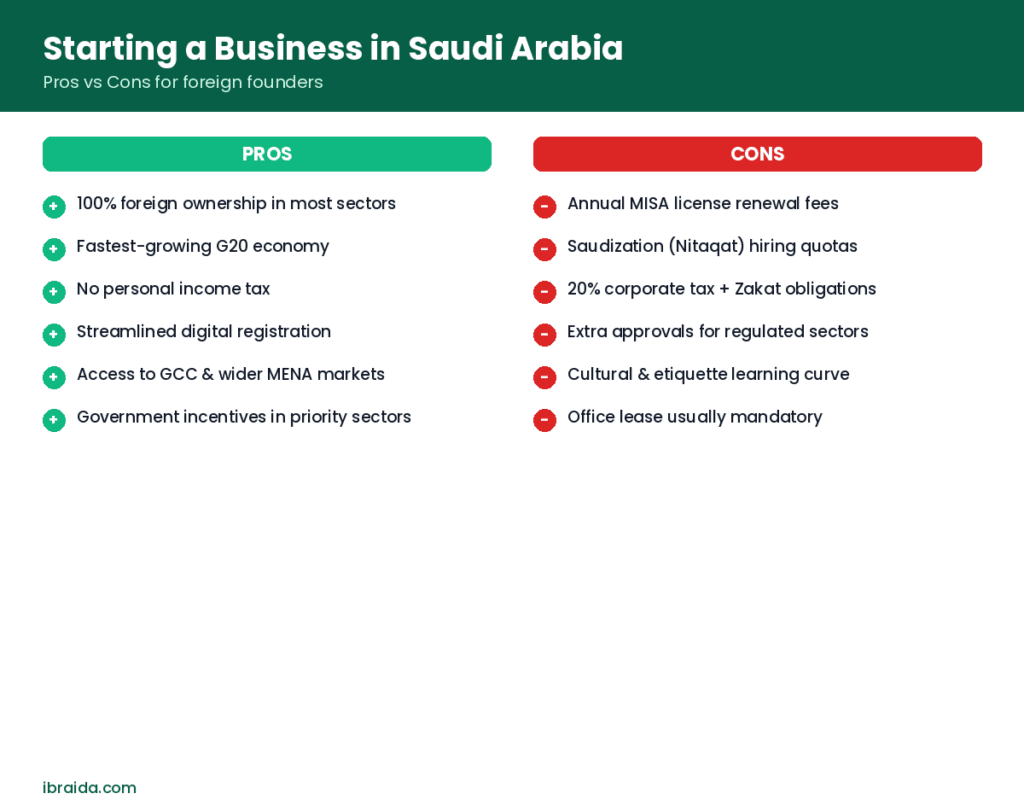
Before you commit months of planning and thousands of dollars in setup costs, it’s worth being honest about the trade-offs. Here’s a balanced look.
| Pros | Cons |
|---|---|
| 100% foreign ownership allowed in most sectors | MISA license renewal fees add up annually (SAR 12,000/year) |
| Fastest-growing G20 economy with massive government spending | Saudization (Nitaqat) quotas require hiring a percentage of Saudi nationals |
| No personal income tax for individuals | Corporate tax (20%) and Zakat obligations still apply depending on ownership structure |
| Streamlined digital registration through MISA and Ministry of Commerce portals | Certain regulated sectors (education, healthcare, finance) require extra approvals and take longer |
| Strategic access to GCC and wider Middle East markets | Cultural and business etiquette learning curve for first-time founders |
| Government incentives for priority sectors like tech, tourism, and manufacturing | Office lease or approved virtual office is mandatory for most license types |
If your business activity falls into one of the priority sectors — renewable energy, logistics, tourism, technology, healthcare, or manufacturing — the pros column gets even longer, since these industries often get faster approvals and additional incentives.
Step-by-Step Process to Start a Business in Saudi Arabia as a Foreigner
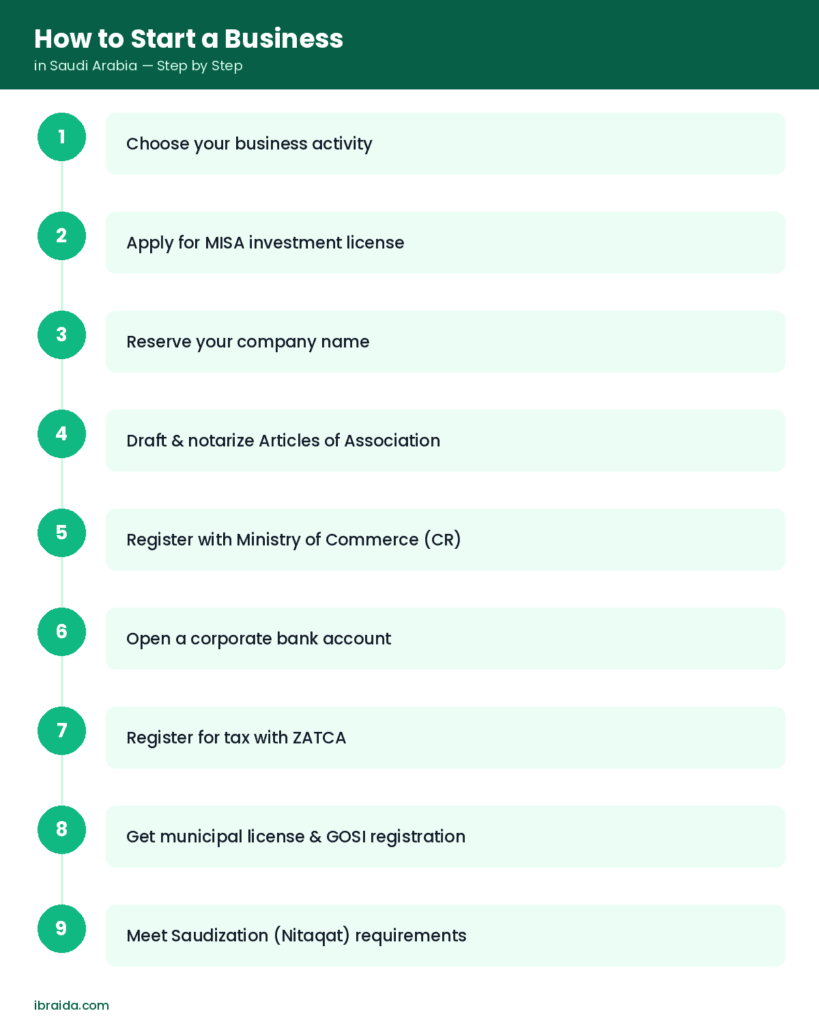
This is the part everyone actually wants. Below is the real sequence you’ll go through if you’re serious about starting a business in Saudi Arabia as a foreign investor in 2026-2027.
Step 1: Choose Your Business Activity
Before anything else, you need to decide exactly what your company will do. Saudi Arabia’s system classifies businesses under more than 1,200 specific activity codes, and the activity you select determines which license type you need, whether extra approvals apply, and even your minimum capital requirement. A trading company, a consulting firm, and a construction contractor are all regulated very differently, so don’t skip this step or pick something vague just to move faster.
Step 2: Apply for Your MISA Investment License
This is the single most important step when you’re figuring out how to start a business in Saudi Arabia for foreigners. The Ministry of Investment of Saudi Arabia (MISA) issues the investment license that legally allows a non-Saudi entity or individual to own and operate a business in the Kingdom.
To apply, you’ll typically submit:
- A business plan outlining your proposed activities
- Your parent company’s commercial registration (if applying as a corporate entity)
- Notarized and apostilled financial statements
- Passport copies of shareholders and directors
- Articles of Association (draft)
Clean, complete applications are usually processed within 3 to 10 working days. Incomplete documentation is the number one reason applications get delayed, so double-check everything before you submit.
Step 3: Reserve Your Company Name
Once your MISA license is approved, you’ll reserve your company name through the Ministry of Commerce portal. The name has to be unique, can’t conflict with existing registered trademarks, and needs to reasonably reflect your business activity. This step is quick, but skipping the trademark check can cost you weeks later if your chosen name gets challenged.
Step 4: Draft and Notarize Your Articles of Association
Your Articles of Association (AoA) define your company’s structure, shareholding, management authority, and internal governance. For an LLC, this document needs to be notarized before you can move to Commercial Registration. Many foreign founders use a local legal consultant for this step since the AoA has to comply with Saudi Companies Law, not just reflect what worked back home.
Step 5: Register with the Ministry of Commerce (Commercial Registration)
With your MISA license and notarized AoA in hand, you apply for your Commercial Registration (CR) certificate. This is what officially makes your company a legal entity in Saudi Arabia — it’s the equivalent of a trade license in the UAE. Once issued, you can sign contracts, lease office space under the company name, and start the bank account process.
Step 6: Open a Corporate Bank Account
Every operating company needs a Saudi corporate bank account. Banks will ask for your CR certificate, MISA license, AoA, and proof of your registered office address. Some banks also want to see a minimum initial deposit, which varies by institution. This step alone can take a few weeks, so factor it into your launch timeline realistically rather than assuming it happens overnight.
Step 7: Register for Tax with ZATCA
Once incorporated, you need to register with the Zakat, Tax and Customs Authority (ZATCA). Most businesses must register for VAT if their taxable turnover exceeds the mandatory threshold, and foreign-owned companies are generally subject to a 20% corporate income tax on profits, separate from any Zakat obligations that apply to Saudi or GCC-owned shares.
Step 8: Get Your Municipal License and GOSI Registration
Depending on your activity, you may also need a municipal license (baladiya) for your physical premises. If you plan to hire staff, you’ll register with the General Organization for Social Insurance (GOSI), which handles social insurance contributions for your employees, both Saudi and expat.
Step 9: Meet Saudization (Nitaqat) Requirements
If you’re hiring, be aware of Nitaqat — the Saudization program that requires companies to employ a minimum percentage of Saudi nationals based on company size and sector. Falling below your required quota can restrict your ability to sponsor work visas for expat staff, so this needs to be part of your hiring plan from day one, not an afterthought.
Types of Business Entities in Saudi Arabia
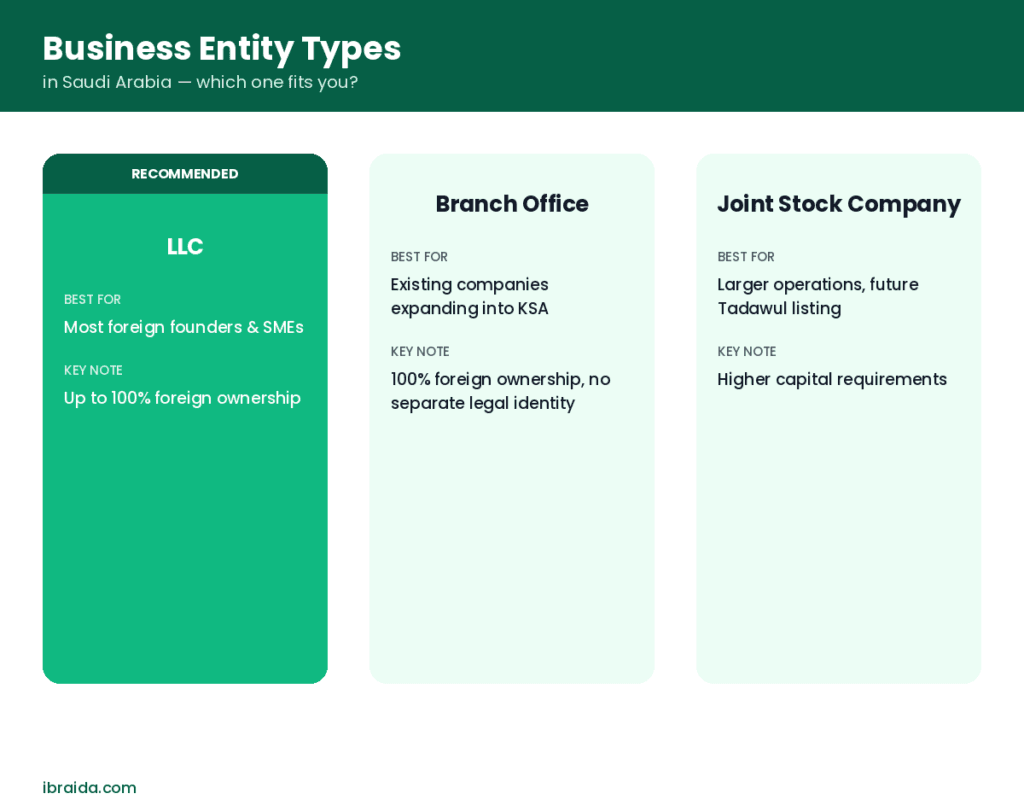
Picking the right legal structure matters just as much as picking the right activity. Here’s how the main options compare.
| Entity Type | Best For | Foreign Ownership | Key Notes |
|---|---|---|---|
| Limited Liability Company (LLC) | Most foreign founders, SMEs, startups | Up to 100% | Most common structure; minimum one shareholder; flexible for most activities |
| Branch Office | Existing foreign companies expanding into KSA | 100% | No separate legal identity from parent company; parent bears full liability |
| Joint Stock Company (JSC) | Larger operations, future stock exchange listing | Varies | Higher capital requirements; needed if planning to list on Tadawul |
| Regional Headquarters (RHQ) | Multinationals centralizing MENA operations | 100% | Comes with specific tax incentives; required for firms wanting to bid on certain government contracts |
For most first-time foreign entrepreneurs reading this guide, the LLC is the practical choice. It’s flexible, doesn’t require the heavier compliance load of a JSC, and gives you a genuine local legal identity rather than tying everything back to a parent company like a branch office does.
How Much Does It Cost to Start a Business in Saudi Arabia?
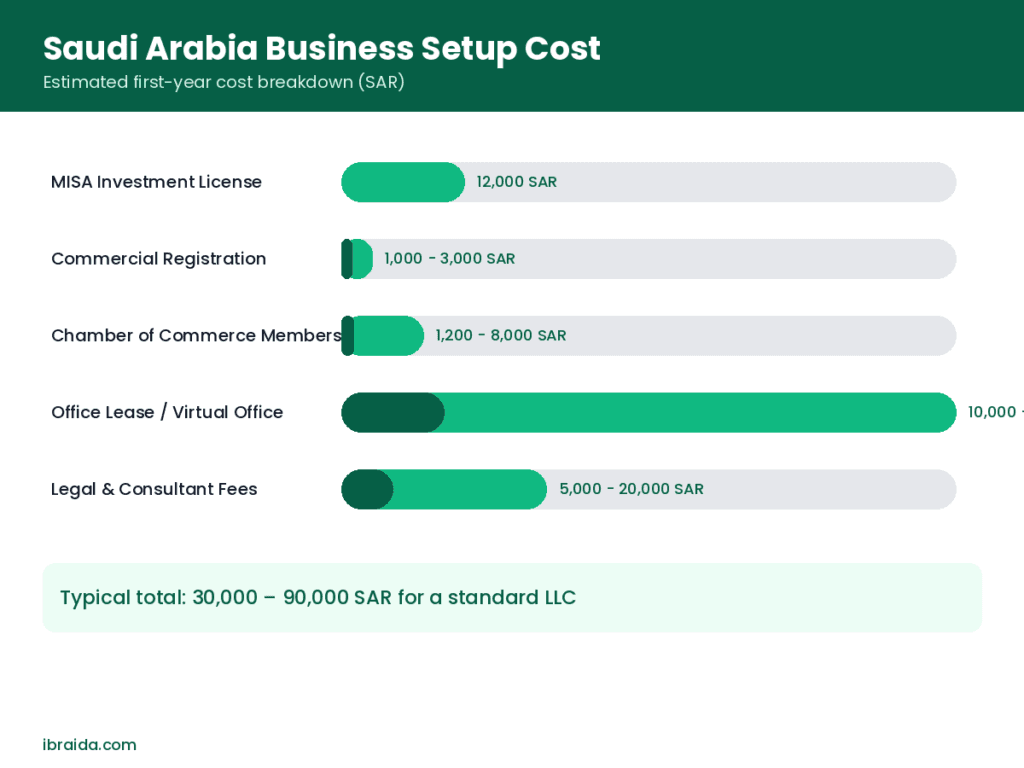
Costs vary by activity and entity type, but here’s a realistic range for a standard LLC setup as of 2026-2027.
| Cost Item | Estimated Range (SAR) |
|---|---|
| MISA Investment License (annual) | ~12,000 SAR |
| Commercial Registration fee | 1,000–3,000 SAR |
| Chamber of Commerce membership | 1,200–8,000 SAR (varies by capital) |
| Office lease or virtual office | 10,000–60,000+ SAR/year |
| Legal/consultant fees for AoA and setup | 5,000–20,000 SAR |
| GOSI and municipal registration | Varies by headcount and activity |
Add it up and most straightforward LLC setups for foreign founders land somewhere between 30,000 and 90,000 SAR in first-year costs, before you factor in employee visas, sponsorship costs, or sector-specific approvals. Regulated industries like healthcare, education, or finance will push this significantly higher because of additional licensing layers.
i think now you are getting How to Start a Business in Saudi Arabia for Foreigners but if you are interesting to try to setup in UAE then this cost tool will help you to calculate cost of the setup in UAE.
Not sure what your UAE setup will actually cost?
Use our free calculator to get an instant, itemized breakdown — license, visa, and office fees, in your own currency.
Documents You’ll Need
Keep this checklist handy before you start the process — missing documents are the biggest cause of delays.
- Valid passport copies for all shareholders and directors — make sure expiry dates give you at least 12 months of validity.
- Parent company’s Certificate of Incorporation if you’re applying as a corporate entity rather than an individual investor.
- Notarized and apostilled financial statements, usually covering the last 1–2 years, to demonstrate financial standing.
- A detailed business plan outlining your activities, projected operations, and investment scope.
- Draft Articles of Association reflecting your ownership structure and governance.
- Proof of registered office address or a signed lease agreement — a residential address won’t satisfy this requirement.
- Board resolution authorizing the Saudi entity setup, required for corporate shareholders.
- Bank reference letter from your existing bank, which some Saudi banks request during the corporate account application.
One detail that trips up a lot of first-time applicants: documents issued outside Saudi Arabia generally need to go through both notarization in the country of origin and attestation through the Saudi embassy or consulate (or an apostille, depending on whether your country is part of the Hague Convention). Skipping this step — or assuming a regular notarization is enough — is one of the most common reasons MISA applications get sent back for resubmission.
- ✓ Every Tiny Step
- ✓ MISA Process
- ✓ Company Registration
- ✓ Banking
- ✓ Tax Registration
- ✓ Required Documents
- ✓ Launch Checklist
Saudi Business Setup Master Checklist
Stop switching between 20 different websites.This premium PDF gives you the exact roadmap professional consultants follow — from planning your business until your company is fully operational in Saudi Arabia.
Should You DIY the Registration or Hire a Local Consultant?
This question comes up constantly, so let’s tackle it directly. Technically, nothing stops a determined foreign founder from handling the entire MISA and Ministry of Commerce process independently — the portals are in English as well as Arabic, and the government has clearly invested in making self-service possible. But in practice, most first-time founders end up working with a local PRO (Professional Relations Officer) or business setup consultant for at least part of the journey, and here’s why that’s not just an upsell.
- Document authentication is unforgiving. Apostille and notarization requirements differ depending on your home country, and a single incorrectly stamped document can bounce your MISA application back weeks later.
- Activity code selection has long-term consequences. A consultant who’s registered dozens of companies will spot activity code mismatches you’d never catch on your own.
- Banking relationships matter. Corporate bank account approval sometimes moves faster when a consultant with an existing relationship at the bank submits the file.
- Government portals change. Saudi Arabia has been actively updating its digital investment infrastructure, and a local consultant tends to know about portal changes and new requirements before they’re widely documented online.
If your business is simple — a small consultancy or trading LLC with straightforward ownership — DIY is genuinely realistic, especially if you’re comfortable with government portals and don’t mind the learning curve. If your activity is regulated (healthcare, education, finance, construction) or your ownership structure is more complex, a consultant will likely save you more in time and rejected applications than their fee costs.
Business Culture and Etiquette Tips for Foreign Founders
Getting your paperwork right is only half the job. Saudi Arabia’s business culture runs on relationships, patience, and respect for hierarchy, and founders who ignore this often find their otherwise-solid business plans stall for reasons that have nothing to do with regulation.
- Relationships come before transactions. Don’t expect to close a deal in your first meeting. Building trust over multiple conversations, sometimes over coffee or a meal, is standard practice, not a delay tactic.
- Friday is the start of the weekend. The work week runs Sunday through Thursday. Scheduling meetings on a Friday or during prayer times is a common early mistake for founders used to a Monday-to-Friday calendar.
- Formal titles and hierarchy matter. Address people by their title and last name until invited to do otherwise, and be mindful of who in the room holds decision-making authority.
- Patience is genuinely a strategy, not just a virtue. Government processes, bank approvals, and partner negotiations often move on a different timeline than founders are used to back home. Building buffer time into your launch plan avoids unnecessary stress.
- Ramadan affects business hours. Working hours shorten during Ramadan, and it’s wise to avoid scheduling major negotiations or launches during this period.
None of this is difficult once you know it’s coming — it just needs to be part of your planning from day one, the same way you’d plan around any other regulatory or operational reality.
Common Mistakes Foreigners Make When Starting a Business in Saudi Arabia
After going through dozens of guides, forums, and consultant write-ups while researching this, a few mistakes keep showing up again and again. Avoid these and you’ll save yourself weeks of back-and-forth.
- Picking the wrong business activity code. Choosing a vague or incorrect activity means you may need to amend your license later, which resets parts of the approval timeline.
- Underestimating Saudization requirements. Founders plan their hiring around expat staff only, then get stuck when Nitaqat quotas block additional work visa sponsorships.
- Assuming the process is identical to the UAE. Saudi Arabia’s two-track MISA + Ministry of Commerce process is different from the UAE’s free zone/mainland system — don’t copy-paste your UAE playbook.
- Not budgeting for annual license renewal. The MISA license isn’t a one-time cost; it renews annually, and missing the renewal window can suspend your ability to operate.
- Delaying the bank account application. Corporate account approval can take weeks. Founders who wait until after incorporation to start this process often stall their launch unnecessarily.
- Ignoring sector-specific approvals. Healthcare, education, and financial services all require additional regulatory sign-off beyond MISA and Ministry of Commerce — skipping this research leads to rejected applications.
- Using unnotarized or improperly apostilled documents. Saudi authorities are strict about document authentication; a missing apostille stamp can bounce your entire application back to square one.
Minimum Capital Requirements
One question that comes up in almost every consultation call: “how much capital do I actually need to show?” The honest answer is that Saudi Arabia doesn’t apply a single fixed minimum capital figure across the board — it depends heavily on your business activity and entity type. Trading and industrial activities have historically required higher declared capital than service-based or consulting activities, and MISA evaluates this on a case-by-case basis as part of your investment license application. Rather than assuming a specific number, the more useful approach is to prepare a realistic business plan that reflects genuine operating costs for your first 12 months, since that’s what MISA and the Ministry of Commerce will actually be assessing when they review your application.
How Long Does the Whole Process Take?
For a straightforward LLC in a non-regulated sector, you’re realistically looking at 3 to 6 weeks from MISA application to a fully operational Commercial Registration, assuming your documents are complete and accurate. Add another 2 to 4 weeks for your corporate bank account to be fully active. Regulated sectors or activities requiring additional government sign-off can stretch this to 2 to 3 months.
Special Economic Zones Worth Knowing About
Unlike the UAE’s free zone model, Saudi Arabia doesn’t run on a network of dozens of free zones. Instead, the Kingdom has rolled out a smaller number of Special Economic Zones (SEZs) designed to attract specific industries with tailored incentives — competitive corporate tax rates, streamlined customs procedures, and 100% foreign ownership guarantees baked directly into the zone regulations. These include zones focused on logistics near King Abdulaziz Port, cloud computing and technology, mineral processing, and integrated manufacturing. If your business activity fits one of these designated sectors, setting up inside an SEZ can mean faster approvals and better tax treatment than a standard mainland Commercial Registration, so it’s worth checking whether your activity qualifies before you default to the standard MISA + Ministry of Commerce route.
Best Business Sectors for Foreign Investors in 2026-2027
Not every sector is equally welcoming right now. These are the areas where Vision 2030 momentum is creating the most opportunity for foreign entrepreneurs:
- Renewable energy and green technology — Vision 2030’s diversification targets have made solar, wind, and green hydrogen projects a national priority, and the government is actively courting foreign expertise and capital in this space.
- Tourism and hospitality — NEOM, the Red Sea Project, and a wave of giga-tourism developments are actively recruiting foreign hospitality operators, boutique hotel brands, and experience-driven tourism businesses that didn’t exist in the Saudi market five years ago.
- Logistics and supply chain — Saudi Arabia is deliberately positioning itself as a regional logistics hub bridging Asia, Africa, and Europe, with major investment going into ports, rail, and warehousing infrastructure.
- Technology and SaaS — a genuinely fast-growing digital economy, backed by government incentive programs aimed specifically at attracting tech founders and startups.
- Healthcare and medical services — demand is high given the country’s growing population and healthcare modernization push, though this sector requires additional regulatory sign-off from the Ministry of Health and Saudi Health Council.
- Construction and proptech — the sheer scale of mega-project spending is fueling contractor, supplier, and proptech demand that will likely continue for the next decade.
Your Saudia Arabia Business Journey Starts Here
From free AI-powered planning tools to everything else we’ve built for entrepreneurs — explore what ibraida.com has to offer.
💚 100% free — no signup required to browse
Frequently Asked Questions
Can foreigners own 100% of a business in Saudi Arabia?
Yes. With a valid MISA investment license, foreign investors can own 100% of their company in most sectors without needing a Saudi local partner or sponsor.
How much does it cost to start a business in Saudi Arabia as a foreigner?
Most straightforward LLC setups cost between 30,000 and 90,000 SAR in the first year, including the MISA license, Commercial Registration, chamber membership, and basic legal fees. Regulated sectors cost significantly more.
How long does it take to start a business in Saudi Arabia?
For a standard, non-regulated LLC, the full process from MISA application to an active Commercial Registration typically takes 3 to 6 weeks, with the bank account taking a few additional weeks.
Do I need a local Saudi partner to start a business?
No, not for most activities. Under the current Investment Law, 100% foreign ownership is permitted in the majority of sectors. A small number of restricted activities still require Saudi participation.
What is the MISA license and why do I need it?
The MISA license is issued by the Ministry of Investment and is the legal document that authorizes a non-Saudi individual or company to invest in and operate a business in the Kingdom. It’s the first mandatory step before Commercial Registration.
Is Saudi Arabia better than the UAE for starting a business?
It depends on your business activity and target market. The UAE offers faster free zone setups and a longer track record for foreign entrepreneurs, while Saudi Arabia offers access to a much larger domestic market and Vision 2030-driven sector opportunities. Many founders end up running entities in both.
Can I start a business in Saudi Arabia remotely, without visiting?
Much of the MISA and Commercial Registration process can be completed digitally, but you’ll typically need to visit at least once for bank account setup, biometric registration, and certain notarizations, depending on your bank and activity type.
What happens if I don’t meet Saudization (Nitaqat) requirements?
Falling below your required Saudi national hiring quota can restrict your ability to renew work visas or sponsor new expat employees, and in more serious cases can limit your access to certain government services and contracts. It’s worth building your hiring plan around your Nitaqat category from the start rather than treating it as a compliance afterthought.
Can I convert a branch office into an LLC later?
Yes, this is a fairly common path for foreign companies that start with a branch office to test the market before committing to a fully separate local entity. The conversion process involves fresh Commercial Registration and MISA documentation, so it’s not instant, but it is a well-established route.
Final Thoughts
Learning how to start a business in Saudi Arabia for foreigners isn’t complicated once you see the actual sequence: choose your activity, get your MISA license, register your Articles of Association, complete Commercial Registration, open your bank account, and handle your tax and Saudization obligations. The process has gotten significantly faster and more foreigner-friendly over the past few years, and the sectors riding the Vision 2030 wave — tech, tourism, logistics, renewable energy — are wide open for founders who move early.
Still Figuring Out Your Dubai Business Setup?
We’ve mapped out the entire process across our in-depth guides — pick up where you left off.
IDEAS
10 Best Business Ideas in Dubai
Not sure what to launch yet? Start here.
FREE ZONE
Dubai Free Zone Guide
30+ free zones compared, costs included.
MAINLAND
Dubai Mainland License Guide
Need to sell locally? Here’s what it costs.
TAX
UAE Corporate Tax Guide
Relief ends Dec 2026 — check your status.
BANKING
Open a Business Bank Account
Documents, timelines, and how to avoid rejection.
The biggest advantage you have right now isn’t capital or connections — it’s information. Most founders fail to plan properly simply because they never saw the real process laid out clearly. Now you have.
References
- Remitly — Doing Business in Saudi Arabia: Small Business Guide
- Enterprise Hub — How to Start a Business in Saudi Arabia as a Foreigner: 2026 Strategic Guide
- European Business Review — Complete Guide to Business Setup in Saudi Arabia (2026)
- TASC Outsourcing — Business Setup in Saudi Arabia for Foreign Investors 2026
- EBDA — How to Start a Business in Saudi Arabia for Foreigners
- Vision2030.ai — How to Start a Business in Saudi Arabia: 2026 Step-by-Step Guide
- Arab Future — Foreign Investment License Requirements in Saudi Arabia 2026
M. Kamran Awan
Founder, ibraida.com
Kamran writes about AI business tools, SEO, and growth strategies for entrepreneurs in the UAE and beyond, drawing on hands-on experience building and scaling digital platforms.
Publix Business Model: 5 Lessons Entrepreneurs Can Learn

Business Models Publix If you’ve been anywhere near social media or the news this week, there’s a good chance you’ve seen the name Publix pop up. It’s not a tech startup, it’s not a UAE free zone, and it’s definitely not something you’d expect to find on a site about business setup in Dubai or…
75 Easiest Startup Businesses to Launch in AI World
STARTUP 75 Easiest Startup Businesses Every year, thousands of people decide “this is the year I finally start my own business” — and most of them never actually do it, because they assume it takes a large budget or a technical skill set they don’t have. That assumption doesn’t really hold up anymore. AI tools…
YCombinator Companies: The Complete Guide to YC Startups, Unicorns, and Success Stories
Business Models ycombinator companies Y Combinator has become one of the most influential startup accelerators in the world. Whenever entrepreneurs discuss startup success stories, venture capital funding, unicorn companies, or the future of technology, the conversation often leads back to ycombinator companies. Since its launch in 2005, Y Combinator has helped thousands of startups scale…


Pingback: Documents Required to Start a Business in Saudi Arabia (7 Easy & Proven Steps)