📅 Last updated: July 2026 | ✍️ By M. Kamran Awan | ⏱️ 10 min read
Table of Contents
30+
Free Zones in Dubai
AED 5,750
Cheapest Starting License
0–9%
Corporate Tax (QFZP-dependent)
3–15
Days to License
Picking the right one of Dubai’s many Dubai free zones used to be simple: find the cheapest package, sign up, done. That approach doesn’t work anymore. With the UAE’s corporate tax rules tightening around Qualifying Free Zone Person (QFZP) status, and over 30 dubai free zones alone competing for your business, the wrong choice can cost you thousands of dirhams in banking delays, tax exposure, or a license that doesn’t actually cover what you do.
This guide walks through every major Dubai free zones, what each one actually costs in 2026-2027, which industries they’re built for, and how to avoid the mistakes that trip up most first-time founders.
Quick Recap: Free Zone vs Mainland
If you’re new here — a free zone company gets 100% foreign ownership and potential 0% tax but generally can’t sell directly to UAE mainland customers. A mainland company can trade anywhere in the UAE but usually costs more to set up. This guide focuses on free zones specifically — for the full comparison, see our Free Zone vs Mainland breakdown.
What Are Dubai Free Zones and How Do They Work?
A free zone is a designated economic area that operates under its own regulatory authority, separate from Dubai’s mainland (DED/DET) system. Each zone — DMCC, IFZA, JAFZA, and dozens of others — issues its own licenses, sets its own fees, and often focuses on specific industries.
Every Dubai free zone shares a few core benefits:
- 100% foreign ownership — no local sponsor required, ever
- Full profit repatriation — move your earnings out of the UAE freely
- Potential 0% corporate tax — on qualifying income, if you meet QFZP conditions (more on this below)
- Streamlined digital setup — many licenses are issued within days, not weeks
- No customs duties — on goods that stay within the zone or get re-exported
The tradeoff: free zone companies generally can’t sell directly to the UAE mainland market without a distributor, agent, or separate mainland branch.
Complete List of Dubai Free Zones (2026-2027)
Before comparing specific options, it helps to see the full picture of what’s available across all Dubai free zones currently operating.
| Free Zone | Industry Focus |
|---|---|
| DMCC (Dubai Multi Commodities Centre) | Trading, commodities, fintech, general business |
| IFZA (International Free Zone Authority) | SMEs, consulting, general trading, startups |
| JAFZA (Jebel Ali Free Zone) | Logistics, manufacturing, import-export |
| DIFC (Dubai International Financial Centre) | Banking, fintech, insurance, asset management |
| Dubai Internet City | Tech, SaaS, IT consulting |
| Dubai Media City | Advertising, PR, broadcasting, content |
| Dubai CommerCity | E-commerce, online retail, fulfillment |
| Dubai South | Aviation, logistics, e-commerce |
| Meydan Free Zone | Consulting, tech, trading, e-commerce |
| Dubai Healthcare City | Hospitals, clinics, medical professionals |
| Dubai Design District (d3) | Fashion, design, art |
| Dubai Knowledge Park | Education, HR, training |
| Dubai Science Park | Pharma, energy, environment |
| Dubai Studio City | Film, TV, music production |
| Dubai Outsource City | BPO, call centers |
| Dubai Airport Free Zone (DAFZA) | Aviation, electronics, cargo |
Top 6 Dubai Free Zones Compared in Detail
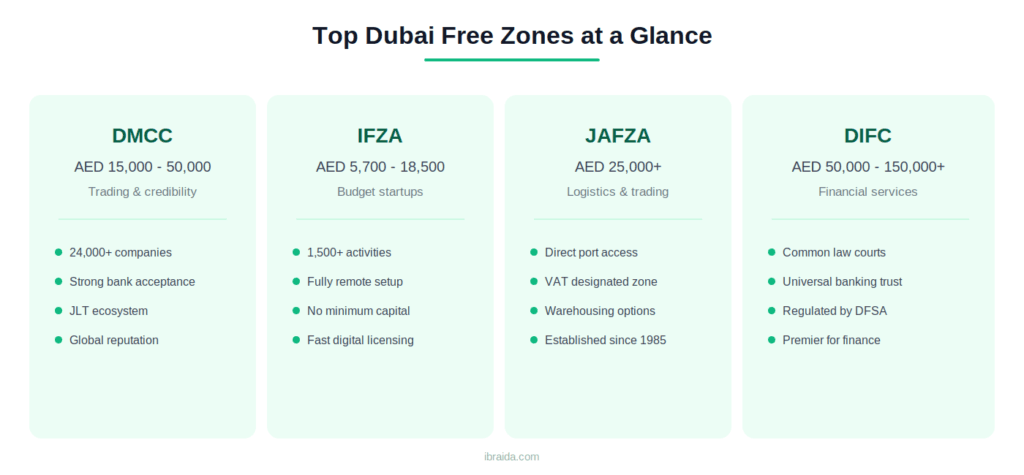
1. DMCC — Best for Trading & Credibility
DMCC is Dubai’s largest free zone by company count, hosting over 24,000 businesses. It’s been named Global Free Zone of the Year by fDi Intelligence for nine years running. Originally built for commodities trading, it now covers general trading, professional services, and tech.
| Pros | Cons |
|---|---|
| Strong global reputation, high banking acceptance | Among the more expensive options |
| Broad activity list, established ecosystem | Office/flexi-desk costs add up quickly |
Indicative license cost: AED 15,000–50,000 annually, depending on activity.
2. IFZA — Best for Budget-Conscious Startups
Located in Dubai Silicon Oasis, IFZA has become the go-to choice for cost-conscious founders. It covers over 1,500 business activities under flexible, low-cost packages with no minimum share capital and fully remote setup.
| Pros | Cons |
|---|---|
| Lowest starting cost among major zones (from ~AED 5,750) | Tier-1 banks are more conservative with IFZA entities |
| Fast, fully digital setup | Less prestigious address than DMCC or DIFC |
Indicative license cost: AED 11,900–18,500 annually.
3. JAFZA — Best for Logistics & Trading
JAFZA is Dubai’s original free zone, built in 1985, and it still has the strongest port access in the emirate through direct connection to Jebel Ali Port. It’s a designated zone for VAT purposes, which matters if you move goods internationally.
| Pros | Cons |
|---|---|
| Direct port access, ideal for import-export and warehousing | Higher overall cost than DMCC or IFZA |
| Favorable VAT treatment for goods movement | Located further from central Dubai |
Indicative license cost: AED 25,000+ annually.
4. DIFC — Best for Financial Services
DIFC operates under English common law with its own courts (the DFSA), making it the only credible option in Dubai for licensed financial activities — banking, insurance, asset management, family offices.
| Pros | Cons |
|---|---|
| Universally strong banking acceptance | Most expensive free zone in Dubai |
| Independent legal framework, ideal for regulated finance | Overkill for non-financial small businesses |
Indicative license cost: AED 50,000–150,000+ annually.
5. Dubai Internet City — Best for Tech & SaaS
The region’s tech hub since 1999, home to regional offices of major global tech companies. Strong ecosystem for SaaS, IT consultancies, and software product companies.
| Pros | Cons |
|---|---|
| Established tech community and investor network | Higher cost than general-purpose zones like IFZA |
| High banking acceptance with tier-1 banks | Less suited to non-tech activities |
Indicative license cost: AED 25,000+ annually.
6. Dubai CommerCity — Best for E-commerce
The Middle East’s first free zone built entirely for e-commerce, with integrated warehousing and last-mile delivery infrastructure. It’s also a designated zone for VAT, which benefits cross-border sellers moving goods between zones.
| Pros | Cons |
|---|---|
| Purpose-built logistics for online retailers | Narrower activity list outside e-commerce |
| Favorable VAT treatment on goods movement | Smaller ecosystem than DMCC or JAFZA |
Indicative license cost: Around AED 15,000+ annually.
📥
Free Download: Dubai Free Zones Comparison Checklist
Compare 6 top free zones side-by-side — costs, banking, visa quotas, and a decision checklist in one PDF.
Download Free ChecklistVisa Quotas by Free Zone
| Dubai Free Zones | Typical Visa Allocation |
|---|---|
| DMCC | Up to 6 per flexi-desk; unlimited with dedicated office (space-based) |
| IFZA | 1–6 depending on package, expandable with office upgrade |
| JAFZA | Based on warehouse/office size, typically higher for industrial units |
| DIFC | Based on office space leased, no fixed cap |
| Meydan | Up to 6 with standard packages, more with upgraded office |
| Dubai CommerCity | 2–6 depending on flexi-desk or warehouse package |
Visa quotas are tied to your office size, not just your license type — upgrading from a flexi-desk to a dedicated office is the most common way to increase your allocation.
Free Zone Costs: What You’ll Actually Pay in 2026-2027
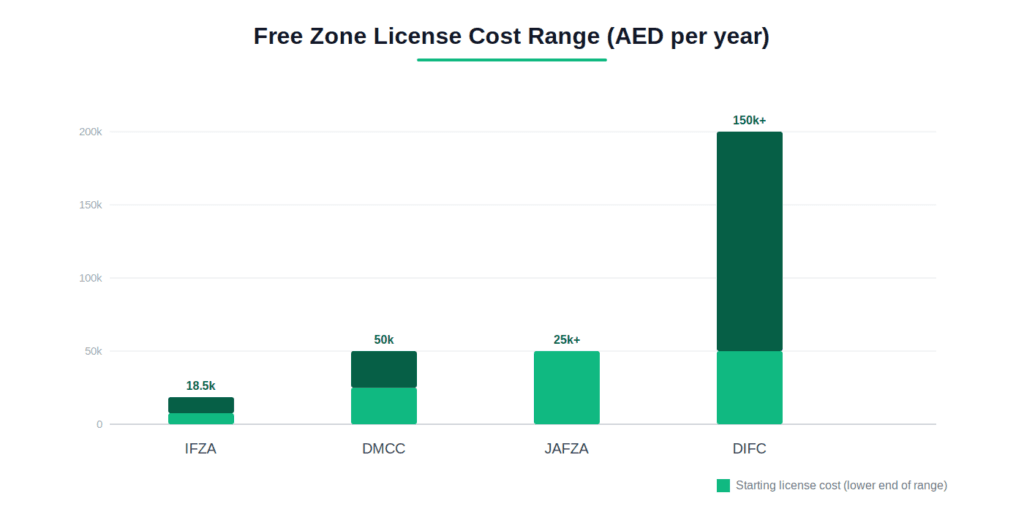
| Cost Item | Typical Range (AED) |
|---|---|
| Basic license (budget zones like IFZA, Meydan) | 5,750 – 18,500 |
| Mid-tier license (DMCC, Dubai Internet City) | 15,000 – 50,000 |
| Premium license (DIFC) | 50,000 – 150,000+ |
| Flexi-desk office space | 8,000 – 25,000/year |
| Dedicated office space | 30,000 – 150,000+/year |
| Name reservation | 350 – 620 |
| Per-visa cost | 3,000 – 7,000 |
Renewal fees typically run close to the original setup cost each year, so budget accordingly rather than being surprised in year two.
🛠️
Planning Your Dubai Business Setup?
Use our free AI-powered business tools to calculate setup costs, compare free zones, and plan your Dubai company formation — all in one place.
Explore Free Business Tools →Real Example: DMCC vs IFZA at AED 600,000 Revenue
Assumptions: AED 600,000 annual revenue, 50% profit margin (AED 300,000 profit), serving international clients (qualifying income).
| Item | DMCC (QFZP) | IFZA (QFZP) |
|---|---|---|
| Setup cost | AED 35,000 | AED 18,000 |
| Annual renewal | AED 30,000 | AED 15,000 |
| Corporate tax (0% QFZP) | AED 0 | AED 0 |
| Total Year 1 cost | AED 65,000 | AED 33,000 |
| Net profit after costs | AED 235,000 | AED 267,000 |
At this revenue level, IFZA’s lower overhead outperforms DMCC by roughly AED 32,000 in year one — DMCC’s premium becomes worthwhile mainly once your business needs its trading credibility or ecosystem.
Want to run these numbers for your own business? Try our free business setup cost calculator on ibraida.com.
Free Zone Corporate Tax: The QFZP Rules You Can’t Ignore
This is the part most 2025-era guides get wrong: a free zone license does not automatically mean 0% tax anymore. Under UAE Federal Decree-Law No. 47 of 2022, free zone companies only get the 0% rate on “qualifying income” if they meet Qualifying Free Zone Person (QFZP) conditions.
To qualify as a QFZP, your company must:
- Maintain adequate substance in the free zone — real office space, staff, and operating expenditure that matches your business scale
- Derive genuinely qualifying income (exports, trading with other free zone entities, manufacturing, and similar activities)
- Not exceed the de minimis threshold — non-qualifying revenue must stay under the lower of AED 5 million or 5% of total revenue
- Prepare audited IFRS financial statements — mandatory regardless of company size
- Comply with transfer pricing rules for related-party transactions
Miss any one of these conditions, and the entire company loses QFZP status for that tax period — not just the non-qualifying portion, all of it, taxed at 9%. Businesses earning under AED 375,000 in taxable income still pay 0% regardless of QFZP status, and companies with total revenue under AED 3 million may qualify for Small Business Relief through 2026.
Practical takeaway: If your business plan relies on the “free zone = tax-free” assumption without real staff and operations in the zone, budget for the 9% rate instead. A registered address alone will not satisfy the substance test.
Step-by-Step: How to Set Up in a Dubai Free Zones
- Choose your free zone and confirm your activity is on their approved list
- Reserve your trade name (AED 350–620)
- Select your license type — Trading, Service, Industrial, or E-commerce
- Choose office type — flexi-desk, virtual, or dedicated office
- Submit documents (passport copies, photos, business plan if required)
- Pay license fees and receive your trade license
- Apply for establishment card and investor/employee visas
- Register for corporate tax on EmaraTax within 30 days of license issuance
- Open a corporate bank account (start with a digital bank if approval is urgent)
How to Choose the Right Free Zone for Your Business
With so many Dubai free zones to pick from, matching your business activity to the right zone is the single most important decision in the setup process.
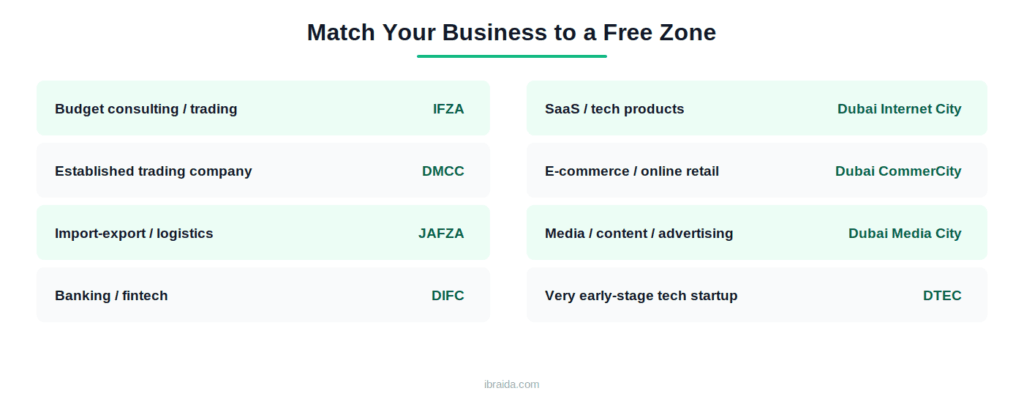
| If your business is… | Consider |
|---|---|
| General trading / consulting on a budget | IFZA, Meydan |
| Established trading company wanting credibility | DMCC |
| Import-export, logistics, warehousing | JAFZA |
| Banking, fintech, asset management | DIFC |
| SaaS, IT consulting, tech products | Dubai Internet City, DTEC |
| E-commerce, online retail | Dubai CommerCity, IFZA |
| Media, content, advertising | Dubai Media City |
Common Mistakes When Choosing a Dubai Free Zone
- Picking by price alone. A cheaper zone can cost more long-term through banking friction, limited activity lists, or forced upgrades later.
- Ignoring banking acceptance. Tier-1 banks reject roughly 30–40% of free-zone applications on first submission, particularly from newer or less-established zones. Workaround: open with a digital bank first (Wio, Mashreq Neo), then migrate to a traditional bank after 6 months of operating history.
- Assuming automatic tax exemption. As covered above, 0% tax requires active QFZP compliance, not just a free zone license.
- Choosing a free zone when 80% of revenue is UAE-based. If most of your customers are inside the UAE, mainland is often cheaper overall once you account for agent fees and distributor cuts.
- Missing the corporate tax registration deadline. Registration on EmaraTax applies to every free zone entity regardless of revenue — the late-registration penalty is a flat AED 10,000.
How Long Does Free Zone Setup Take?
| Stage | Typical Timeline |
|---|---|
| License issuance (most zones, complete documents) | 3–15 working days |
| Visa processing per applicant | 1–3 weeks |
| Full setup incl. visa & bank account | 3–5 weeks |
Also you Can CheckOut Dubai Mainland License Guide 2026-2027: Essential Costs & Easy Process
Frequently Asked Questions
Which Dubai free zone is cheapest?
IFZA and Meydan are generally the most affordable, with basic license packages starting around AED 5,750–11,900 depending on the activity and package selected.
Can a free zone company sell to mainland UAE customers?
Not directly. Free zone companies typically need a local distributor, commercial agent, or a separate mainland branch to sell into the UAE domestic market.
Do all Dubai free zones offer 0% tax?
No. 0% corporate tax only applies to qualifying income earned by a business that meets Qualifying Free Zone Person (QFZP) conditions — it is not automatic just because you hold a free zone license.
Which free zone is best for a tech startup?
Dubai Internet City is the established choice for tech companies, while DTEC (inside Dubai Silicon Oasis) suits very early-stage startups wanting a co-working environment at lower cost.
How many Dubai free zones are there?
There are more than 30 active Dubai free zones, each governed by its own authority and typically focused on specific industries such as trading, technology, media, or finance.
Final Thoughts
Choosing between Dubai free zones depends on matching your specific activity, budget, and banking needs — not just picking the most recognizable name or the lowest advertised price. IFZA and Meydan work well for lean, budget-conscious setups; DMCC and JAFZA suit trading and logistics businesses that need credibility and infrastructure; DIFC remains the only serious option for regulated financial services.
If you haven’t yet decided between free zone and mainland altogether, our guide on the Best Business Ideas in Dubai 2026-2027 breaks down that decision in more depth, alongside setup costs and step-by-step guidance in our UAE Business Setup Guide.
Not Sure Which Free Zone Fits Your Business?
Get personalized guidance on choosing the right free zone, license type, and tax structure for 2026-2027.
Get In Touch →📚 You Might Also Like
References
- BCL — Best Free Zone in Dubai: Top UAE Free Zones Compared 2026
- AB Capital — List of Free Zones in Dubai 2026
- Acclime UAE — Corporate Tax in UAE Free Zones: QFZP Rules
- PwC — UAE Corporate Tax Credits and Incentives
- Dubai Business Services — Best Free Zones Dubai 2026: Top 10 for Foreign Investor
Disclaimer: This article is for general informational purposes only and does not constitute legal, financial, or tax advice. Free zone regulations, costs, and QFZP requirements can change; consult a licensed business setup consultant or tax advisor before making structuring decisions.
M. Kamran Awan
Founder, ibraida.com
Kamran writes about AI business tools, SEO, and growth strategies for entrepreneurs in the UAE and beyond, drawing on hands-on experience building and scaling digital platforms.
Pingback: Best Business Ideas in Dubai 2026-2027 | Complete Guide + Costs
Pingback: Dubai Mainland License Guide 2026-2027: Essential Costs & Easy Process