📅 Last updated: July 2026 | ✍️ By M. Kamran Awan | ⏱️ 23 min read
Table of Contents
Every year, more Americans look at their tax bracket, their business idea, and a map of the world, and land on the same question: could this work better somewhere else? Dubai comes up constantly in that search, and for good reason — but almost every guide written for American founders either oversimplifies the process into a sales pitch or skips the one thing that actually makes the American experience different from every other nationality’s: the IRS doesn’t stop caring about your income just because you moved it to Dubai.
This guide covers business setup in Dubai for US citizens the way it should be covered — the genuine opportunity, the real process, and the compliance obligations back home that no UAE-based consultant is going to walk you through in detail, because it’s simply not their area of expertise.
Quick Summary
Everything US entrepreneurs should know before starting a business in Dubai.
100%
Foreign Ownership | 0%
Personal Income Tax | 1–3
Weeks Setup |
- US citizens can own 100% of a Dubai company in most Free Zones and Mainland business activities.
- Many businesses can be established remotely from the United States.
- The UAE has 0% personal income tax and 0–9% corporate tax, depending on eligibility and taxable profits.
- American founders must continue complying with IRS, FBAR and FATCA reporting requirements.
- Free Zones generally suit international businesses, while Mainland companies are better for serving the UAE market.
- Corporate banking usually takes longer than company registration because of compliance checks.
Can Americans Actually Own a Business in Dubai?
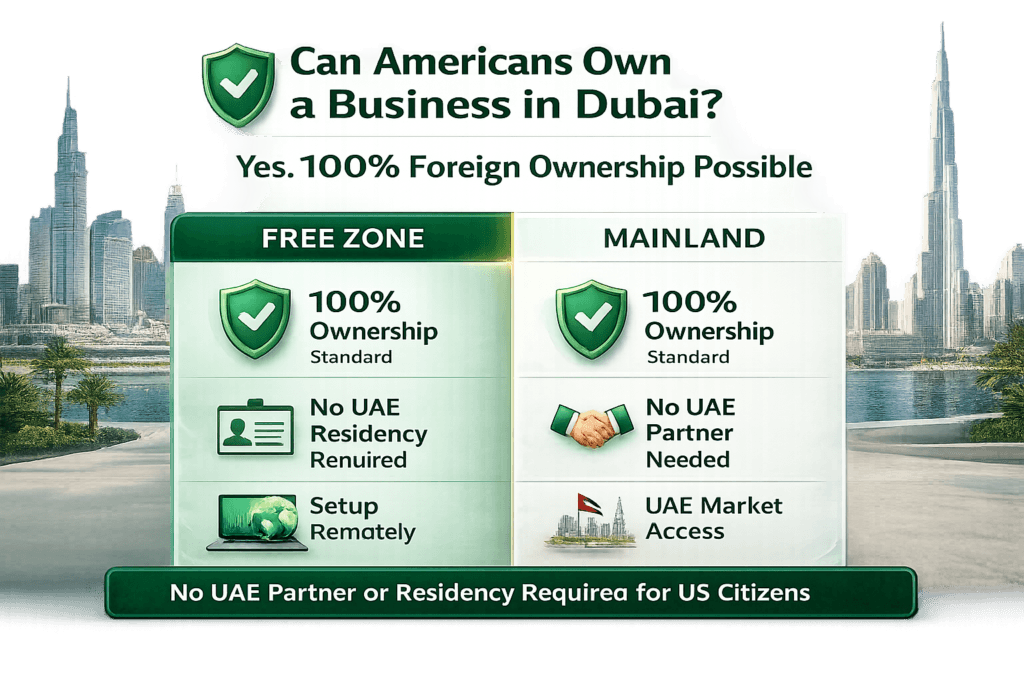
Yes, and this surprises a lot of first-time researchers who assume there’s some special restriction for US citizens. There isn’t. Business setup in Dubai for US citizens works under the same ownership rules that apply to every other foreign nationality — 100% foreign ownership is now standard across free zones and, since reforms to the UAE Commercial Companies Law, across most mainland activities too. You don’t need a UAE national as a partner for the vast majority of business types, and you don’t need to already be a UAE resident to start the process.
What you do need is clarity on which license structure fits your business, because business setup in Dubai for US citizens isn’t a single path — it’s a choice between free zone, mainland, and occasionally offshore structures, each with genuinely different implications for where you can sell, what you’ll pay, and how your US tax filing will look afterward.
Free Zone vs Mainland: What Actually Changes for Americans
The core free zone versus mainland decision works the same way for Americans as it does for any other founder, but it’s worth revisiting specifically in the context of business setup in Dubai for US citizens, since the “right” answer often depends on where your customers actually are.
If you’re running a US-facing consulting business, an e-commerce brand selling internationally, or a remote agency serving clients outside the UAE, a free zone company is almost always the simpler and cheaper route. Free zones allow 100% ownership, don’t require a UAE office in many cases, and can often be set up entirely online before you ever book a flight. Our Dubai Free Zones Guide breaks down every major free zone by cost and industry fit, which is worth reading before you commit to a specific jurisdiction.
If your business genuinely needs to sell to customers physically inside the UAE — a retail concept, a local services business, or anything targeting government contracts — mainland licensing is the correct route despite the higher cost and mandatory office requirement. Our Dubai Mainland License Guide covers license types, office areas, and realistic costs for that path in detail.
Step-by-Step: How Business Setup in Dubai for US Citizens Actually Works
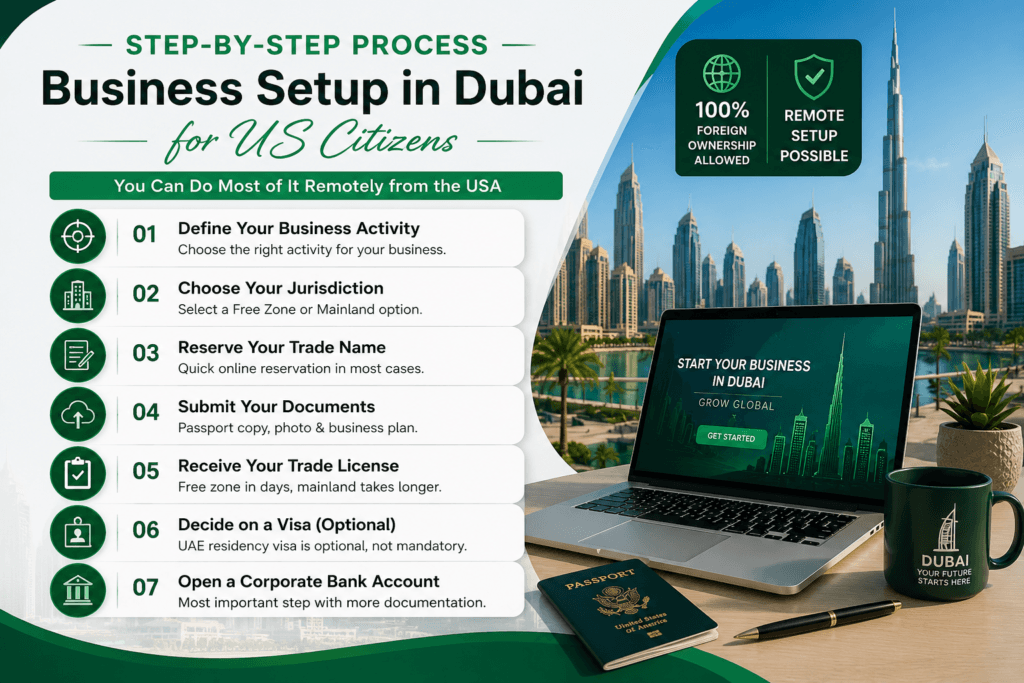
The mechanical process doesn’t differ from any other nationality’s setup, but it’s worth walking through with an American founder’s timeline in mind, since most of this can genuinely be completed without leaving the United States.
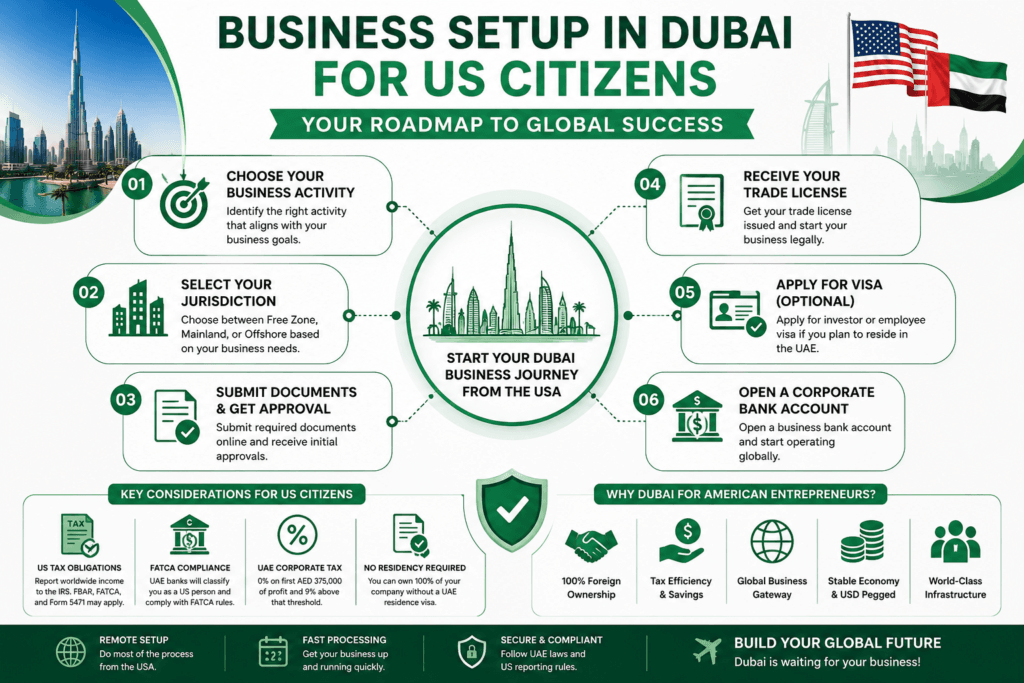
- Define your business activity — this determines your license category and whether free zone or mainland fits better
- Choose your jurisdiction — a specific free zone, or mainland through Dubai’s Department of Economy and Tourism
- Reserve your trade name — completed entirely online in most cases
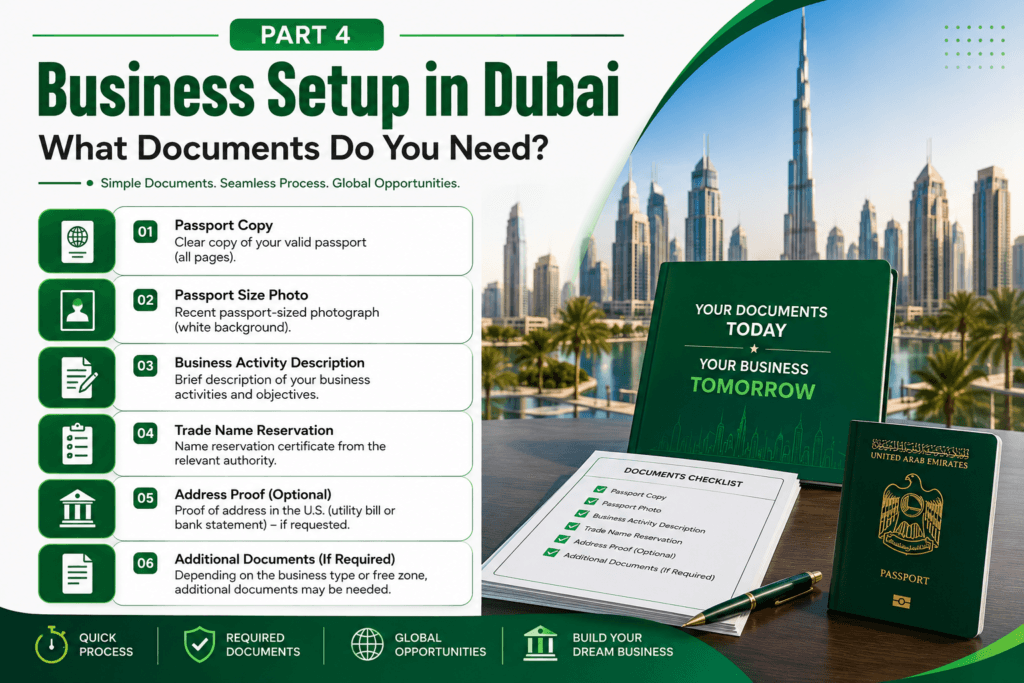
- Submit your documents — passport copy, passport photo, and a short business plan or activity description are usually sufficient at this stage
- Receive your trade license — free zone licenses can often be issued within days; mainland licenses typically take a bit longer
- Decide on a visa — a UAE residence visa is optional for company ownership, not mandatory, which surprises many American founders who assume they need to relocate
- Open a corporate bank account — this is genuinely the step where American founders hit the most friction, covered in detail below
Because a residence visa isn’t required just to own the company, a significant portion of business setup in Dubai for US citizens can be completed entirely remotely, with travel only becoming necessary if you decide to pursue residency, need biometrics for a visa, or want to open a bank account with a bank that requires in-person verification.
What Does Business Setup in Dubai for US Citizens Actually Cost?
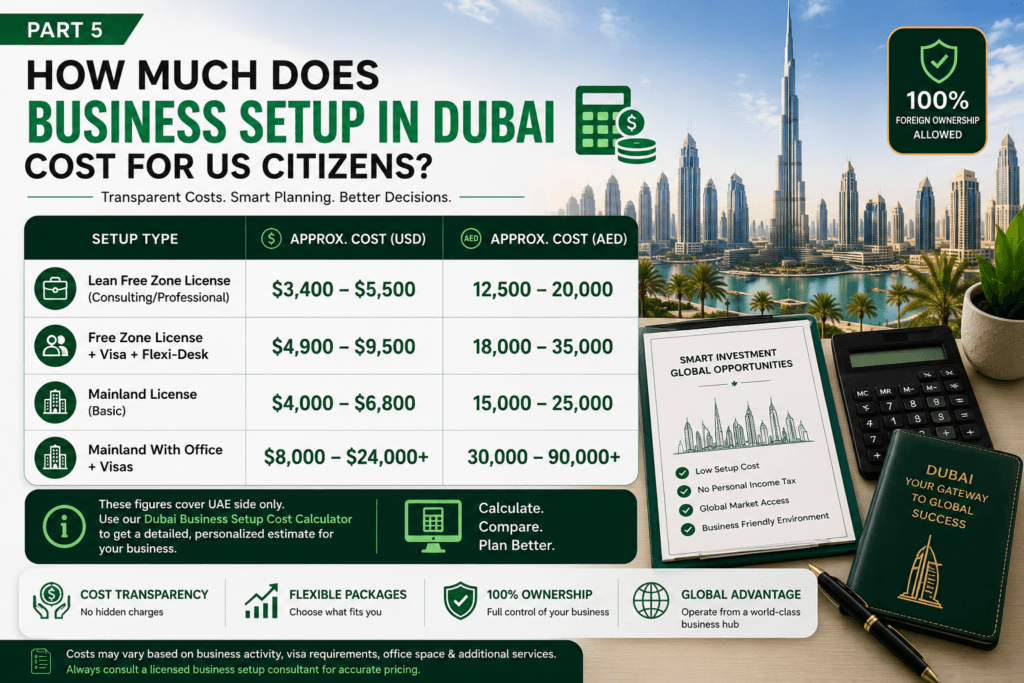
Cost expectations for Americans follow the same structure as any other nationality’s Dubai business setup, though it’s worth anchoring the numbers specifically here since dollar-to-dirham confusion trips up a lot of first-time American founders.
| Setup Type | Approximate Cost (USD) | Approximate Cost (AED) |
|---|---|---|
| Lean free zone license (consulting/professional) | $3,400 – $5,500 | 12,500 – 20,000 |
| Free zone license + visa + flexi-desk | $4,900 – $9,500 | 18,000 – 35,000 |
| Mainland license (basic) | $4,000 – $6,800 | 15,000 – 25,000 |
| Mainland with office + visas | $8,000 – $24,000+ | 30,000 – 90,000+ |
These figures cover the UAE side only. For a full breakdown of every cost component — license, office, visas, and banking — across every structure, our Dubai Business Setup Cost Calculator lets you build a line-by-line estimate specific to your business rather than relying on a single averaged figure.
UAE Corporate Tax: What Americans Actually Owe Locally
Business setup in Dubai for US citizens doesn’t exempt you from UAE corporate tax rules, which apply identically regardless of your nationality. The UAE charges 0% corporate tax on the first AED 375,000 of taxable profit and 9% above that threshold, with qualifying free zone companies potentially reaching 0% on qualifying income under the QFZP regime. Small businesses earning under AED 3,000,000 in revenue may also qualify for Small Business Relief through a specific election, though this relief is scheduled to close at the end of 2026.
Our UAE Corporate Tax Guide covers these thresholds, the Small Business Relief deadline, and the QFZP conditions in full — all of which apply to an American-owned company exactly as they would to any other founder’s structure.
The Part No UAE Guide Explains Properly: Your US Tax Obligations
This is genuinely the section that distinguishes business setup in Dubai for US citizens from every other nationality’s version of this process, and it deserves real attention rather than a single dismissive paragraph.
The United States is one of only two countries in the world that taxes its citizens on worldwide income regardless of where they live or where their business is incorporated. Moving your company to Dubai does not end your US tax filing obligations — it adds a layer of international reporting on top of them.
What This Actually Means in Practice
- Worldwide income reporting. Profit earned through your UAE company must still be reported to the IRS, even though it’s taxed at 0-9% locally rather than at US corporate rates.
- FBAR (Foreign Bank Account Report). If your UAE bank account balance exceeds $10,000 at any point during the year, you’re required to file an FBAR with FinCEN, separate from your regular tax return.
- Form 5471 or similar international information returns. Owning a foreign corporation typically triggers additional IRS reporting requirements depending on your ownership percentage and structure.
- FATCA compliance at the banking level. Every UAE bank will ask, as a routine part of onboarding, whether you’re a “US person,” and you’ll complete a W-9 or equivalent self-certification so the bank can meet its own FATCA reporting obligations back to the US Treasury.
None of this is a reason to avoid business setup in Dubai for US citizens — millions of Americans manage international business structures compliantly every year — but it is a strong reason to bring in a US-qualified cross-border accountant from day one rather than treating it as an afterthought once your Dubai company is already operating. Building the reporting structure in from the start is dramatically simpler than reconstructing it retroactively.
Banking: Where American Founders Hit the Most Friction
If there’s one step in business setup in Dubai for US citizens that consistently surprises people, it’s banking. UAE banks are entirely capable of and comfortable with onboarding American clients — this happens constantly — but the FATCA classification step adds a layer of documentation that founders from most other countries don’t encounter.
In practice, this means your bank application will include a US-person self-certification, and some banks apply more conservative risk appetites toward US-linked applicants than others. This is precisely the kind of detail our guide to opening a business bank account in Dubai is built to help with — it covers which banks tend to move faster, what documentation genuinely speeds up approval, and how digital-first banks like Wio can sometimes offer a faster, more remote-friendly onboarding path than traditional institutions for founders who aren’t yet UAE residents.
Do You Need a UAE Residence Visa?
No — and this is one of the more liberating facts about business setup in Dubai for US citizens that often gets buried in generic guides. Owning a UAE company does not require you to hold UAE residency. Plenty of American founders run a Dubai-registered business while remaining based in the United States, using the company purely as an operating entity rather than a relocation vehicle.
That said, many American founders eventually do pursue a UAE residence visa, either an investor visa tied to their company or, as the business grows, a longer-term UAE Golden Visa. If long-term residency, family sponsorship, or extended time in the UAE is part of your plan, our UAE Golden Visa Guide covers every eligibility category in detail — including the investor, entrepreneur, and specialized talent routes that many US founders end up qualifying for once their business is established.
Remote Setup: How Much Can You Actually Do From the US?
A meaningful share of business setup in Dubai for US citizens can be completed without stepping foot in the UAE. Trade name reservation, initial approvals, document submission, and even license issuance for many free zone structures happen entirely online. Where remote setup typically hits a wall is banking and, if you pursue one, visa biometrics — both of which still generally require either a video call, an in-person branch visit, or a trip to the UAE for Emirates ID processing.
A practical pattern that’s become common among American founders: complete the license and initial paperwork remotely, then plan a single trip to the UAE timed around opening your bank account and, if applicable, completing visa biometrics — turning what could be several separate trips into one focused visit.
Still Figuring Out Your Dubai Business Setup?
We’ve mapped out the entire process across our in-depth guides — pick up where you left off.
IDEAS
10 Best Business Ideas in Dubai
Not sure what to launch yet? Start here.
FREE ZONE
Dubai Free Zone Guide
30+ free zones compared, costs included.
MAINLAND
Dubai Mainland License Guide
Need to sell locally? Here’s what it costs.
TAX
UAE Corporate Tax Guide
Relief ends Dec 2026 — check your status.
BANKING
Open a Business Bank Account
Documents, timelines, and how to avoid rejection.
Which US States Send the Most Founders to Dubai?
Interest in business setup in Dubai for US citizens skews heavily toward states with a strong presence of remote-first industries and high state tax burdens. California, New York, and Texas consistently show the highest volume of inquiries, though the underlying motivations differ. California and New York founders are frequently driven by a combination of high state income tax and a genuinely global client base that doesn’t depend on a US physical presence. Texas founders, despite having no state income tax at home, are often drawn by UAE corporate structuring benefits and the currency diversification a USD-pegged dirham provides. Florida follows a similar pattern, with a growing number of e-commerce and consulting founders exploring business setup in Dubai for US citizens specifically as a way to build an international operating entity alongside an existing US business rather than replacing it entirely.
UAE Company vs a US LLC: Which Actually Fits Your Situation?
A question that comes up constantly during business setup in Dubai for US citizens is whether a UAE entity should replace, or simply complement, an existing US LLC. In most cases, the honest answer is complement rather than replace. A US LLC remains useful for accessing US banking rails, US-based payment processors, and domestic credibility with American clients or vendors who expect a US business entity on the other end of a contract. A UAE company adds international banking access, potential tax efficiency at the entity level, and a base for expanding into Middle Eastern, South Asian, or broader international markets.
Founders running both structures typically use the US LLC for domestic operations and client-facing US business, while the UAE company handles international contracts, holds international banking relationships, and in some cases serves as the entity through which UAE residency is eventually pursued. This dual-structure approach does add complexity to your accounting and reporting, which is exactly why coordinating with a cross-border accountant from the outset matters so much for business setup in Dubai for US citizens specifically, compared to founders from countries without worldwide income taxation.
Not sure what your UAE setup will actually cost?
Use our free calculator to get an instant, itemized breakdown — license, visa, and office fees, in your own currency.
Foreign Tax Credit: Does It Reduce Your US Tax Bill?
Because UAE corporate tax rates sit well below US corporate tax rates, business setup in Dubai for US citizens generally doesn’t generate much foreign tax credit relief on the corporate side — there simply isn’t much UAE tax paid to credit against US liability in most cases, particularly for companies benefiting from the 0% qualifying free zone regime or Small Business Relief. This is different from setting up in a higher-tax jurisdiction, where foreign tax credits can meaningfully offset US tax owed.
What this means practically: founders pursuing business setup in Dubai for US citizens primarily for currency diversification, international banking access, or global market positioning tend to have realistic expectations about the actual US tax savings, while those expecting the move to eliminate their US tax bill entirely are usually working from an incomplete picture. A qualified cross-border accountant can model your specific situation, including whether the Foreign Earned Income Exclusion applies if you genuinely relocate and spend the majority of your year outside the United States, which is a separate and more substantial tax benefit than the corporate structure alone provides.
Your Dubai Business Journey Starts Here
From free AI-powered planning tools to everything else we’ve built for entrepreneurs — explore what ibraida.com has to offer.
💚 100% free — no signup required to browse
Choosing a Visa Path if You Do Want UAE Residency
While UAE residency isn’t required for business setup in Dubai for US citizens, founders who do want it have a few realistic paths once their company is established. An investor or partner visa tied directly to your company ownership is the most common starting point, typically valid for two to three years and renewable as long as the underlying business remains active. As your business grows, particularly if it crosses the revenue or investment thresholds covered in our UAE Golden Visa Guide, a longer-term 5 or 10-year Golden Visa becomes a realistic upgrade path, offering the added benefit of not being tied to continuous UAE presence the way standard residency visas are.
For American founders specifically, the Golden Visa route carries an additional appeal: it doesn’t require renouncing US citizenship, doesn’t affect your US tax filing status on its own, and can function as a long-term optionality play even for founders who have no immediate plans to relocate permanently. Spending sufficient time in the UAE can also open the door to UAE tax residency certificates, which can be relevant for founders navigating double-taxation questions with a qualified advisor, though this is a genuinely advanced planning consideration rather than a starting point.
Business Setup Timeline for US Citizens
Most American entrepreneurs can complete the licensing process within a few weeks. Banking usually takes the longest due to additional compliance checks.
Choose Your Business Activity & Jurisdiction
Select your business activity and decide whether a Free Zone or Mainland company best fits your goals.
Reserve Trade Name & Initial Approval
Reserve your company name and complete the initial approval process with the relevant authority.
Free Zone Trade License
Most Free Zone companies receive their trade license within a few business days after submitting the required documents.
Mainland Trade License
Mainland company registration generally takes longer because of additional approvals and office requirements.
Corporate Bank Account
Bank account approval is often the longest stage for US citizens due to FATCA and compliance verification.
Residence Visa Processing
If you choose to obtain UAE residency, visa processing normally takes one to three weeks after completing the required formalities.
For most US entrepreneurs, the company can be legally established within one to two weeks. However, your business becomes fully operational once the corporate bank account is approved, which may take several additional weeks depending on compliance requirements.
For most founders pursuing business setup in Dubai for US citizens without a UAE residency visa, the license itself can realistically be active within one to two weeks, with the banking step being the true determinant of when the business becomes fully operational with local payment capability.
Common Mistakes American Founders Make
- Assuming 0% UAE tax means 0% US tax. Your UAE company’s profit is still reportable income to the IRS, regardless of the local UAE tax rate.
- Skipping a cross-border accountant until problems appear. FBAR and international information return requirements are far easier to build in from the start than to fix retroactively.
- Choosing mainland when a free zone would have worked. If your revenue is genuinely international, the extra mainland cost and office requirement often isn’t necessary.
- Underestimating the FATCA documentation step in banking. Budget extra time for this specific part of account opening rather than assuming it will move as fast as it might for a non-US applicant.
- Assuming a UAE residence visa is required to own the company. It isn’t, and forcing that step in prematurely adds unnecessary cost and complexity.
- Ignoring UAE corporate tax registration because “it’s basically tax-free.” Registration with the Federal Tax Authority is mandatory from day one regardless of your actual tax liability.
Pros & Considerations
Every business decision comes with opportunities and responsibilities. Here’s a quick comparison to help US entrepreneurs make an informed choice.
✅ Why Dubai is a Great Choice
100% Foreign Ownership Keep full ownership of your business without requiring a local partner.
0% Personal Income Tax The UAE does not levy personal income tax on individuals.
Remote Company Setup Many Free Zone businesses can be established directly from the USA.
Global Business Hub Operate from one of the world’s leading international business centres.
Investor & Golden Visa Opportunities Business owners may qualify for long-term UAE residency. |
⚠️ Things to Consider
IRS Reporting Still Applies US citizens must continue reporting worldwide income.
FBAR & FATCA Compliance Foreign bank accounts may trigger additional reporting requirements.
Longer Bank Verification Opening a corporate account may take more time for US founders.
Professional Tax Advice Cross-border accounting is highly recommended before incorporation.
Corporate Tax Registration Registration is mandatory even if your company owes little or no corporate tax. |
For most American entrepreneurs, Dubai offers an excellent combination of global market access, full business ownership, and tax-efficient operations. However, these advantages work best when paired with proper US tax planning and ongoing compliance from day one.
Who Genuinely Benefits Most From This Move?
Business setup in Dubai for US citizens tends to make the most sense for a specific set of profiles: consultants and service providers whose clients are already global rather than US-local, e-commerce founders selling internationally, and business owners looking to diversify banking, currency exposure, and long-term residency options while keeping their US citizenship fully intact. It tends to make less sense as a purely tax-motivated move for founders whose income is entirely US-sourced and who aren’t prepared to handle the added compliance layer — in those cases, the UAE tax savings can be outweighed by US reporting complexity if it’s not managed properly from the start.
Two More Questions American Founders Often Ask
Will opening a UAE company trigger an IRS audit?
Not on its own. Business setup in Dubai for US citizens is entirely legal and increasingly common, and the IRS has established, well-understood reporting mechanisms — FBAR, Form 5471, and standard foreign income reporting — specifically designed to handle exactly this scenario. The risk isn’t in having a foreign company; it’s in failing to report it correctly, which is precisely why proper cross-border accounting support matters more here than in a purely domestic US business.
Can I use my existing US business bank account for UAE operations instead?
Generally not effectively. A UAE-registered company typically needs its own UAE or internationally recognized corporate account to receive payments cleanly, satisfy local compliance requirements, and maintain a clear audit trail separate from your US entity’s finances. Mixing UAE company revenue through a US account tends to create exactly the kind of reporting ambiguity that complicates both UAE compliance and US tax filing down the line.
Frequently Asked Questions
Can a US citizen own 100% of a Dubai company?
Yes. Business setup in Dubai for US citizens allows full 100% foreign ownership in the vast majority of free zone and mainland business activities, with no requirement for a UAE national partner.
Do I have to pay US taxes if my income comes from a UAE company?
Yes. US citizens are taxed on worldwide income regardless of where it’s earned or where the company is incorporated. Your UAE company’s profit remains reportable to the IRS even though it may be taxed at 0-9% locally in the UAE.
Can I set up a Dubai business entirely remotely from the US?
Much of the process can be completed remotely, including trade name reservation, document submission, and license issuance for many free zone structures. Banking and, if pursued, visa biometrics typically require either a video call, in-person verification, or a trip to the UAE.
Do I need a UAE residence visa to own a business there?
No. A UAE residence visa is optional for company ownership, not mandatory. Many American founders operate a Dubai company while remaining based in the United States.
What is FATCA and why does it matter for my UAE bank account?
FATCA (the Foreign Account Tax Compliance Act) requires foreign banks, including UAE banks, to identify and report US-person account holders to US tax authorities. This means your UAE bank will ask you to complete a US-person self-certification as a standard part of account opening.
Is Dubai actually tax-free for American business owners?
The UAE itself offers 0% personal income tax and 0-9% corporate tax depending on profit level, but this does not make your income tax-free from a US perspective. You remain fully subject to US federal tax filing and reporting obligations on your worldwide income.
Putting It All Together
Every element of business setup in Dubai for US citizens ultimately connects back to two parallel tracks that need to move together: the UAE side, which is genuinely straightforward and welcoming to American founders, and the US compliance side, which requires the same discipline you’d apply to any other significant financial decision. Treating business setup in Dubai for US citizens as purely a UAE process, without the US reporting layer built in from the start, is the single most common reason founders run into unnecessary complications later.
Done properly, business setup in Dubai for US citizens gives you a genuinely useful international business base — 100% ownership, largely remote setup, competitive local tax treatment, and a currency-diversified banking relationship — while keeping your US citizenship, your existing US business interests, and your compliance standing fully intact. The founders who navigate this most smoothly are the ones who treat the UAE license and the US accounting relationship as a single coordinated project rather than two separate, disconnected tasks.
If you take one practical step away from this guide, let it be this: before you file a single UAE document, have an initial conversation with a cross-border accountant who specifically understands business setup in Dubai for US citizens, not just general international tax. The UAE side of this process is well-documented and predictable. The US side is where genuine expertise pays for itself many times over, and it’s far cheaper to get that conversation right at the start than to correct it after your Dubai company has already been operating for a year.
For everything else — ideas, licensing, cost planning, and long-term residency — our full guide series covers the rest: Best Business Ideas in Dubai, Dubai Free Zones Guide, Dubai Mainland License Guide, UAE Corporate Tax Guide, Business Bank Account Guide, UAE Golden Visa Guide, and the Dubai Business Setup Cost Calculator.
Disclaimer:This article is for general informational purposes only and does not constitute legal, financial, immigration, or tax advice. UAE regulations and US tax reporting requirements can change, and individual circumstances vary significantly; consult a licensed UAE business setup consultant and a US-qualified cross-border tax accountant before making structuring decisions.
References
- Noblecor Ventures — Business Setup in Dubai for US Citizens 2026
- Shuraa — How to Start a Business in Dubai from the US in 2026
- MSZ Consultancy — Business Setup Consultants in Dubai for US Entrepreneurs
- IRS — International Businesses and US Reporting Requirements
- Dubai DET — Business Licensing Overview
M. Kamran Awan
Founder, ibraida.com
Kamran writes about AI business tools, SEO, and growth strategies for entrepreneurs in the UAE and beyond, drawing on hands-on experience building and scaling digital platforms.