
📅 Last updated: July 2026 | ✍️ By M. Kamran Awan | ⏱️ 11 min read
Table of Contents
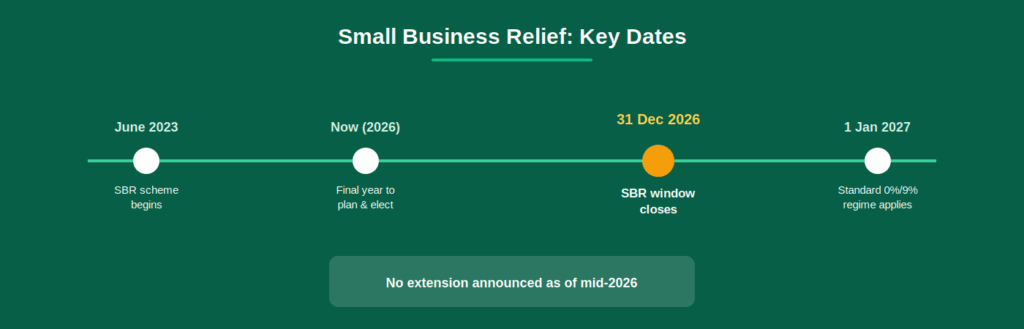
Understanding UAE corporate tax is no longer optional for small business owners in 2026 — not push it off for later. If you run a small business in the UAE, 2026 is the year to actually understand your corporate tax position — not push it off for later. The Small Business Relief scheme that’s let thousands of small companies pay zero UAE corporate tax since 2023 is scheduled to expire on 31 December 2026, and there’s no extension mechanism currently on the table. That means every small business owner who’s been coasting on this relief needs a plan for what happens in 2027, and every founder starting a business right now needs to understand exactly where they stand today.
This guide breaks down UAE corporate tax in plain terms for small businesses specifically — what you actually owe, who qualifies for relief, what’s changing, and the mistakes that cost founders real money.
| 0% Tax up to AED 375,000 | 9% Standard Rate Above Threshold | AED 3M Small Business Relief Cap | Dec 31, 2026 Relief Deadline |
The Basics: How UAE Corporate Tax Actually Works
Before diving into relief schemes, it helps to understand how UAE corporate tax actually works at its core.The UAE introduced federal corporate tax under Federal Decree-Law No. 47 of 2022, effective for financial years starting on or after 1 June 2023. Every business — mainland, free zone, or otherwise — is now a taxable person under this law, even if the actual tax owed ends up being zero.
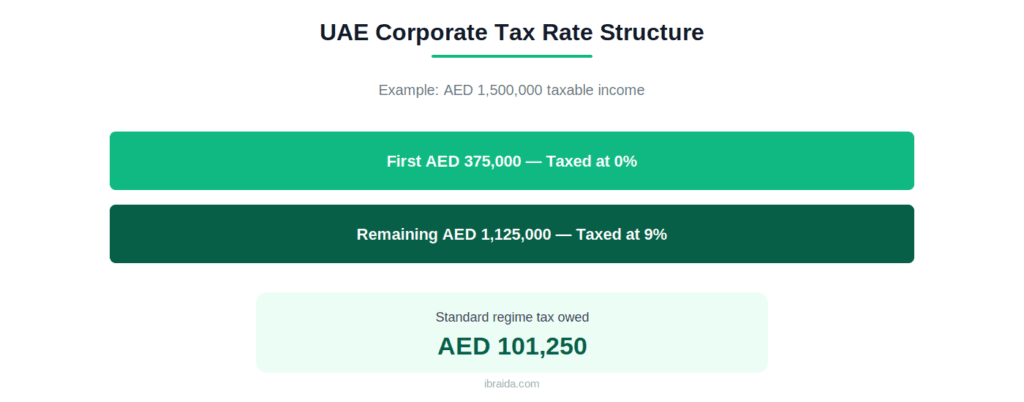
The standard structure is straightforward:
- 0% tax on taxable income up to AED 375,000
- 9% tax on taxable income above AED 375,000
- Corporate tax registration with the Federal Tax Authority (FTA) is mandatory for every business, regardless of profit or revenue level
- Tax returns are filed once per financial year, due within 9 months of the year-end
This AED 375,000 threshold is a tax band, not a revenue exemption — it applies to every business permanently, and it’s separate from the Small Business Relief scheme discussed below. A lot of confusion among small business owners comes from mixing these two up, so it’s worth being precise about the difference from the start.
if we are talking about UAE corporate tax then you also READ this too.
Small Business Relief: The Scheme That’s Ending in 2026
Small Business Relief is the single most valuable UAE corporate tax concession available to small businesses right now. Small Business Relief (SBR) is a temporary provision under Article 21 of the Corporate Tax Law, introduced through Ministerial Decision No. 73 of 2023. It lets qualifying resident businesses elect to be treated as having zero taxable income entirely — not just a 0% rate on the first AED 375,000, but genuinely zero corporate tax on all of it, regardless of how much you actually earned.
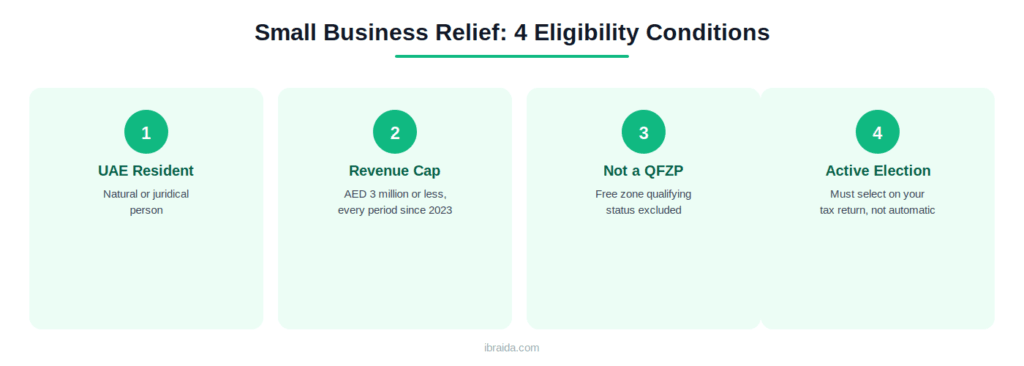
| Condition | Requirement |
|---|---|
| Residency | Must be a UAE resident person (natural or juridical) |
| Revenue cap | AED 3,000,000 or less, in the current period and every prior period since June 2023 |
| Free zone status | Cannot be a Qualifying Free Zone Person (QFZP) — the two regimes are mutually exclusive |
| Group structure | Cannot be part of a multinational group with consolidated revenue above AED 3.15 billion |
| Election | Must be actively elected on your corporate tax return — it’s not automatic |
The revenue test is cumulative and permanent in effect: if your revenue exceeded AED 3 million in any tax period since June 2023, you’re permanently disqualified from Small Business Relief for every future period, even if your revenue drops back below the threshold later. This trips up growing businesses more often than you’d expect — a strong year can quietly close this door for good.
The deadline that matters most right now: Small Business Relief only applies to tax periods ending on or before 31 December 2026. From 1 January 2027, businesses that relied on SBR move into the standard regime — 0% on the first AED 375,000 of taxable profit and 9% above that. No extension has been announced as of mid-2026, so this is genuinely closing, not just a recurring headline.
Small Business Relief vs the AED 375,000 Threshold: Don’t Confuse These
These two provisions get mixed up constantly, and the difference matters financially.
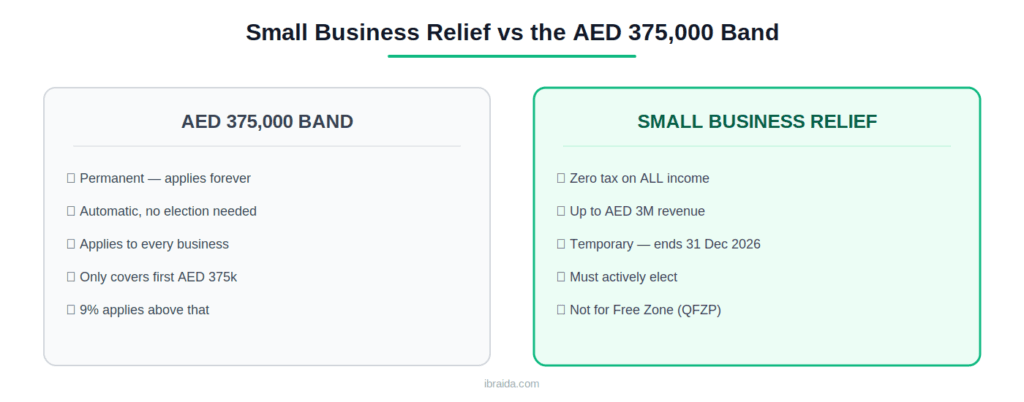
| Feature | AED 375,000 Threshold | Small Business Relief |
|---|---|---|
| Permanent or temporary | Permanent | Temporary — ends 31 Dec 2026 |
| What it covers | 0% only on the first AED 375,000 of profit | 0% on ALL taxable income, regardless of amount |
| Eligibility | Automatic for every business | Must actively elect; revenue capped at AED 3M |
| Applies to QFZPs | Not applicable (different regime) | Not available to QFZPs |
In practice: a profitable small business earning AED 1.5 million in taxable income would owe roughly AED 101,250 in tax under the standard regime (9% on the amount above AED 375,000). Under Small Business Relief, that same business owes zero. That’s the real financial value of the relief while it lasts — and exactly why the 2026 deadline is worth planning around now rather than in December.
The Trade-Off Nobody Tells You About
This is the part of UAE corporate tax planning most founders skip past — and it can cost more than the relief actually saves. Electing Small Business Relief isn’t automatically the right move, even if you qualify. When you elect SBR for a tax period, you give up two things for that period:
- Loss carry-forward — any tax losses incurred during an SBR period cannot be carried forward to offset future profits
- Interest expense carry-forward — disallowed net interest expenditure from that period is also forfeited
If your business is in a loss-making or investment-heavy phase, electing SBR to save zero tax (since you’d owe nothing anyway in a loss year) while forfeiting losses you could have carried forward for up to 10 years is usually the wrong call. SBR makes the most sense for small, consistently profitable businesses that don’t need those carry-forward provisions. Model both scenarios with your actual numbers before electing — this isn’t a decision to make on autopilot just because you’re eligible.
How to Actually Elect Small Business Relief: Step by Step
The election itself is simpler than most founders expect, but it has to be done correctly and on time to count.
- Confirm eligibility before you start — check your revenue for the current period and every period since June 2023, not just the current year
- Log into EmaraTax with your registered corporate tax account
- Prepare your financial statements for the tax period using cash-basis or accrual accounting, whichever you’ve been using consistently
- When completing your corporate tax return, actively select the Small Business Relief election — this does not happen automatically even if you qualify
- Submit your return within 9 months of your financial year-end
- Keep records supporting your revenue figures for at least 7 years, since the FTA can review filings well after submission
One detail that catches people out: even though SBR simplifies your calculation, you still need to file a complete corporate tax return. There’s no shortcut form for “small businesses that owe nothing” — the same EmaraTax return process applies, just with a different outcome once the election is made.
Your Dubai Business Journey Starts Here
From free AI-powered planning tools to everything else we’ve built for entrepreneurs — explore what ibraida.com has to offer.
💚 100% free — no signup required to browse
Registration: Deadlines and Penalties
Corporate tax registration with the FTA is mandatory for every taxable person, and this catches out more small businesses than the tax calculation itself does. Getting your UAE corporate tax registration right from day one avoids penalties that have nothing to do with how much you actually owe.
| Requirement | Detail |
|---|---|
| Who must register | Every business, including those with zero revenue or eligible for SBR |
| Registration platform | EmaraTax (Federal Tax Authority portal) |
| Filing deadline | Within 9 months of financial year-end |
| Late registration penalty | AED 10,000 flat fee |
| Late payment penalty (from April 2026) | Up to 14% per year on unpaid tax |
Registering late is one of the most common — and most avoidable — mistakes small business owners make, often because they assume “small business” means no filing obligation. It doesn’t. Even a business that will ultimately owe zero tax under Small Business Relief must still register and file a return on time, or the AED 10,000 penalty applies regardless of the underlying tax liability.
Record-Keeping: What the FTA Actually Expects
Even businesses paying zero tax under Small Business Relief need to maintain proper records, and this is where many small business owners underinvest. At minimum, keep invoices and receipts for all revenue and expenses, bank statements reconciled against your accounting records, contracts and agreements relevant to your business activity, and any documentation supporting your revenue calculation for the SBR threshold test.
Records must be retained for a minimum of 7 years from the end of the relevant tax period, and the FTA has the authority to request them at any point within that window, not just immediately after filing. “We didn’t owe anything so we didn’t keep records” is not a defense the FTA accepts, and reconstructing years of financial records after the fact is far more expensive than maintaining them properly from day one.
Free Zone Businesses: A Different Set of Rules
UAE corporate tax works differently for free zone companies compared to mainland businesses, which is worth understanding before you assume Small Business Relief applies to you. If your business operates in a Dubai free zone, Small Business Relief isn’t available to you at all — Qualifying Free Zone Persons are explicitly excluded from SBR. Instead, free zone companies have their own path to 0% tax through the QFZP regime, which we covered in detail in our Dubai Free Zones Guide.
The short version: a free zone company gets 0% tax on qualifying income only if it maintains adequate substance in the zone, derives genuinely qualifying income, and meets the de minimis threshold for non-qualifying revenue. Miss any condition, and the entire company loses QFZP status for that period and the following four years, taxed at 9% on all income — not just the non-qualifying portion. The two regimes (SBR and QFZP) are mutually exclusive, so free zone founders need to think about this differently than mainland founders do.
A Practical Example: Two Small Businesses, Two Different Outcomes
Seeing how UAE corporate tax rules actually play out with real numbers makes the decision much clearer than reading the conditions alone. Consider two hypothetical small businesses to see how these rules play out differently in practice.
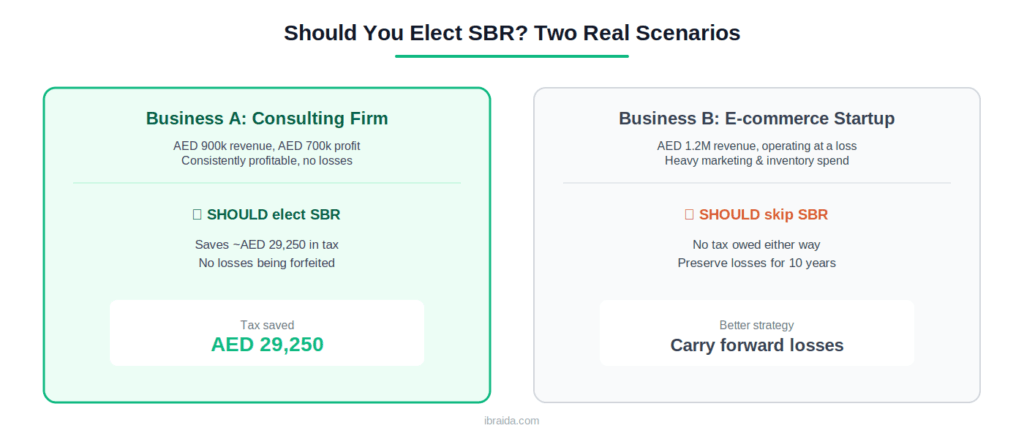
Business A is a mainland consulting firm earning AED 900,000 in annual revenue with AED 700,000 in taxable profit, consistently profitable for three years with no losses to carry forward. Electing Small Business Relief makes this business’s taxable income zero, saving roughly AED 29,250 in tax it would otherwise owe under the standard 9% rate above AED 375,000. There’s no meaningful downside here since there are no losses being forfeited.
Business B is an early-stage e-commerce company with AED 1.2 million in revenue but currently operating at a loss due to heavy marketing and inventory investment. Electing SBR here would forfeit that loss for future use — but since the business isn’t currently profitable anyway, there’s no current-year tax to save by electing. In this case, skipping the SBR election and preserving the loss to offset future profits is usually the stronger long-term move, since UAE tax law allows losses to be carried forward for up to 10 years once you’re in the standard regime.
These two scenarios show why “am I eligible” and “should I elect” are genuinely different questions — eligibility is a revenue test, but the right decision depends on your specific profit and loss position for that period.
Does Small Business Relief Affect VAT Too?
No — and this is a distinction worth understanding clearly, because corporate tax and VAT are entirely separate systems in the UAE with their own thresholds and rules. Small Business Relief only affects your corporate tax liability. It has no bearing on your VAT obligations whatsoever.
A common point of confusion in UAE corporate tax planning is assuming VAT and corporate tax are the same system — they aren’t. VAT registration becomes mandatory once your taxable turnover crosses AED 375,000 in any trailing 12-month period, with voluntary registration available from AED 187,500 if you want to register early to reclaim input VAT on expenses. A small business fully exempt from corporate tax under SBR can still be required to register for, charge, and remit VAT if its turnover crosses that separate threshold. Founders sometimes assume that because they’re “tax-exempt” under SBR, VAT doesn’t apply to them either — that assumption gets expensive quickly once the FTA notices a VAT registration gap.
If your revenue is approaching AED 375,000 and you haven’t registered for VAT, that’s a separate and equally urgent compliance item from your corporate tax election, and it deserves its own checklist rather than being lumped in with your SBR planning.
What Happens After 2026: Preparing for the Transition
Planning ahead for your UAE corporate tax position after Small Business Relief ends will save you from a stressful surprise in 2027.Once Small Business Relief closes, any business currently relying on it moves into the standard 0%/9% regime starting with tax periods after 31 December 2026. A few things are worth doing now rather than waiting:
- Model your 2027 tax liability under the standard regime using your current profit trajectory, so the transition isn’t a surprise
- Reconsider your loss position — if you’ve been electing SBR every year and forfeiting losses, calculate what those losses would have been worth carried forward
- Review your accounting method — SBR allows simplified cash-basis accounting; the standard regime typically requires accrual accounting, so this transition may mean upgrading your bookkeeping setup
- Talk to an FTA-registered tax agent before your 2026 filing if you’re close to the AED 3 million threshold, since a strong final year could either help or permanently disqualify you depending on timing
📥
Free Download: UAE Corporate Tax Checklist
A complete checklist covering registration, SBR eligibility, and your 2027 transition plan.
Download Free ChecklistCommon Mistakes Small Business Owners Make
Most costly UAE corporate tax mistakes come from assumptions, not from the rules themselves being complicated.
- Assuming eligibility equals relief. SBR must be actively elected on your tax return — being under the revenue threshold does nothing on its own.
- Not registering because “we’re too small.” Registration is mandatory regardless of revenue or profit level, and the AED 10,000 penalty doesn’t care about your tax liability.
- Electing SBR in a loss year. This forfeits carry-forward losses for zero benefit, since you’d have owed nothing anyway.
- Missing the cumulative revenue test. One strong year above AED 3 million permanently closes the door on SBR for every future period, even if revenue drops back down later.
- Combining personal and business revenue incorrectly. Freelancers running multiple income streams may need to combine all business revenue for the AED 3 million test.
- Ignoring the 2026 deadline entirely. Treating SBR as a permanent feature of UAE tax, rather than the temporary bridge it was designed to be, leaves businesses unprepared for 2027.
Still Figuring Out Your Dubai Business Setup?
We’ve mapped out the entire process across 4 in-depth guides — pick up where you left off.
Frequently Asked Questions
Who does UAE corporate tax actually apply to?
UAE corporate tax applies to every business — mainland, free zone, or otherwise — registered as a taxable person under Federal Decree-Law No. 47 of 2022, regardless of size or profitability.
Do I have to pay UAE corporate tax if my UAE business made no profit?
You still need to register with the FTA and file a return, even at zero profit. Registration is mandatory regardless of profitability, and the late registration penalty applies whether or not any tax is actually owed.
Is Small Business Relief the same as the AED 375,000 zero-rate band?
No. The AED 375,000 threshold is a permanent 0% band that applies to everyone on their first AED 375,000 of profit. Small Business Relief is a temporary, separate election available until 31 December 2026 that can zero out tax on all income up to AED 3 million in revenue, not just the first AED 375,000.
Can free zone companies claim Small Business Relief?
No. Qualifying Free Zone Persons are excluded from Small Business Relief entirely. Free zone companies pursue 0% tax through the separate QFZP regime instead.
What happens if my revenue goes over AED 3 million after I’ve been claiming Small Business Relief?
You become permanently ineligible for Small Business Relief in all future tax periods, even if revenue later drops back below AED 3 million. This is a one-way test, so it’s worth monitoring closely as your business scales.
Can I still get corporate tax registered if I’ve been operating without registering for over a year?
Yes, but expect to pay the AED 10,000 late registration penalty regardless of how long the delay has been. It’s worth checking current EmaraTax guidance for any active penalty waiver initiatives before assuming the full penalty is unavoidable.
What’s replacing Small Business Relief after 2026?
As of mid-2026, no replacement scheme has been announced. Businesses currently relying on SBR should plan to transition into the standard 0%/9% regime for tax periods starting in 2027 unless new guidance changes this.
Final Thoughts
UAE corporate tax for small businesses currently offers a genuinely generous window through Small Business Relief — but it’s a window with a closing date, not a permanent feature of doing business here. If your revenue sits comfortably under AED 3 million and you’ve been electing SBR each year, 2026 is the year to model what 2027 looks like without it, rather than finding out the hard way when your first standard-regime tax bill arrives.
Whether you’re setting up fresh or reviewing an existing structure, our Dubai Mainland License Guide and Dubai Free Zones Guide both cover how licensing choice interacts with your tax position in more depth.
Disclaimer: This article is for general informational purposes only and does not constitute legal, financial, or tax advice. UAE Corporate tax rules, thresholds, and deadlines can change; consult an FTA-registered tax agent before making tax elections or structuring decisions.
References
- UAE Ministry of Finance — Small Business Relief Ministerial Decision No. 73 of 2023
- Federal Tax Authority — Small Business Relief
- PwC — UAE Corporate Tax Credits and Incentives
- Velmont Crest — UAE Small Business Relief 2026: Deadline Guide
- Kayrouz & Associates — UAE Tax Changes 2026
M. Kamran Awan
Founder, ibraida.com
Kamran writes about AI business tools, SEO, and growth strategies for entrepreneurs in the UAE and beyond, drawing on hands-on experience building and scaling digital platforms.