Every founder emailing me about Saudi Arabia eventually asks the same question in some form: “okay, but what’s this actually going to cost me?” Fair question. The honest answer is that the cost of starting a business in Saudi Arabia isn’t one number — it’s a stack of smaller numbers that depend on your activity, your entity type, and how much of the process you handle yourself versus hand off to a consultant.
I already walked through the full registration process in our step-by-step guide to starting a business in Saudi Arabia, and touched on entity choice in our LLC vs Branch Office comparison. This article is the one piece that was still missing: a real, itemized breakdown of the cost of starting a business in Saudi Arabia, so you can actually budget before you commit to anything.
Table of Contents
Quick Answer: How Much Does It Cost?
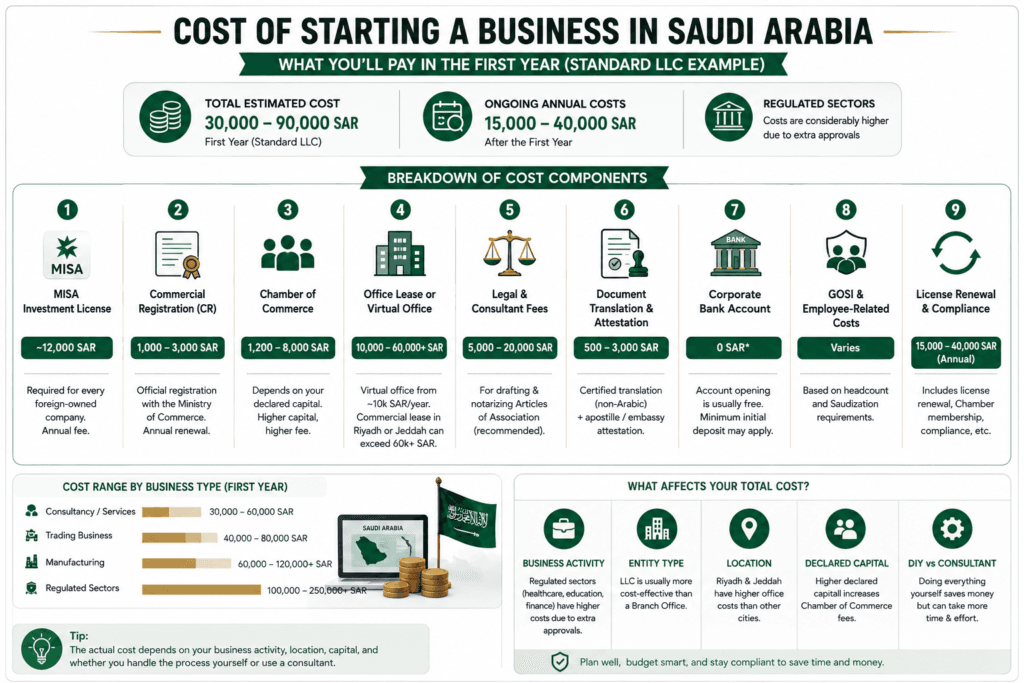
- The cost of starting a business in Saudi Arabia for a standard LLC typically lands between 30,000 and 90,000 SAR in the first year.
- Regulated sectors (healthcare, education, finance) push the cost of starting a business in Saudi Arabia considerably higher due to extra approvals.
- Ongoing annual costs (license renewal, Chamber of Commerce, compliance) typically run 15,000–40,000 SAR every year after that.
Now let’s break down exactly where that money goes.
Full Breakdown of the Cost of Starting a Business in Saudi Arabia
MISA Investment License
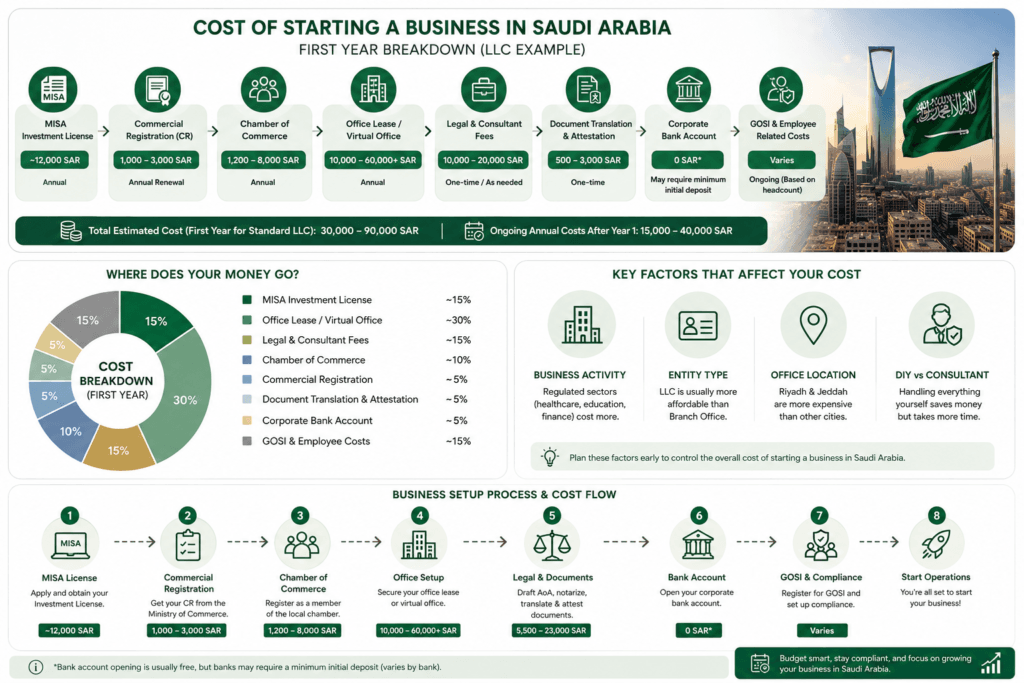
This is the first real line item in the cost of starting a business in Saudi Arabia, and it’s non-negotiable — every foreign-owned company needs it. The MISA Investment License runs approximately 12,000 SAR annually, and this is a recurring cost, not a one-time fee, so budget for it every year going forward.
Commercial Registration (CR) Fee
Once your MISA license clears, your Commercial Registration fee adds another 1,000 to 3,000 SAR to the cost of starting a business in Saudi Arabia. This is what officially makes your company a legal entity through the Ministry of Commerce.
Chamber of Commerce Membership
Every registered company needs Chamber of Commerce membership, which ranges from 1,200 to 8,000 SAR depending on your declared capital. Higher-capital companies pay more here, which is worth factoring into the overall cost of starting a business in Saudi Arabia if you’re deciding how much capital to declare.
Office Lease or Virtual Office
You can’t complete Commercial Registration without a registered office address — a residential address won’t cut it. This is one of the bigger swing factors in the cost of starting a business in Saudi Arabia: a virtual office or shared workspace might run 10,000 SAR a year, while a proper commercial lease in Riyadh or Jeddah can easily hit 60,000 SAR or more.
Legal and Consultant Fees
Drafting and notarizing your Articles of Association typically costs 5,000 to 20,000 SAR if you use a local legal consultant, which most founders do. This is optional in theory but adds real protection against the documentation mistakes that delay applications, so most people treat it as part of the standard cost of starting a business in Saudi Arabia rather than an avoidable extra.
Document Translation and Attestation
Every non-Arabic document needs certified translation, and documents from outside Saudi Arabia usually need apostille or embassy attestation. Budget 500 to 3,000 SAR for this — a small line item, but one that catches first-time founders off guard when it’s not planned for.
Corporate Bank Account
Opening your account itself is usually free, but some banks require a minimum initial deposit. This isn’t technically a “cost” since it’s your own capital sitting in the account, but it does affect your available cash flow, so factor it into your overall cost of starting a business in Saudi Arabia planning.
GOSI and Employee-Related Costs
If you’re hiring from day one, GOSI (social insurance) contributions and Saudization compliance costs add another variable layer to the cost of starting a business in Saudi Arabia. These scale directly with headcount, so a solo consultancy pays almost nothing here, while a 10-person operation needs a real payroll budget from month one.
Full Cost Table
| Cost Item | Estimated Range (SAR) | Recurring? |
|---|---|---|
| MISA Investment License | ~12,000 | Annual |
| Commercial Registration | 1,000–3,000 | Annual renewal |
| Chamber of Commerce Membership | 1,200–8,000 | Annual |
| Office Lease / Virtual Office | 10,000–60,000+ | Annual |
| Legal & Consultant Fees (AoA) | 5,000–20,000 | One-time |
| Translation & Attestation | 500–3,000 | One-time |
| GOSI & Payroll Setup | Varies by headcount | Ongoing |
Cost by Entity Type: LLC vs Branch Office
We covered this in detail in our LLC vs Branch Office comparison, but here’s the short version: the cost of starting a business in Saudi Arabia as an LLC includes Articles of Association drafting (5,000–15,000 SAR) that a branch office skips entirely, since a branch isn’t a separate legal entity. On the flip side, branch offices pay 3,000–8,000 SAR in parent company document legalization that LLCs don’t need. Net-net, the cost difference between the two structures is usually just a few thousand SAR — not enough to be the deciding factor on its own.
Cost by Business Activity
Not every activity carries the same cost of starting a business in Saudi Arabia. Here’s roughly how it scales:
- Consulting / services: Lowest end of the range — minimal capital requirements, straightforward MISA approval, no extra regulatory sign-off.
- Trading: Moderate — often requires higher declared capital and sometimes import/export registration.
- Industrial / manufacturing: Higher — factory or facility setup costs stack on top of standard registration fees.
- Healthcare, education, finance: Highest — additional regulatory approvals from sector-specific authorities significantly increase the cost of starting a business in Saudi Arabia, sometimes doubling the standard budget.
Cost by City: Riyadh vs Jeddah vs Other Regions
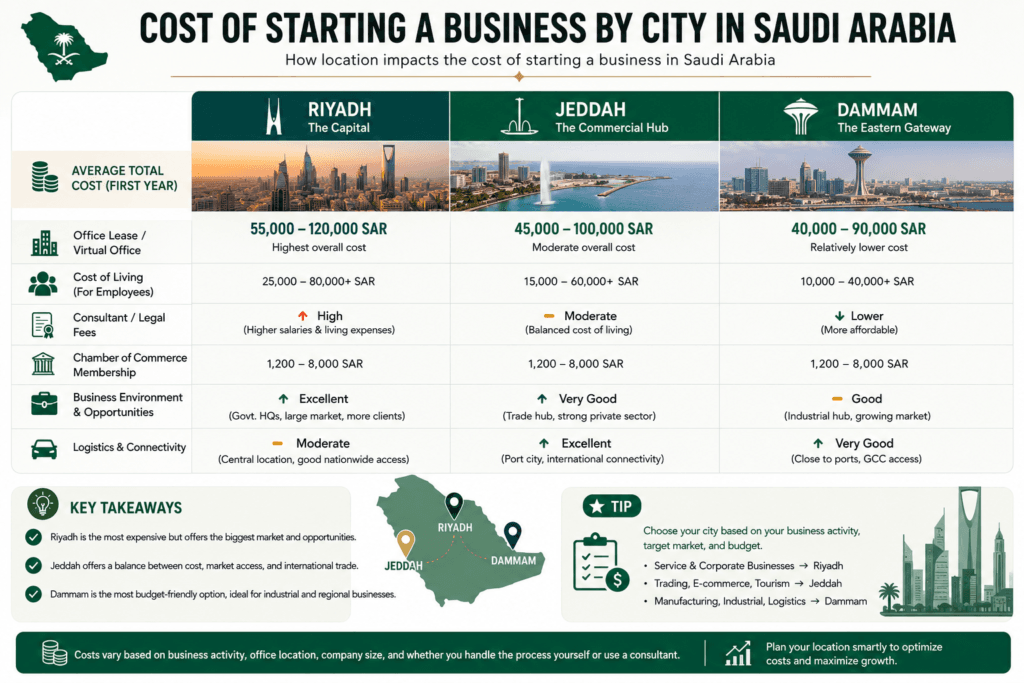
Location plays a bigger role in the cost of starting a business in Saudi Arabia than most guides mention. The registration fees themselves (MISA, Commercial Registration, Chamber of Commerce) are the same no matter where you set up — but your office costs, which are one of the biggest variables in your total budget, shift significantly by city.
| City | Typical Office Cost (Annual, SAR) | Notes |
|---|---|---|
| Riyadh | 25,000 – 80,000+ | Highest demand due to giga-project and government contract activity |
| Jeddah | 18,000 – 55,000 | Strong for trading and logistics-focused businesses |
| Dammam / Eastern Province | 15,000 – 45,000 | Lower cost, strong for industrial and energy-sector activities |
| NEOM / Red Sea Project areas | Varies significantly | Newer zones with developing rate structures and specific incentives |
If your business activity doesn’t require face-to-face client meetings or a physical storefront, choosing a lower-cost city or a virtual office in a secondary business district can meaningfully reduce the cost of starting a business in Saudi Arabia without affecting your MISA or Commercial Registration approval at all — location doesn’t change your eligibility, only your overhead.
Minimum Capital Requirements and How They Affect Your Budget
One detail that trips up a lot of first-time founders: there’s no single fixed minimum capital figure for the cost of starting a business in Saudi Arabia. MISA evaluates required capital case-by-case based on your business activity, and this declared capital indirectly affects several other costs.
- Trading and industrial activities generally require higher declared capital than service-based consulting activities.
- Your Chamber of Commerce membership fee scales with declared capital — higher capital means a higher membership tier.
- Banks sometimes reference declared capital when assessing your corporate account application, even though it’s not a strict legal requirement for account opening.
- Over-declaring capital “to be safe” is a common mistake — it increases your Chamber of Commerce fees and paperwork without any real benefit if your actual operating costs don’t require it.
The practical approach: build a realistic 12-month operating budget for your specific activity, and let that number — not a guess — inform your declared capital. This keeps the cost of starting a business in Saudi Arabia proportional to what your business genuinely needs.
When You’ll Actually Pay Each Cost (Timeline)
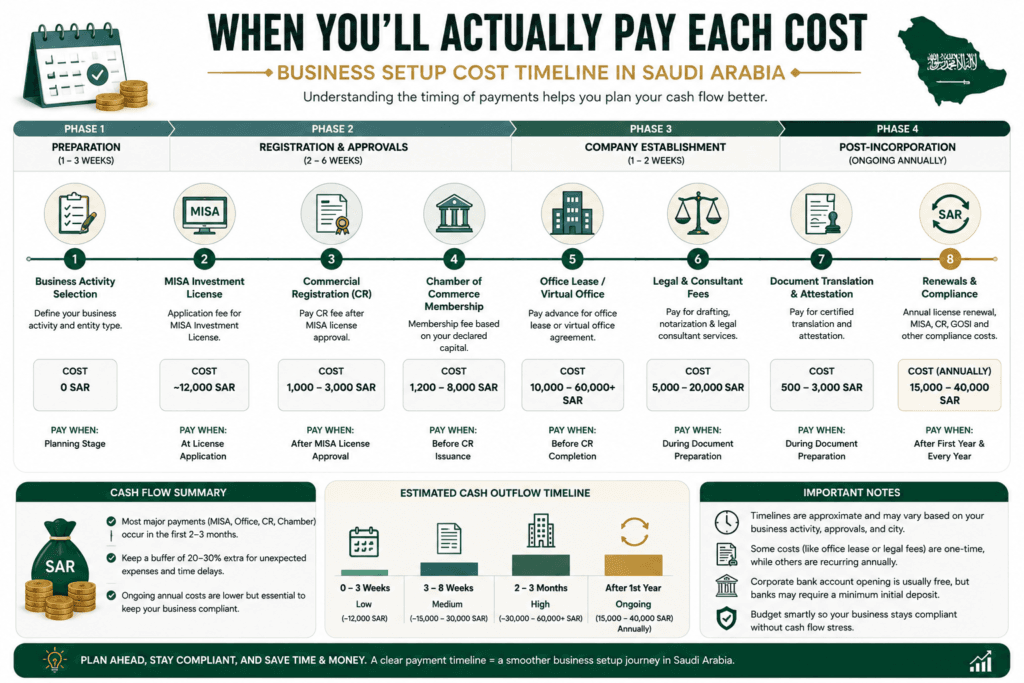
Budgeting isn’t just about the total — it’s about cash flow timing. Here’s roughly when each piece of the cost of starting a business in Saudi Arabia actually comes due:
| Stage | Costs Due |
|---|---|
| Before applying (Week 0) | Translation & attestation of documents, legal consultant retainer (if used) |
| MISA application (Week 1) | MISA Investment License fee (~12,000 SAR) |
| Articles of Association (Week 2-3) | Notarization and legal drafting fees |
| Commercial Registration (Week 3-4) | CR fee, Chamber of Commerce membership |
| Office setup (Week 4-5) | First lease payment or virtual office subscription |
| Bank account (Week 5-8) | Minimum deposit (if required by your bank) |
| Ongoing (Month 3+) | Payroll, GOSI, accounting, first VAT filing if applicable |
Spreading the cost of starting a business in Saudi Arabia across this timeline — rather than assuming it all hits at once — makes cash flow planning far more manageable, especially if you’re self-funding the launch.
Sample Budget: A Realistic First-Year Scenario
Numbers are easier to plan around with a concrete example. Here’s a realistic first-year cost of starting a business in Saudi Arabia for a small consulting LLC with one foreign shareholder, no employees in year one, and a virtual office in Riyadh:
| Item | Cost (SAR) |
|---|---|
| MISA Investment License | 12,000 |
| Commercial Registration | 1,500 |
| Chamber of Commerce Membership | 2,000 |
| Virtual Office (Riyadh, annual) | 15,000 |
| Legal & AoA Drafting | 8,000 |
| Translation & Attestation | 1,200 |
| Total (Year 1) | ~39,700 SAR |
This lands comfortably within the typical 30,000–90,000 SAR range we mentioned earlier, and shows how the cost of starting a business in Saudi Arabia stays manageable for a lean, service-based setup without regulated-sector complications.
Pros and Cons: DIY Setup vs Full-Service Consultant
| Pros | Cons |
|---|---|
| DIY keeps the cost of starting a business in Saudi Arabia lower upfront | DIY risks costly delays from document or activity code mistakes |
| Consultants reduce rejected applications and rework | Full-service consultants can add 15,000–40,000 SAR to your budget |
| Consultants often have faster banking relationships | Not all consultants are equally reliable — vetting takes time |
| DIY works well for simple, non-regulated activities | Regulated sectors almost always need professional help regardless of cost |
Hidden Costs Founders Often Miss
- Annual renewals. The MISA license and Commercial Registration both renew yearly — treat the cost of starting a business in Saudi Arabia as a recurring line item, not a one-time expense.
- Currency conversion and transfer fees. Moving capital from your home country into a Saudi account often carries bank fees that add up.
- Sector-specific inspections. Municipal or civil defense inspections for physical premises can carry their own fees.
- Employee visa and Iqama costs. Each expat hire brings sponsorship, medical testing, and Iqama fees that aren’t part of the initial registration cost but hit within your first year.
- Accounting and audit fees. LLCs need ongoing bookkeeping and, eventually, audited financial statements — a recurring cost many first-time founders forget to budget for.
Financing Your Setup: Self-Funding vs Other Options
Most first-time founders self-fund the cost of starting a business in Saudi Arabia, and for good reason — the amounts involved (30,000–90,000 SAR for a standard LLC) are modest enough that external financing usually isn’t necessary just for registration. That said, it’s worth knowing your options if you’re stretching your budget or planning a larger operation from day one.
- Self-funding remains the most common route. It keeps you free of repayment obligations while you’re still validating the market, and it’s the fastest path since there’s no approval process to wait on.
- Reinvesting from an existing business works well if you’re expanding an operation that’s already profitable elsewhere, using retained earnings to cover the cost of starting a business in Saudi Arabia without touching personal savings.
- Local bank financing is technically available but typically requires an operating track record inside Saudi Arabia first — not something a brand-new entity can usually access at the registration stage.
- Angel or investor funding makes sense for larger-scale ventures, particularly in priority Vision 2030 sectors where investor interest is genuinely strong, but it adds equity dilution and governance complexity that most solo founders don’t need for a straightforward registration.
For the vast majority of founders reading this, budgeting the cost of starting a business in Saudi Arabia out of existing savings or business revenue is the simplest and fastest path to actually launching.
Saudi Arabia vs UAE: How the Setup Costs Compare
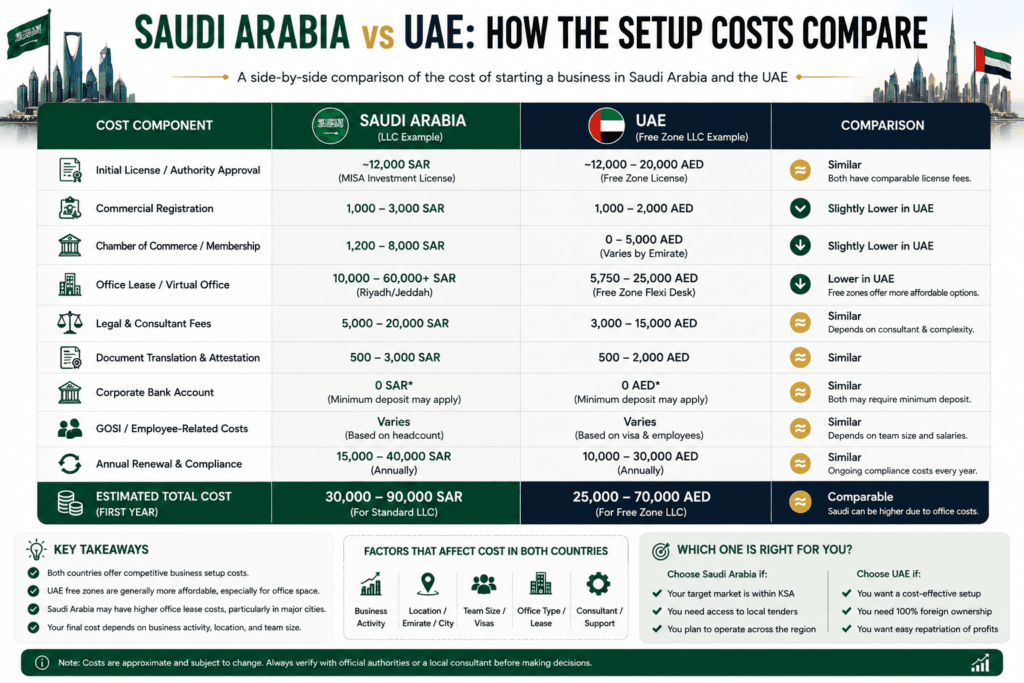
If you’re weighing both Gulf markets, here’s the honest comparison. The cost of starting a business in Saudi Arabia and the cost of setting up in the UAE land in a broadly similar range for a standard small business, but the fee structure differs.
- UAE free zones often advertise lower headline license fees (some starting around AED 5,750, roughly 5,900 SAR), but many free zone packages restrict you to operating only within the zone or internationally, not directly in the local UAE market.
- Saudi Arabia’s MISA + Commercial Registration route gives you full mainland market access from day one, without the free zone vs mainland decision UAE founders have to navigate.
- UAE mainland licensing (the closest equivalent to Saudi’s standard setup) typically costs more than free zone options and lands in a similar range to the cost of starting a business in Saudi Arabia.
- Ongoing costs are comparable in both markets — annual license renewals, office costs, and visa/employee costs apply in both the UAE and Saudi Arabia.
Bottom line: don’t pick a market based on setup cost alone — the cost of starting a business in Saudi Arabia and in the UAE are close enough that market opportunity, client base, and long-term strategy should drive the decision, not a few thousand SAR or AED difference in registration fees.
Not sure what your UAE setup will actually cost?
Use our free calculator to get an instant, itemized breakdown — license, visa, and office fees, in your own currency.
Common Mistakes When Budgeting for Saudi Arabia
- Treating the cost of starting a business in Saudi Arabia as a one-time number. Annual renewals catch founders off guard every single year if they’re not planned for.
- Underestimating office costs. Founders budget for the cheapest virtual office option, then realize their activity or client expectations require a real commercial address.
- Skipping the legal consultant to save money. A rejected MISA application due to bad documentation often costs more in lost time than the consultant fee would have.
- Ignoring employee-related costs until hiring starts. GOSI, Iqama fees, and Saudization compliance costs should be modeled before you commit to a headcount, not after.
- Not comparing entity types before budgeting. The cost of starting a business in Saudi Arabia shifts meaningfully depending on whether you choose an LLC or a branch office, so this decision should come before your final budget, not after.
- Forgetting currency transfer costs. Founders budget the exact SAR figures from this guide, then get surprised by international wire fees and exchange spreads eating into their available capital once it actually lands in Saudi Arabia.
- Assuming Riyadh pricing applies everywhere. Office cost estimates found online often reflect Riyadh rates specifically — applying those numbers to a Dammam or Jeddah setup can lead to over-budgeting by a wide margin.
Your Saudia Arabia Business Journey Starts Here
From free AI-powered planning tools to everything else we’ve built for entrepreneurs — explore what ibraida.com has to offer.
💚 100% free — no signup required to browse
How to Reduce the Cost of Starting a Business in Saudi Arabia
- Start with a virtual office if your activity doesn’t require a physical storefront or facility.
- Handle simple, non-regulated MISA applications yourself instead of paying full consultant fees.
- Declare the minimum viable capital your activity requires rather than over-capitalizing early.
- Bundle legal, translation, and notarization services with one provider instead of paying separately for each.
- Delay hiring until your revenue can absorb GOSI and payroll costs, rather than over-hiring at launch.
Currency, Payments & Repatriating Profits
One part of the cost of starting a business in Saudi Arabia that rarely makes it into standard checklists is currency handling. The Saudi Riyal (SAR) has been pegged to the US Dollar for decades, which actually works in your favor if you’re transferring capital from USD-based accounts — exchange rate volatility isn’t the risk it would be with a floating currency. If you’re transferring from PKR, GBP, or CAD, though, budget for standard international transfer fees and a realistic exchange spread, since banks rarely offer the exact mid-market rate.
- International wire fees typically run 0.5%–2% of the transferred amount, depending on your home bank and the receiving Saudi bank.
- SWIFT transfers remain the standard method for moving initial capital into your new corporate account, though some banks now support faster digital transfer rails for established relationships.
- Repatriating profits back to your home country as a foreign shareholder is generally permitted under Saudi investment regulations, but confirm your specific bank’s documentation requirements for outbound transfers once you’re operational.
- Keep a currency buffer in your initial budget — a 3–5% cushion for exchange rate movement and transfer fees prevents a shortfall between what you planned to send and what actually lands in your Saudi account.
None of this dramatically changes the cost of starting a business in Saudi Arabia, but it’s the kind of detail that causes a few thousand SAR of unplanned slippage if you don’t account for it upfront — exactly the sort of gap that turns a clean budget into a stressful scramble in week three.
Saudi Arabia Business Setup Cluster
Not Sure Where to Start? Read the Complete Guide First
This article is part of our full Saudi Arabia business setup series. If you haven’t already, start with our complete step-by-step pillar guide covering MISA licensing, costs, entity types, documents, and everything else you need to launch in 2026-2027.
Read the Full Step-by-Step Guide →Frequently Asked Questions
What is the average cost of starting a business in Saudi Arabia?
For a standard LLC in a non-regulated sector, the average cost of starting a business in Saudi Arabia falls between 30,000 and 90,000 SAR in the first year, including licensing, registration, office, and legal fees.
Is the cost of starting a business in Saudi Arabia higher for foreigners than locals?
Foreign investors pay the MISA Investment License fee, which Saudi nationals don’t need, so yes — the cost of starting a business in Saudi Arabia is somewhat higher for foreign-owned companies, primarily due to this one additional license.
Are there any government incentives that reduce setup costs?
Yes. Priority sectors under Vision 2030 — renewable energy, tourism, logistics, and technology — sometimes qualify for reduced fees or fast-tracked approvals that can lower the overall cost of starting a business in Saudi Arabia.
Does the cost of starting a business in Saudi Arabia include visa costs for employees?
No, standard company registration costs don’t include employee visa or Iqama fees. These are separate, ongoing costs that apply once you start hiring.
Is it cheaper to register an LLC or a branch office?
They’re close. An LLC pays more upfront for Articles of Association drafting, while a branch office pays more for parent company document legalization — the overall cost of starting a business in Saudi Arabia is similar either way.
Can I reduce the cost of starting a business in Saudi Arabia by skipping a consultant?
You can, if your activity is straightforward and you’re comfortable navigating government portals yourself. For regulated sectors or complex ownership structures, skipping professional help often costs more in delays than it saves.
Does the cost of starting a business in Saudi Arabia vary by city?
The core registration fees (MISA, Commercial Registration, Chamber of Commerce) stay the same nationwide, but office costs vary significantly — Riyadh runs highest, while Dammam and the Eastern Province are generally more affordable.
Is there a way to get an accurate quote before applying?
Most local legal consultants and business setup firms offer free initial consultations where they’ll estimate the cost of starting a business in Saudi Arabia based on your specific activity, giving you a more precise number than general ranges before you commit.
How much should I budget for the second year of operations?
Year two is typically lighter than year one since you skip one-time setup costs like Articles of Association drafting. Expect roughly 15,000–40,000 SAR annually for license renewals, office costs, and compliance, depending on your activity and headcount.
UAE Business Setup Cluster
Thinking About the UAE Instead? Read Our Complete Guide
If you’re comparing Saudi Arabia against the UAE, start with our full step-by-step guide covering free zones, mainland licensing, costs, visas, and everything else you need to launch in Dubai in 2026-2027.
Read the UAE Step-by-Step Guide →More From Our UAE Business Setup Series
- How to Start a Business in UAE: Complete Step-by-Step Guide (Pillar)
- Dubai Free Zones Guide 2026-2027: Complete List & Comparison
- Dubai Mainland License Guide 2026-2027
- Dubai Business Setup Cost Calculator & Comparison 2026-2027
- How to Open a Business Bank Account in Dubai 2026-2027
- UAE Corporate Tax Guide for Small Businesses 2026-2027
- UAE Golden Visa Guide 2026-2027: Requirements & Process
- Dubai Freelance Visa & Permit Guide 2026-2027
- Business Setup in Dubai for Pakistani Citizens: Complete Guide
- How to Start a Business in Dubai from the USA
- Best Business Ideas in Dubai 2026-2027
Final Thoughts
The cost of starting a business in Saudi Arabia isn’t a mystery once you break it down line by line — MISA license, Commercial Registration, office, legal fees, and the ongoing costs that follow. Budget for the full first year, not just the registration paperwork, and you’ll avoid the surprise expenses that catch most first-time founders off guard. If you haven’t already, pair this with our complete step-by-step setup guide and our LLC vs Branch Office breakdown to plan your entire launch, not just the budget.
References
- Enterprise Hub — How to Start a Business in Saudi Arabia as a Foreigner: 2026 Strategic Guide
- European Business Review — Complete Guide to Business Setup in Saudi Arabia (2026)
- TASC Outsourcing — Business Setup in Saudi Arabia for Foreign Investors 2026
- EBDA — How to Start a Business in Saudi Arabia for Foreigners
- Setup in Saudi — Subsidiary (LLC) vs Branch Office Cost Comparison
- Arab Future — Foreign Investment License Requirements in Saudi Arabia 2026
- Remitly — Doing Business in Saudi Arabia: Small Business Guide
Disclaimer
This article is for general informational purposes only and does not constitute legal, financial, tax, or immigration advice. Business setup regulations, government fees, and licensing requirements in Saudi Arabia can change without notice, and figures mentioned here are estimates based on research at the time of publishing. Before making any business decisions, please verify current requirements directly with MISA, the Ministry of Commerce, ZATCA, or a licensed local legal/financial consultant. ibraida.com and the author accept no liability for actions taken based on the information in this article.


Publix Business Model: 5 Lessons Entrepreneurs Can Learn
Business Models Publix If you’ve been anywhere near social media or the news this week, there’s a good chance you’ve seen the name Publix pop up. It’s not a tech startup, it’s not a UAE free zone, and it’s definitely not something you’d expect to find on a site about business setup in Dubai or…
75 Easiest Startup Businesses to Launch in AI World
STARTUP 75 Easiest Startup Businesses Every year, thousands of people decide “this is the year I finally start my own business” — and most of them never actually do it, because they assume it takes a large budget or a technical skill set they don’t have. That assumption doesn’t really hold up anymore. AI tools…
YCombinator Companies: The Complete Guide to YC Startups, Unicorns, and Success Stories
Business Models ycombinator companies Y Combinator has become one of the most influential startup accelerators in the world. Whenever entrepreneurs discuss startup success stories, venture capital funding, unicorn companies, or the future of technology, the conversation often leads back to ycombinator companies. Since its launch in 2005, Y Combinator has helped thousands of startups scale…