If you are a foreign entrepreneur planning to enter the Saudi market, the very first document standing between you and a legally operating company is the MISA investment license. Issued by the Ministry of Investment of Saudi Arabia, this license is what allows a non-Saudi individual or company to own, register, and run a business inside the Kingdom — with up to 100% foreign ownership in most sectors. A lot of founders assume it works like a regular trade license, apply without preparing the right documents, and end up stuck for weeks waiting on corrections. This guide breaks down exactly what a MISA investment license Saudi Arabia authorities require in 2026-2027, what it costs, how long it takes, and where investors commonly go wrong, so you can apply once and get it right — without paying an agency thousands of riyals just to explain the basics.
We’ll also cover how the license fits into the bigger picture of setting up in the Kingdom, because getting the MISA investment license approved is only step one. What you do afterward — Commercial Registration, banking, Saudization planning — determines whether the business actually gets off the ground on schedule.
Table of Contents
What Is a MISA Investment License?
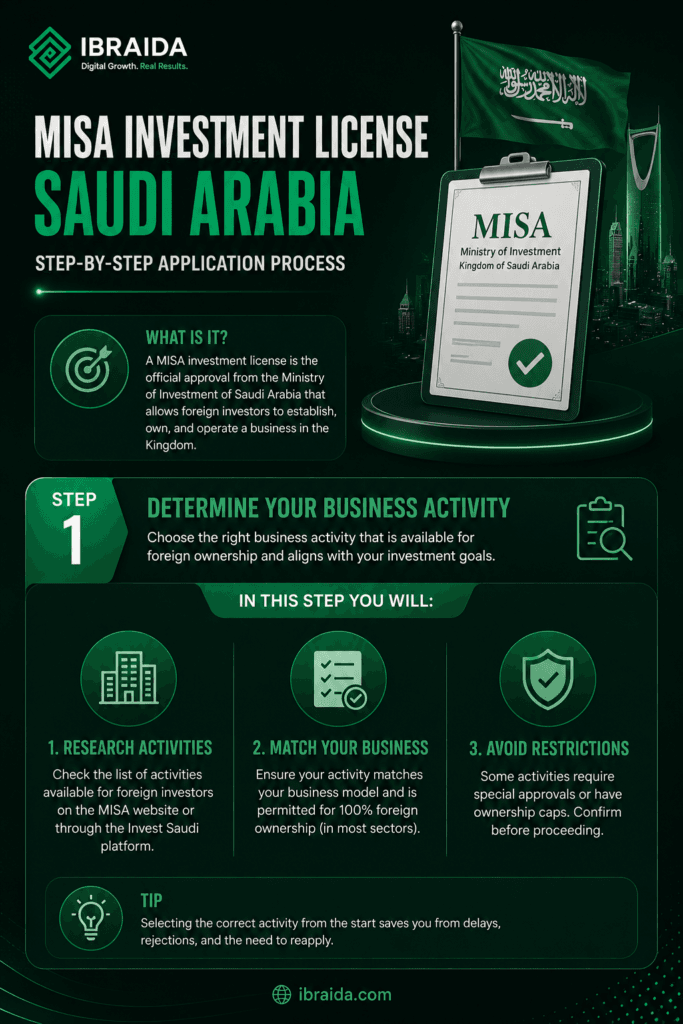
A MISA investment license Saudi Arabia grants is the official approval issued by the Ministry of Investment of Saudi Arabia (formerly SAGIA, the Saudi Arabian General Investment Authority) that permits a foreign investor to establish, own, or operate a business inside the Kingdom. Without it, a non-Saudi cannot legally hold shares in a Saudi company, open a branch of a foreign entity, or issue a Commercial Registration (CR) — the license is effectively the legal gateway that every foreign investor must pass through before anything else in the setup process can happen.
Once granted, the license enables the investor to:
- Issue a Commercial Registration (CR) with the Ministry of Commerce
- Open a corporate bank account in Saudi Arabia
- Sponsor employee visas and Iqamas (residency permits)
- Register with the Chamber of Commerce and access government tenders
- Apply for an investor residency visa in the founder’s own name
Saudi Arabia’s investment framework has moved steadily toward full foreign ownership across most sectors as part of Vision 2030, and the MISA investment license Saudi Arabia issues is the mechanism through which that ownership is formally recognized.
Who Can Apply for a MISA Investment License?
Almost any foreign individual or entity can apply for a MISA investment license Saudi Arabia grants, provided the intended business activity falls within a sector that is currently open to foreign ownership. In practice, applicants fall into a few broad groups:
- Existing foreign companies looking to open a branch office or a wholly-owned subsidiary in Saudi Arabia
- Individual foreign investors forming a new company, either solo or with partners
- Joint ventures between a foreign investor and a Saudi national or company
- Startups and solo founders applying under the entrepreneur license route, typically backed by a patent, venture capital funding, or a recognized incubator
- GCC nationals and companies, who in some cases face lighter requirements depending on the activity
There is no restriction based on nationality, so Pakistani, Indian, UK, US, and Canadian investors are all eligible to apply on equal footing, as long as the underlying activity, capital, and documentation requirements are met. if you want to read about freelance license there is full guide for you
Why Foreign Investors Need a MISA License
Under Saudi commercial law, no foreign individual or company can hold equity in a Saudi-registered entity, or open a branch office, without first securing MISA’s approval. This applies whether you are setting up a fully foreign-owned LLC, entering a joint venture with a Saudi partner, opening a branch of an existing company, or launching a solo entrepreneurial venture. Operating without one — or continuing to operate on an expired one — blocks access to banking, government portals, visa issuance, and the Chamber of Commerce, and can expose the business to penalties under Saudi Arabia’s anti-concealment (anti-cover-up) regulations, which are enforced strictly against unlicensed foreign involvement in local companies.
For Pakistani entrepreneurs and other foreign nationals eyeing the Saudi market, the MISA investment license is also what unlocks the country’s most attractive incentives: reduced restrictions on ownership, access to Vision 2030-aligned sectors, and in many cases, a faster and more transparent process than what was available under the old SAGIA system.
It’s also worth noting that a MISA investment license Saudi Arabia issues is entity-specific — it’s tied to the exact company, shareholders, and activity named in the application. If ownership or activity changes later, an amendment through MISA is required rather than a fresh registration, which is generally faster but still needs to be filed promptly to stay compliant.
Saudi Arabia Business Setup Cluster
Not Sure Where to Start? Read the Complete Guide First
This article is part of our full Saudi Arabia business setup series. If you haven’t already, start with our complete step-by-step pillar guide covering MISA licensing, costs, entity types, documents, and everything else you need to launch in 2026-2027.
Read the Full Step-by-Step Guide →Types of MISA Investment Licenses
MISA issues several categories of licenses, and choosing the correct MISA investment license Saudi Arabia category depends entirely on the business activity you plan to register. Applying under the wrong category is one of the most common reasons applications get delayed or rejected.
| License Type | Best Suited For | Key Notes |
|---|---|---|
| Service License | Consulting, IT, marketing, engineering, tech and other B2B service businesses | The most commonly issued category; broad activity coverage |
| Trading (Commercial) License | Import, export, wholesale, and retail activities | May involve minimum capital and, for some retail activities, phased ownership rules |
| Industrial License | Manufacturing and production facilities | Requires additional approvals from sector regulators; longer processing time |
| Entrepreneur License | Startups with a patented idea, VC backing, or a support letter from an approved incubator (MISA, PIF, KAUST, TDF) | Reduced fees and simplified documentation compared to the standard route |
| Real Estate License | Foreign real estate development companies | Typically requires a minimum project value and is restricted outside Makkah and Madinah |
| Agricultural License | Farming, aquaculture, and agri-tech ventures | Subject to Ministry of Environment, Water and Agriculture oversight |
| Professional License | Individuals or firms offering specialised, credential-based services | May require proof of professional qualification or accreditation |
| Mining License | Exploration and extraction activities | Joint review with the Ministry of Industry and Mineral Resources |
Beyond these eight core categories, MISA also processes branch office registrations for existing foreign companies and Regional Headquarters (RHQ) licenses for multinationals relocating their regional base to Riyadh.
2025-2026 MISA Regulatory Changes You Should Know
Anyone researching a MISA investment license Saudi Arabia issued even two years ago should treat that information as outdated, because the framework has shifted meaningfully. In February 2025, MISA replaced the older activity-by-activity “Investment License” model with a Unified Investment Registration system. Under the new approach, investors no longer need a separate license for every individual activity — related activities can typically be consolidated under one registration, which cuts down on both paperwork and renewal complexity.
Other changes worth knowing before you apply in 2026-2027:
- Greater parity between local and foreign investors in terms of legal protections and obligations
- Strengthened investment protection guarantees, aimed at giving foreign investors more legal certainty around asset protection and dispute resolution
- New incentive programs tied to priority sectors under Vision 2030, including tax relief and streamlined approvals for strategic industries
- Periodic fee adjustments — MISA has waived or reduced fees for entrepreneur and general licenses at various points over the past two years, so the cost figures in this guide should always be cross-checked against the live MISA portal
The takeaway for anyone applying for a MISA investment license Saudi Arabia currently offers is simple: verify the current rules directly with MISA or a licensed consultant before finalizing your business plan, since regulations here move faster than most other GCC jurisdictions.
AI Business OS — Notion Dashboard
A complete 12-module Notion system to run your entire business from one place — clients, projects, finances, and content, fully linked and ready to use.
- Clients CRM & Projects tracker
- Finance, Invoices & Subscriptions Tracker
- AI Prompt Vault & SOP Library
- Goals, OKRs & Content Planner
- Instant Gumroad delivery — duplicate and start today
MISA Investment License Requirements 2026-2027
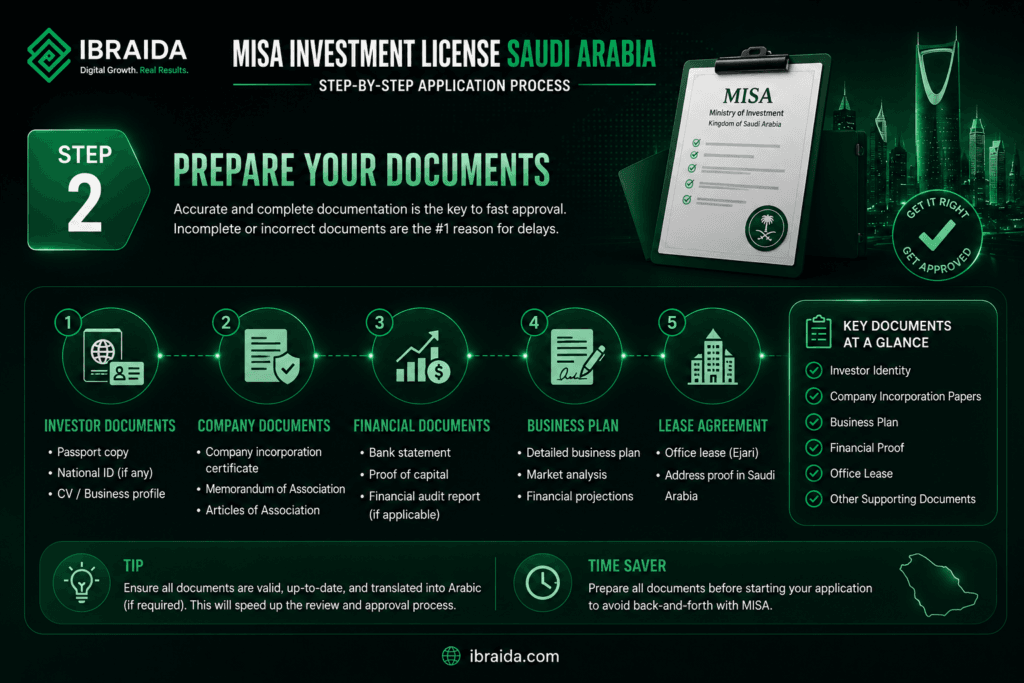
Documentation requirements shift slightly depending on the license type and legal structure you choose, but for a standard MISA investment license application, you should be ready with the following:
- Passport copies of all shareholders, partners, or directors
- Certificate of Incorporation of the parent/home-country company, attested and translated into Arabic
- Memorandum and Articles of Association, legalized in the country of origin
- Audited financial statements of the parent company for the last fiscal year (some license categories require proof of minimum financial standing)
- Power of Attorney authorizing a representative to submit and manage the application in Saudi Arabia
- A detailed business plan outlining the proposed activity, ownership structure, and investment scope
- Board resolution approving the establishment of a Saudi entity or branch
- Bank reference letter confirming the financial standing of the investor
Alongside the paperwork, MISA also evaluates a few qualitative factors before approval:
- Permitted activity: the business activity must fall within sectors currently open to foreign investment
- Capital adequacy: some categories carry minimum capital thresholds depending on the sector
- Regulatory compliance: the applicant and parent company must have a clean compliance record, with no history of commercial concealment violations
- Business reputation: a credible track record strengthens the application, particularly for larger investment categories
All foreign-issued documents typically need notarization and Ministry of Foreign Affairs attestation (or apostille, where applicable) in the country of origin, plus certified Arabic translation before submission to MISA.
MISA License Cost Breakdown
Government fee structures for a MISA investment license Saudi Arabia authorities charge have changed more than once over the past few years, and MISA has periodically waived certain fees to attract foreign capital, so always confirm the live figures on the MISA e-Services portal before budgeting. As of 2026, the typical structure looks like this:
Founders often ask whether the MISA investment license cost is a one-time payment or a recurring one — it’s both. The issuance fee covers the license term you choose (up to five years), but the Investor Relations Center subscription renews annually and is usually the largest line item after the first year, so it deserves its own place in your cash-flow planning rather than being treated as a rounding error.
| Cost Item | Approximate Fee (SAR) | Notes |
|---|---|---|
| License issuance | ~2,000/year (up to 5 years) | Paid once for the chosen license duration |
| Investor Relations Center subscription (Year 1) | ~10,000 | Covers access to MISA’s investor support services |
| Investor Relations Center subscription (Year 2 onward) | ~60,000/year | Standard annual fee; entrepreneur license holders often pay significantly less |
| License amendment | ~2,000 + CR update fee | Applies when changing activity, ownership, or entity details |
| Commercial Registration (Ministry of Commerce) | 1,200-1,600 | Separate from MISA; required after license approval |
| Document attestation, translation, notarization | Varies | Depends on document volume and country of origin |
On top of these government line items, budget for legal consultation, PRO/agent service fees if you use a setup consultancy, office lease costs required for your national address, and visa and Iqama expenses once you start sponsoring employees. Entrepreneur-license applicants generally pay a fraction of the standard annual fee, which is one reason many first-time founders deliberately structure their application around that category when they qualify.
Step-by-Step MISA License Application Process
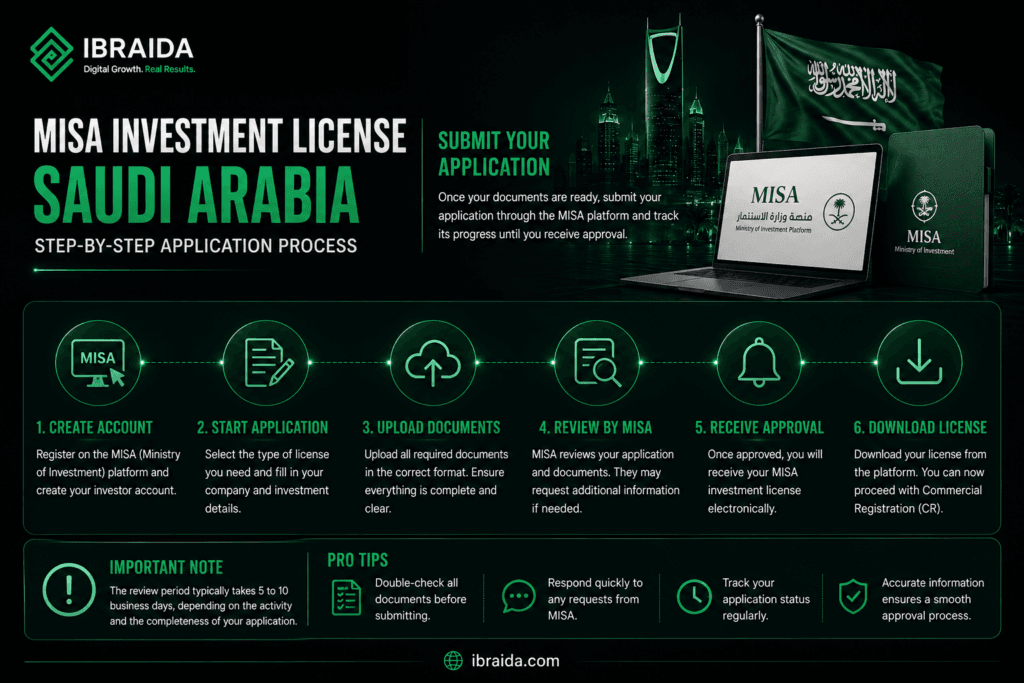
Applying for a MISA investment license Saudi Arabia is done almost entirely online through MISA’s investor portal. Here is the typical sequence:
- Determine eligibility and license category. Confirm your intended activity falls under an open sector and pick the correct license type (service, trading, industrial, entrepreneur, etc.).
- Prepare and attest documents. Collect passports, incorporation documents, financials, and Power of Attorney, then get them notarized, apostilled/legalized, and translated into Arabic.
- Create a MISA investor account. Register on the MISA e-Services portal using the applicant’s or authorized representative’s credentials.
- Submit the application. Upload all required documents, select the license type, and fill in company and shareholder details.
- Pay the applicable fees. Government charges are settled electronically once the application is reviewed and accepted for processing.
- Respond to MISA queries. If any document is unclear or incomplete, MISA will request clarification — delayed responses are the single biggest cause of processing slowdowns.
- Receive the MISA investment license. Once approved, the license is issued digitally through the portal.
- Proceed to Commercial Registration. Use the license to register with the Ministry of Commerce, open a corporate bank account, and begin operational setup.
MISA License Processing Time
Processing time for a MISA investment license Saudi Arabia authorities issue typically ranges from 3 to 15 working days once a complete, error-free application is submitted. Straightforward service or trading license applications with clean documentation are often approved within a week; industrial, real estate, and mining licenses tend to take longer because they require sign-off from additional sector regulators. Missing attestations, mismatched company names across documents, or an unclear business plan are the most common reasons an otherwise fast application stretches into several weeks.
As a rough timeline reference, a well-prepared MISA investment license application, followed immediately by Commercial Registration, national address setup, and bank account opening, can realistically have a foreign-owned company operational in Saudi Arabia within four to six weeks from the day documents are first submitted.
Pros and Cons of Getting a MISA Investment License
Before committing capital and time to the process, it helps to weigh what the license genuinely unlocks against the ongoing obligations that come with it.
Pros
- Full foreign ownership: most sectors allow 100% foreign ownership with no requirement for a local Saudi partner
- Access to a large, high-purchasing-power market: Saudi Arabia is the largest economy in the GCC, with direct access to regional trade
- Investor residency visas: license holders and their families can obtain long-term residency tied to the business
- Government incentives: Vision 2030-aligned sectors benefit from tax incentives, customs exemptions, and support programs
- Credibility: a MISA-licensed entity can bid on government tenders and build banking relationships that unlicensed operators cannot
Cons
- Ongoing annual costs: the Investor Relations Center subscription rises significantly from the second year onward for standard licenses
- Document-heavy process: attestation, translation, and notarization requirements add real time and cost, particularly for multi-shareholder companies
- Saudization obligations: most license categories require hiring a minimum percentage of Saudi nationals, which affects hiring plans
- Sector restrictions: some activities still require a Saudi partner or face capped foreign ownership, and operations in Makkah and Madinah face added limits
- Renewal risk: letting the license lapse freezes the Commercial Registration and can block banking access and visa renewals until it’s reinstated
Common Mistakes to Avoid When Applying
- Choosing the wrong license category for the actual business activity, which forces a costly amendment later
- Submitting financial documents that aren’t properly attested or translated into Arabic
- Underestimating the annual Investor Relations Center fee when budgeting cash flow for year two
- Assuming a MISA investment license Saudi Arabia issues is enough to start trading on its own — a Commercial Registration and, in many cases, municipal and Chamber of Commerce registrations still need to follow
- Letting the license lapse near its expiry date instead of starting renewal at least 60 days in advance
MISA License vs Commercial Registration: What’s the Difference?
These two documents are often confused, but they serve different purposes. The MISA investment license Saudi Arabia issues is the foreign-investment approval — it is what permits a non-Saudi to own or operate a business in the first place. The Commercial Registration (CR), issued separately by the Ministry of Commerce, is the operating license that lists your company’s approved activities and legal structure once MISA has cleared the ownership. In practical terms, the MISA license comes first; the CR follows immediately after, and both are needed before you can open a bank account, hire staff, or sign commercial contracts in Saudi Arabia.
If you are still deciding between structuring your entry through a wholly foreign-owned LLC or a branch office, it’s worth reading our guide on setting up an LLC in Saudi Arabia before locking in your license category, since the entity structure directly affects which MISA license type fits your business.
MISA License for Pakistani and South Asian Investors
Saudi Arabia has become one of the most practical entry points into the Gulf for Pakistani entrepreneurs, largely because of geographic proximity, an established expat community, and a MISA investment license Saudi Arabia process that treats Pakistani applicants no differently than investors from anywhere else in the world. That said, a few things are worth planning for specifically:
- Document attestation from Pakistan takes longer than from some other countries — factor in extra time for MOFA attestation and embassy legalization of your incorporation documents
- Bank reference letters from Pakistani banks are generally accepted, but should be issued in English or accompanied by a certified translation
- Capital transfer from Pakistan to Saudi Arabia for share capital should go through proper banking channels to avoid delays during MISA’s financial review
- Combining a MISA license with an investor visa lets Pakistani founders relocate to Saudi Arabia and sponsor family members once the Commercial Registration is active
If you’re comparing Saudi Arabia against Dubai or the wider UAE for your first Gulf entity, our Saudi Arabia business setup guide for Pakistani citizens and Dubai business setup checklist walk through the cost and process differences side by side, which is often the deciding factor for first-time founders choosing between the two markets.
UAE Business Setup Cluster
Thinking About the UAE Instead? Read Our Complete Guide
If you’re comparing Saudi Arabia against the UAE, start with our full step-by-step guide covering free zones, mainland licensing, costs, visas, and everything else you need to launch in Dubai in 2026-2027.
Read the UAE Step-by-Step Guide →More From Our UAE Business Setup Series
- How to Start a Business in UAE: Complete Step-by-Step Guide (Pillar)
- Dubai Free Zones Guide 2026-2027: Complete List & Comparison
- Dubai Mainland License Guide 2026-2027
- Dubai Business Setup Cost Calculator & Comparison 2026-2027
- How to Open a Business Bank Account in Dubai 2026-2027
- UAE Corporate Tax Guide for Small Businesses 2026-2027
- UAE Golden Visa Guide 2026-2027: Requirements & Process
- Dubai Freelance Visa & Permit Guide 2026-2027
- Business Setup in Dubai for Pakistani Citizens: Complete Guide
- How to Start a Business in Dubai from the USA
- Best Business Ideas in Dubai 2026-2027
References
- Ministry of Investment of Saudi Arabia (MISA) – Official Portal
- Ministry of Commerce, Saudi Arabia – Commercial Registration Services
- Saudi Arabian General Investment Authority (SAGIA) Legacy Portal
- Saudi Vision 2030 – Official Site
- Zakat, Tax and Customs Authority (ZATCA) – Corporate Tax and VAT
- Ministry of Human Resources and Social Development – Saudization Rules
Related reading on ibraida.com: Saudi Arabia business setup cost for Pakistani entrepreneurs, How Pakistanis can start a business in Saudi Arabia, and our business setup cost calculator for comparing Gulf jurisdictions.
Conclusion
A MISA investment license Saudi Arabia grants is the single most important approval in your entire market-entry process — every other step, from Commercial Registration to banking to visas, depends on getting this one right first. The good news is that the process itself isn’t complicated once you understand it: pick the correct license category for your actual activity, get your documents properly attested and translated in advance, budget realistically for both the one-time issuance fee and the recurring annual subscription, and respond quickly if MISA comes back with a query. Most delays founders run into aren’t caused by MISA being slow — they’re caused by incomplete paperwork going in.
If you’re still deciding between Saudi Arabia and other Gulf markets, or want a full cost comparison before you commit, our related guides on Saudi Arabia and Dubai business setup linked above break down the numbers side by side so you can plan your entry with a clear budget instead of guesswork.
Frequently Asked Questions About the MISA Investment License
1. What is a MISA investment license Saudi Arabia used for?
It’s the legal approval that allows a foreign investor to own and operate a business in Saudi Arabia. It’s a prerequisite for issuing a Commercial Registration, opening a corporate bank account, and sponsoring employee visas.
2. How much does a MISA investment license Saudi Arabia cost in 2026?
Government fees typically include a license issuance fee of around SAR 2,000 per year, an Investor Relations Center subscription of roughly SAR 10,000 in year one and up to SAR 60,000 annually afterward, plus separate Commercial Registration and attestation costs. Entrepreneur license holders usually pay significantly less. Fees have been waived or reduced in recent periods, so always check the live rate on the MISA portal.
3. How long does it take to get a MISA license?
Most straightforward applications are approved within 3 to 15 working days once complete documentation is submitted. Industrial, mining, and real estate categories can take longer due to additional regulatory reviews.
4. Can a foreigner own 100% of a company in Saudi Arabia with a MISA license?
Yes, in most sectors. Saudi Arabia’s investment reforms under Vision 2030 have opened the majority of business activities to full foreign ownership, though a small number of sectors still require a Saudi partner or have ownership caps.
5. What’s the difference between a MISA license and Sagia license?
They’re the same thing under different names. SAGIA (Saudi Arabian General Investment Authority) was restructured into the Ministry of Investment of Saudi Arabia (MISA) in 2020, so any reference to a “Sagia license” today refers to what is now issued as a MISA investment license.
6. Do I need a Saudi partner to get a MISA license?
Not for most business activities — full foreign ownership is permitted. A small number of restricted sectors, and businesses operating in Makkah or Madinah, may still require a Saudi partner or additional approvals.
7. What happens if I don’t renew my MISA license on time?
An expired license freezes your Commercial Registration, blocks online banking and government portal access, disqualifies you from tenders, and prevents visa renewals until the license is reinstated. Renewal should start at least 60 days before expiry.
8. Can I apply for a MISA investment license without visiting Saudi Arabia?
Yes. The entire application for a MISA investment license Saudi Arabia processes is handled online through the MISA e-Services portal, and a Power of Attorney lets a local representative or consultant submit documents and respond to queries on your behalf. Most investors only need to travel once the license and Commercial Registration are active, to open the corporate bank account and complete Iqama formalities.
9. Which sectors are closed to foreign investment under MISA?
A small “negative list” of sectors remains restricted or closed to foreign ownership, including certain activities related to defense, real estate brokerage in Makkah and Madinah, and a handful of security-sensitive industries. MISA publishes the current negative list on its portal, and it’s worth checking before finalizing your business activity.
Disclaimer
This article is for general informational purposes only and does not constitute legal, financial, tax, or immigration advice. Business setup regulations, government fees, and licensing requirements in Saudi Arabia can change without notice, and figures mentioned here are estimates based on research at the time of publishing. Before making any business decisions, please verify current requirements directly with MISA, the Ministry of Commerce, ZATCA, or a licensed local legal/financial consultant. ibraida.com and the author accept no liability for actions taken based on the information in this article.