Last reviewed: July 2026
Learning how to start a business in UAE sounds intimidating at first, but the process itself isn’t the hard part — the hard part is finding a guide that gives you real numbers instead of vague promises. If you’ve spent any time researching this, you’ve probably noticed something: most guides read like they were written by the same template. Big promises about “tax-free” living, vague mentions of “free zones,” and not a single real number in sight.
This one’s different. It’s built around what actually happens when you register a company here in 2026 — the real costs, the paperwork nobody warns you about, and the tax rules that are about to change in 2027 for a lot of small businesses. If you’re planning to launch an online store, a trading company, a consultancy, or a small tech team, this should give you an honest picture before you spend a single dirham.
One thing worth saying upfront: rules around free zones, tax relief, and compliance in the UAE shift fairly often. The figures and thresholds below reflect the position as of mid-2026, but always cross-check current fees and deadlines against the official UAE government portal and the Federal Tax Authority’s EmaraTax services before you commit money — this article is a planning guide, not legal or tax advice.
Table of Contents
Why People Keep Choosing the UAE
There’s no single reason entrepreneurs pick the UAE — it’s usually a combination of a few things stacking up.
Location. Dubai and Abu Dhabi sit within an eight-hour flight of roughly two-thirds of the world’s population. For anyone doing trade, logistics, or import/export, that’s not a marketing line — it’s a genuine operational advantage.
Ownership. For most activities, you no longer need a local Emirati partner to own your company outright. That wasn’t always true — this changed through a series of reforms over the past several years, and it’s one of the biggest reasons foreign founders now register directly instead of going through a local sponsor.
Tax. There’s no personal income tax. Corporate tax exists since June 2023, but it’s structured so that the first AED 375,000 of taxable profit is taxed at 0%, and only the amount above that is taxed at 9%. Free zone companies that meet certain conditions can keep paying 0% on qualifying income. There’s more nuance here than most articles admit, so it gets its own section further down — because the rules are shifting for 2027, and if you’re building a business now, that matters.
Speed. A lot of free zones can issue a license in three to five working days once your paperwork is in order. That’s fast compared to most jurisdictions.
A genuinely diverse economy. Beyond oil and real estate, there’s real activity in tech, e-commerce, healthcare, education, renewable energy, and financial services — which means opportunities aren’t limited to a couple of “obvious” industries anymore.
Before You Register: Ask Yourself This
Before you figure out how to start a business in UAE, it’s tempting to jump straight to “which free zone is cheapest,” but that question comes later. First, be honest about a few things:
- Are your customers mostly inside the UAE, or spread internationally?
- Do you actually need a physical office, or would a flexi-desk work fine for the next year?
- Will you be sponsoring staff visas from month one, or starting solo?
- Does your business involve physical goods crossing borders — meaning customs registration?
- What’s your real first-year budget once you add visas, an office, and a bank account — not just the license fee you saw advertised?
Getting honest answers here saves you from picking a jurisdiction that looks cheap on paper but ends up costing more once visas and office requirements are factored in.
Mainland, Free Zone, or Offshore — Which One Actually Fits?
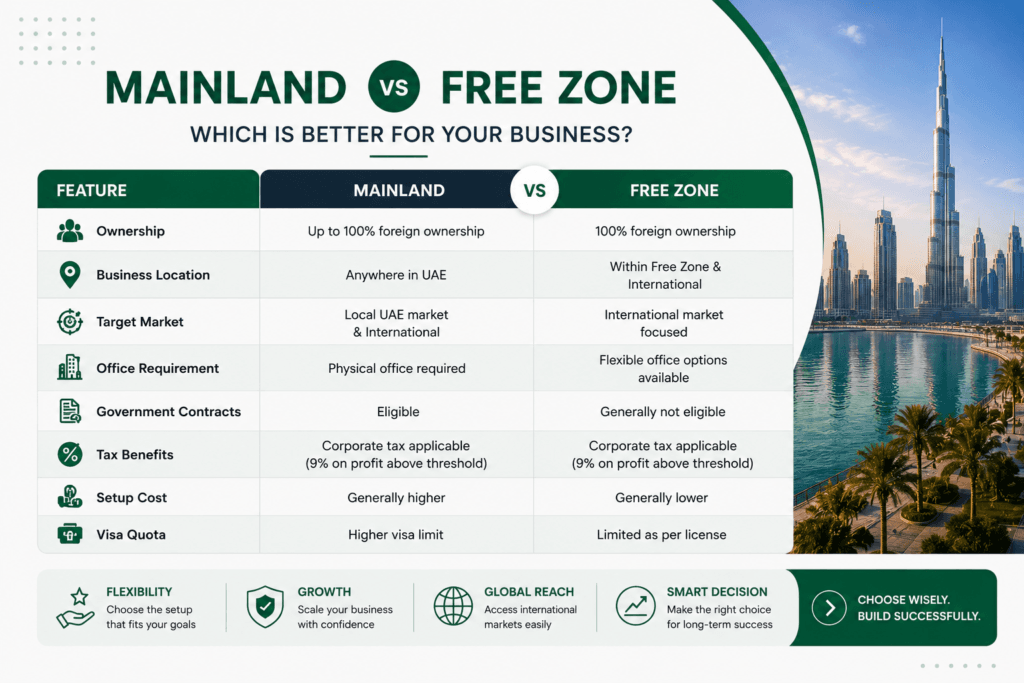
This is the decision that shapes almost everything else when you’re figuring out how to start a business in UAE: your costs, your market access, and how much flexibility you have later.
“For a complete breakdown of every Dubai free zone, see our Dubai Free Zone Guide“
| Jurisdiction | Market Access | Ownership | Office Requirement | Best Fit |
|---|---|---|---|---|
| Mainland | Full access to the UAE market, including government contracts | 100% foreign ownership for most activities | Physical office required | Businesses serving local UAE customers or bidding on government work |
| Free Zone | Operates within the zone and internationally; selling directly to mainland customers usually needs a distributor or dual license | 100% foreign ownership | Often flexible — a shared desk is usually enough | Startups, freelancers, consultants, e-commerce, international trade |
| Offshore | No direct UAE trading — used for holding structures | 100% foreign ownership | None; no visa eligibility either | Holding companies, IP holding, asset structuring |
A quick reality check on each:
Mainland companies are licensed through the relevant emirate’s Department of Economic Development. If your plan involves walk-in customers, retail, or contracts with government entities, this is generally the only route that works cleanly.
Free zones are where most first-time founders end up, and for good reason — there are more than 50 of them across the UAE (IFZA, SPC Free Zone, RAKEZ, DMCC, Meydan, SHAMS, and Ajman Free Zone are among the more commonly used ones), and they’re built specifically to make setup fast and foreign-ownership-friendly.
Offshore structures — through providers like RAK ICC or JAFZA Offshore — aren’t really for “starting a business” in the operational sense. They’re for holding assets, IP, or running international activity that never touches the UAE market directly.
What Legal Structure Should You Actually Register?
| Structure | Best For | Ownership | Liability |
|---|---|---|---|
| Sole Establishment | Individual professionals | Single owner | Unlimited |
| Limited Liability Company (LLC) | Most commercial businesses | One or more owners | Limited |
| Civil Company | Professionals, consultancies | Multiple partners | Depends on the agreement |
| Branch Office | Foreign companies expanding in | Parent company | Parent company is liable |
| Free Zone Company (FZE/FZC) | International or startup businesses | 100% foreign ownership | Limited |
For most people reading this, the real choice comes down to two options: a Free Zone Company if you’re serving international clients, freelancing, or running e-commerce — or a Mainland LLC if your customers are physically in the UAE.
How to Start a Business in UAE: The Registration Process, Step by Step
- Pick your business activity. The UAE licenses by specific activity code, and this single choice determines your license category, which approvals you’ll need, and which free zones or authorities you’re even eligible to register under.
- Choose jurisdiction and structure based on the tables above.
- Reserve your trade name — expect to pay somewhere between AED 620 and AED 2,000, depending on how common or unique the name is.
- Get initial approval from your chosen free zone authority or the Department of Economic Development.
- Draft and attest your Memorandum of Association, if your structure requires one — LLCs and civil companies generally do.
- Lock in your office or flexi-desk. Mainland requires a real physical address; most free zones will accept a shared desk, but you still need something on record to sponsor visas later.
- Pay the license fee and get your trade license issued.
- Apply for an establishment card, which is what allows you to sponsor visas.
- Start the visa process — your own investor visa first, then employee visas, including the medical test and Emirates ID.
- Open a corporate bank account. This is, honestly, the step that trips people up most. UAE banks have tightened compliance checks significantly, especially for free zone companies and virtual office setups. Have your business plan and source-of-funds documentation ready before you even book the appointment.
- Register for corporate tax, and VAT if applicable, through the Federal Tax Authority’s EmaraTax portal.
What It Actually Costs to Start a Business in UAE in 2026
This is usually where guides get vague. Here’s what things actually run.
License Fees by Jurisdiction (Approximate, AED/Year)
| Jurisdiction/Zone | Typical License Cost |
|---|---|
| Ajman Free Zone | From ~4,900–5,000 (zero-visa packages) |
| SPC Free Zone (Sharjah) | From ~5,750–5,760 |
| SHAMS Free Zone | From ~5,750 |
| RAKEZ | From ~9,500 |
| IFZA (Dubai) | ~10,000–30,000 |
| Dubai Mainland (DED) | ~12,000–25,000+ |
| Abu Dhabi Mainland (select activities) | From ~1,000 |
Costs That Rarely Make It Into the “Advertised Price”
- Trade name registration: AED 620–2,000
- Establishment card: AED 1,800–2,000
- Visa, per person: AED 3,500–4,800, plus medical test and Emirates ID
- Office or flexi-desk: AED 8,000–50,000/year, depending on location
- Extra approvals for regulated activities (health, food, education): AED 500–3,000
- Setup agent or consultancy fees, if you use one: AED 3,000–8,000
What a Realistic First Year Looks Like
- Solo freelancer, zero-visa free zone setup: roughly AED 8,000–19,000
- Small e-commerce business with 2–3 visas: roughly AED 35,000–45,000
- Mainland trading company with an office and 2 visas: roughly AED 90,000–115,000
Renewals typically cost 70–100% of the original license fee each year — worth planning for beyond just year one.
Documents You’ll Actually Be Asked For
- Passport copies of every shareholder and director, valid for at least six months
- Passport-size photos on a plain white background
- The completed application form from your chosen authority
- Proof of address — a recent utility bill or bank statement usually works
- A short business plan or activity description, especially for regulated sectors like health or finance
- An NOC from your current sponsor, if you’re already a UAE resident on someone else’s visa
- Attested MOA/AOA for LLCs and civil companies
- Board resolution and power of attorney, if the shareholder is a company rather than an individual
Digital, clear scans are usually fine at the application stage. Originals tend to get requested later, during visa processing and bank onboarding.
Realistic Timeline
- Trade name reservation and initial approval: 1–2 working days
- License issuance: 3–5 working days, once your paperwork is complete
- Establishment card: 2–3 working days
- Investor visa, including medical and Emirates ID: 1–2 weeks
- Corporate bank account: 2–6 weeks, depending on the bank’s compliance review
Most founders are licensed and technically “open” within two to three weeks. The bank account is almost always the slowest part — start that conversation as early as your license allows.
Corporate Tax: What Changes Between 2026 and 2027
This is the part that’s genuinely shifting, and it’s worth reading carefully if you’re planning past this year.
Where things stand right now (2026): – 0% on taxable income up to AED 375,000 – 9% on taxable income above that threshold – Free zone companies that qualify as a “Qualifying Free Zone Person” can keep a 0% rate on qualifying income, provided they maintain real substance in the zone and their income meets the qualifying conditions – Large multinationals — those with global revenues of €750 million or more — have also been subject to a separate 15% Domestic Minimum Top-up Tax since January 2025, aligning the UAE with OECD Pillar Two rules. This one doesn’t affect small or mid-sized businesses, but it’s part of why the UAE’s tax system is getting more structured, not less – Small Business Relief currently lets resident businesses with revenue of AED 3 million or less elect to be treated as having zero taxable income for the period
What’s changing for 2027: Small Business Relief, as it exists now, is a transitional measure — it applies only through tax periods ending on or before 31 December 2026. From 1 January 2027 onward, businesses that have relied on it will need to file and calculate corporate tax under the standard rules, which also means maintaining proper bookkeeping, transfer pricing documentation where relevant, and full tax accounting — not just a simplified zero-tax election.
If your business has been leaning on Small Business Relief to avoid dealing with formal tax accounting, 2027 is when that changes. The practical move is to start building proper books now — invoicing systems, expense tracking, and ideally an accountant or tax agent who understands UAE corporate tax — so you’re not scrambling in early 2027.
There’s also a broader compliance shift running in parallel: e-invoicing is being rolled out in phases through 2026 and 2027, and businesses should expect this to become a standard requirement rather than an optional upgrade.
Registration is never optional, regardless of whether tax is owed. Every taxable business needs a Tax Registration Number and must file, even at 0%. VAT registration is separate and generally kicks in once taxable turnover passes AED 375,000 a year.
If your revenue is anywhere near these thresholds, it’s worth a short consultation with a UAE-based tax agent rather than guessing — the penalties for late registration apply even when no tax is actually due. The Federal Tax Authority’s corporate tax page has the current thresholds and filing deadlines if you want to verify anything here directly.
What Kind of Business Actually Works Here
- E-commerce — local or global online stores, usually under a free zone commercial license
- Trading companies — import/export, leaning on the UAE’s ports and logistics network
- Digital marketing and creative agencies — SEO, content, branding, paid media
- IT, SaaS, and AI companies — software and cloud services under a professional or commercial license
- Consultancies — finance, HR, legal, strategy, usually under a civil company or free zone professional license
- Tourism and hospitality — tour operators, travel planning, events
- Restaurants and cafés — food and beverage, which comes with extra municipal and health approvals
- Freelance permits — available in several free zones for individual designers, writers, developers, and consultants working solo
Where People Actually Lose Money
- Picking the cheapest license without checking activity scope. If the license doesn’t technically cover what you’re doing, you’ll pay amendment fees to fix it later — often more than the difference you saved.
- Comparing free zones on license price alone. A “cheap” license paired with an expensive visa package can end up costing more overall than a slightly pricier zone with better visa rates.
- Underestimating how strict banks have become. Some free zones and virtual office setups face noticeably tighter scrutiny. Ask about bank pre-approval odds before committing to a zone, not after.
- Assuming Small Business Relief is permanent. It isn’t — it ends for periods starting in 2027. Set up your bookkeeping for the standard regime now, not later.
- Skipping tax registration because “I’m under the threshold.” Registration and filing are required regardless of whether tax is owed. Penalties apply even at zero liability.
Can a foreigner own 100% of a business in the UAE?
es, for most activities, in both free zones and increasingly on the mainland — no local Emirati partner is required anymore for the majority of commercial and professional activities.
How much does it actually cost to start a business in the UAE?
Base free zone licenses start around AED 5,000–6,000, but a realistic first-year total — including visas and a workspace — usually lands between AED 18,000 for a solo freelancer and well over AED 100,000 for a mainland company with staff.
Is free zone or mainland better for a foreign founder?
Free zones are generally faster and cheaper, and they suit startups, freelancers, and international traders well. Mainland makes more sense if you need to serve local UAE customers directly or bid on government contracts.
Do I have to pay corporate tax in the UAE?
Income above AED 375,000 is taxed at 9%. Many free zone companies can still qualify for 0% on qualifying income, and small businesses under AED 3 million in revenue can currently elect temporary relief — but only through 2026.
What happens to Small Business Relief after 2026?
It ends for tax periods starting on or after 1 January 2027. Businesses that used it will need to move to standard corporate tax filing and proper tax accounting from 2027 onward.
How long does it take to get a business license?
Many free zones issue licenses in 3–5 working days once documents are complete. Mainland can take longer, depending on activity approvals.
Do I need to visit the UAE in person to register a company?
Most of the process can be done remotely, but you’ll typically need to be physically present for visa medical tests and Emirates ID biometrics.
Can I run a UAE free zone company while living somewhere else?
Yes — plenty of founders manage free zone companies remotely, particularly for service-based or online businesses. You’ll still need at least one visit for visa biometrics if you sponsor a residency visa.
What’s the cheapest realistic way to start a business here?
A zero-visa freelance or professional license in a lower-cost free zone — Ajman Free Zone, SHAMS, or SPC Free Zone are common choices — typically comes in under AED 10,000 all-in for the first year.
Do I need a local UAE sponsor?
Not for most activities anymore. Free zone companies never required one, and mainland ownership reforms removed the requirement for the majority of commercial and professional activities. A small number of strategic or regulated sectors are the exception.
Can a free zone company sell directly to mainland customers?
Not without extra steps — usually a mainland distributor, a mainland branch, or a dual-license arrangement.
Final Thoughts
If you’ve read this far, you now know more about how to start a business in UAE than most of the generic guides floating around online. It isn’t complicated once you know the real numbers — but it’s easy to get wrong if you only look at the advertised license fee. The founders who have the smoothest experience are the ones who pick their jurisdiction based on where their actual customers are, budget for visas and banking upfront instead of as an afterthought, and get their bookkeeping in order early rather than waiting until Small Business Relief disappears in 2027.
If you’re still deciding between mainland and free zone, or which zone fits your budget, it’s worth spending a week talking to a setup consultant or two before signing anything — most offer free consultations, and a 30-minute call can save you from a costly mismatch six months in.
If you’re still figuring out the right business model or need help sharpening your business plan before you register, you can also use our free business tools at Ibraida to research opportunities, refine your strategy, and get your paperwork-ready content sorted before you even step into a free zone office.
Sources & References
This guide was researched and cross-checked against official UAE government sources and recognized tax advisory publications, rather than written from assumptions. If you want to verify any figure or rule yourself, these are good places to start:
- The Official Portal of the UAE Government — Corporate Tax
- Federal Tax Authority — Official Website
- Federal Tax Authority — Corporate Tax Topics
- EY Global — UAE Domestic Minimum Top-up Tax Legislation
- PwC Tax Summaries — United Arab Emirates Corporate Tax Credits & Incentives
Rules around free zones and tax relief change fairly often, so treat these as your go-to pages for the latest official figures rather than relying on this article alone a year from now.
Internal Reading Suggestions
- Best Business Ideas in Dubai
- Dubai Free Zones Guide 2026-2027
- Dubai Mainland License
- UAE Business Visa Guide
- Startup Costs in UAE: Full Breakdown
- Foreign Investment in UAE