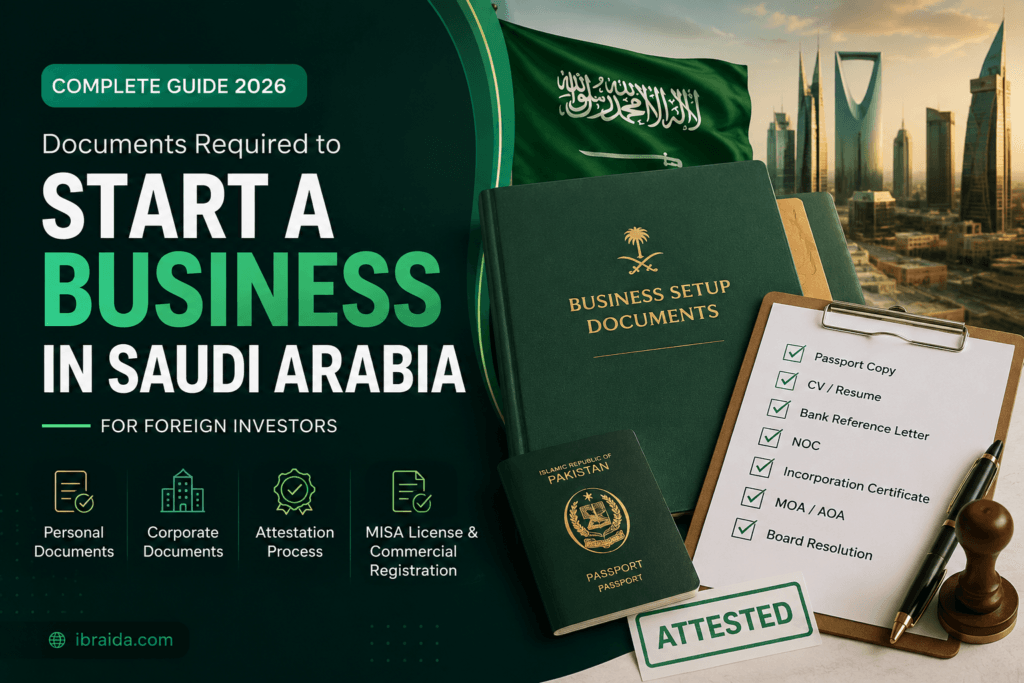
Quick Answer: To start a business in Saudi Arabia as a foreign investor, you need a core set of documents required to start a business in Saudi Arabia: passport copies, CV, bank reference letter, and NOC for the personal file; plus attested corporate documents (incorporation certificate, MOA/AOA, board resolution) if a company is the shareholder. These pass through a four-step attestation chain before being submitted to MISA for the investment license, followed by a separate document set for commercial registration and bank account opening.
Starting a company in the Kingdom sounds complicated until you see it laid out on paper — and once you know the exact documents required to start a business in Saudi Arabia, the whole process becomes a checklist rather than a mystery. Most foreign investors lose weeks not because the paperwork itself is difficult, but because nobody tells them upfront which documents to prepare, in what format, and in what order MISA and the Ministry of Commerce actually want them. Some applicants find out three weeks into the process that a document they thought was optional was actually mandatory, or that an attestation they completed has already expired by the time they’re ready to submit. This guide walks through every one of the documents required to start a business in Saudi Arabia, from your very first application to the moment your commercial registration certificate lands in your inbox, so you can prepare everything in the right order the first time.
At Ibraida, we’ve worked directly with Pakistani entrepreneurs going through this exact process, and the pattern repeats almost every time: the business idea and capital are ready long before the paperwork is. In one recent case, a client’s MISA application sat pending for nearly three weeks purely because a bank reference letter had been issued too early and expired before the Saudi Embassy attestation was completed. That single timing mistake, more than any complexity in the documents themselves, is what actually costs people the most time — which is exactly why this guide sequences everything by when you should prepare it, not just what you need.
Key facts at a glance:
- Personal documents (passport, CV, bank reference, NOC) are needed for every application type
- Corporate documents apply only if a company, not an individual, is the shareholder or if you’re opening a branch office
- All foreign documents must pass a four-step attestation chain before Saudi authorities accept them
- Attestation from Pakistan typically takes two to three weeks
- A separate, additional document set is required at the bank account stage, even after commercial registration is complete
Table of Contents
Documents Required to Start a Business in Saudi Arabia: Why It Matters Before You Apply
Saudi Arabia’s investment authority (MISA) and the Ministry of Commerce process thousands of applications every month, and incomplete files are the single biggest reason for delays. Unlike some markets where you can submit rough drafts and fix things later, Saudi authorities expect a complete, attested file on first submission. Missing a single document, or submitting one that hasn’t gone through the correct legalization chain, can push your timeline back by weeks rather than days — which is exactly why knowing the documents required to start a business in Saudi Arabia before you begin makes such a difference. If you’ve already read our guide on how to start a business in Saudi Arabia for foreigners, you know the process runs through MISA licensing before commercial registration, and each of those stages has its own separate document requirements that build on one another.
Getting this right the first time doesn’t just save weeks, it also protects you from re-attestation costs, which can add up quickly when documents come from Pakistan, India, or other South Asian countries where embassy attestation itself takes time and money. Every re-submission means another round of courier fees, another visit to the Ministry of Foreign Affairs, and another wait in the Saudi Embassy’s queue. Investors who treat the documents required to start a business in Saudi Arabia as a one-time checklist exercise, rather than something to rush through, consistently move faster through the entire registration pipeline.
It also helps to understand that Saudi authorities are not being deliberately difficult — the documents required to start a business in Saudi Arabia exist to verify that the investor is legitimate, financially capable, and operating within an approved business activity. Once you see the logic behind each requirement, the process feels far less arbitrary and far easier to plan around.
Personal file, corporate file, attestation chain, MISA license, commercial registration, and bank account requirements — organized stage by stage so nothing gets missed or expires before you need it.
Download the Checklist — $4Core Personal Documents Every Foreign Investor Needs
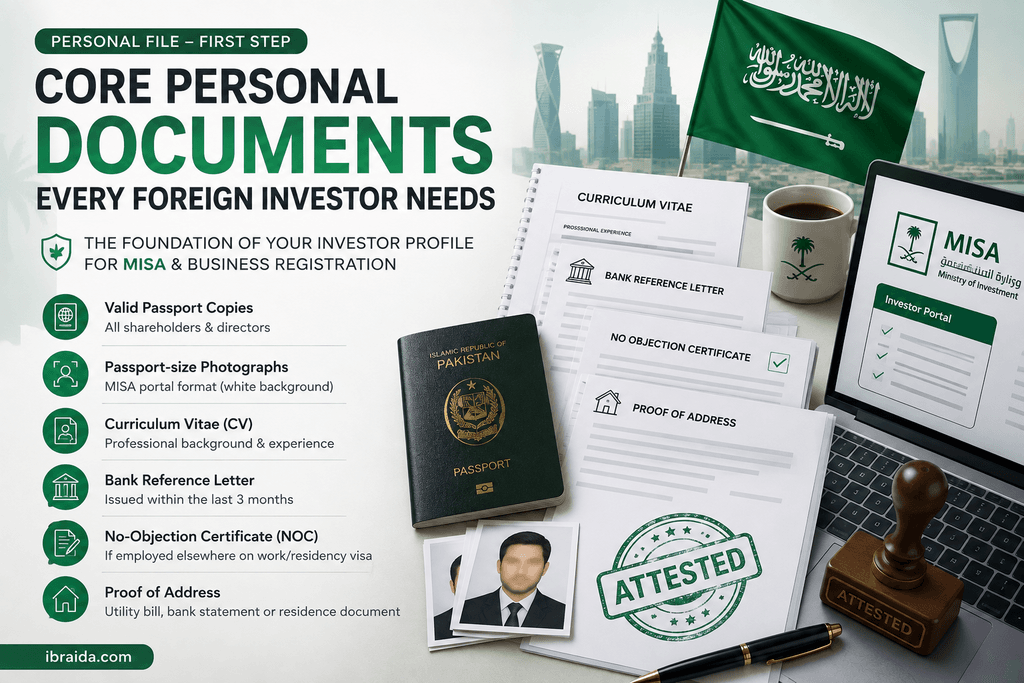
Regardless of the business activity or legal structure you choose, the personal documents required to start a business in Saudi Arabia form a baseline set that applies across almost every application type. These form the foundation of your investor profile and are usually the first things MISA’s portal asks for:
- Valid passport copies of all shareholders and directors, with at least six months validity remaining from the date of submission
- Passport-size photographs in the exact format specified by MISA’s online portal, usually with a white background and specific dimensions
- Curriculum Vitae (CV) for each shareholder, showing relevant business or professional background related to the proposed activity
- Bank reference letter confirming the investor’s financial standing, issued within the last three months by a recognized bank
- No-objection certificate (NOC), if the investor is currently employed elsewhere under a work or residency visa in another country
- Proof of address in the home country, usually a recent utility bill, bank statement, or government-issued residence document
These form what MISA refers to internally as the personal file, and they represent the first layer of documents required to start a business in Saudi Arabia that every applicant encounters. Each of these documents needs to be current — a bank reference letter issued eight months ago, for example, is often rejected simply because it falls outside the accepted validity window. It’s worth requesting fresh copies of anything time-sensitive only once you’re ready to begin the formal submission process, rather than gathering everything months in advance.
Alongside this personal file, you’ll need the additional documents required to start a business in Saudi Arabia as a branch of an existing company rather than a fresh LLC — something we cover in much greater detail in our LLC company registration guide, which walks through the structural differences between the two paths.
Corporate Documents for Companies and Branch Offices
If the investor is a company rather than an individual, or if you’re setting up a branch office of an existing foreign entity, the documents required to start a business in Saudi Arabia grow considerably. Expect to prepare the following, each attested through the same legalization chain described later in this guide:
- Certificate of Incorporation of the parent company, attested and legalized in the country of origin
- Memorandum and Articles of Association (MOA/AOA) showing the ownership structure, share capital, and authorized business activities
- Board resolution authorizing the establishment of the Saudi entity and naming an authorized signatory to act on the company’s behalf
- Audited financial statements for the parent company, typically covering the last one to two fiscal years
- Power of Attorney (POA) for the local representative or legal consultant handling submissions on your behalf inside Saudi Arabia
- Commercial registration extract of the parent company from its home country’s official business registry
Every one of these documents required to start a business in Saudi Arabia at the corporate level needs to pass through the same attestation chain as personal documents — a step many first-time applicants underestimate in both time and cost, especially when the parent company’s home country has a slower or more bureaucratic legalization process. Companies with multiple shareholders should also expect to submit a shareholder resolution reflecting the exact ownership percentages that will appear on the Saudi entity’s Articles of Association, since any mismatch between the parent company’s records and the new entity’s filing is a common cause of rejection at the commercial registration stage.
Branch offices in particular face a slightly heavier documentary burden than fresh LLCs, since MISA needs to verify not just the individual investor but the entire parent company structure standing behind the Saudi branch. If your business model allows for either path, it’s worth weighing the extra documentation and processing time of a branch office against the relative simplicity of registering a new LLC from scratch.
Attestation and Legalization: The Step Most People Get Wrong
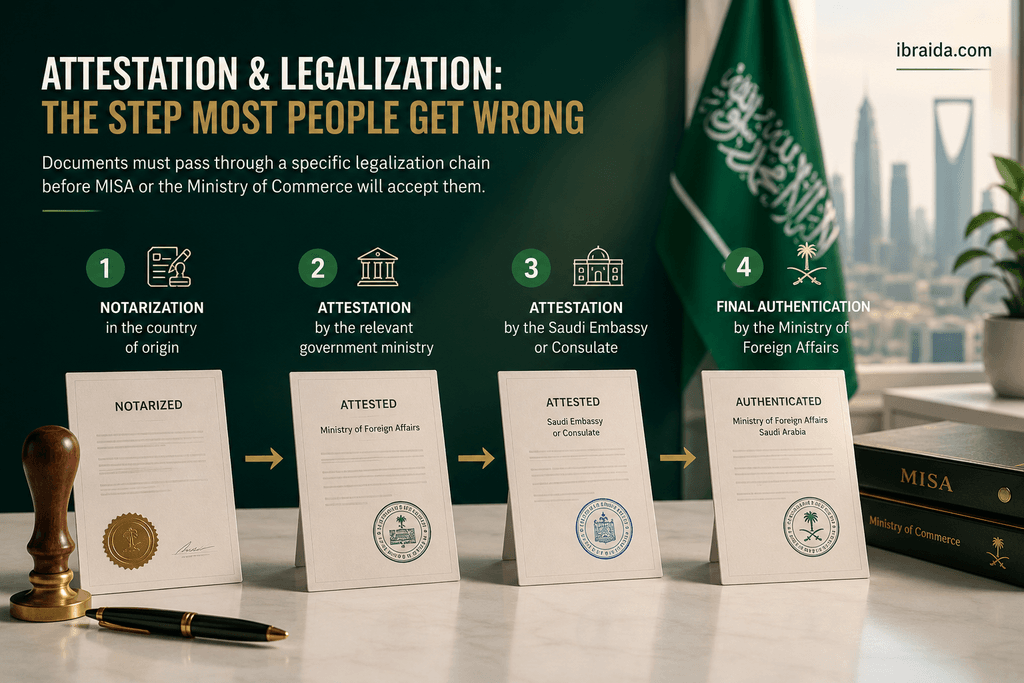
This is where most delays happen, and it’s the single most misunderstood part of preparing the documents required to start a business in Saudi Arabia. Saudi authorities won’t accept a document just because it’s genuine — it needs to pass through a specific legalization chain before MISA or the Ministry of Commerce will even look at it. The standard chain looks like this:
- Notarization in the country of origin, confirming the document was signed or issued as claimed
- Attestation by the relevant government ministry, usually the Ministry of Foreign Affairs in that country
- Attestation by the Saudi Embassy or Consulate located in that same country
- Final authentication by the Ministry of Foreign Affairs once the document physically reaches Saudi Arabia
Skipping any one of these four steps for any of the documents required to start a business in Saudi Arabia means the document will be rejected outright, and you’ll have to restart that portion of the chain — which is far more time-consuming than simply doing it correctly the first time. For applicants coming from Pakistan specifically, this typically means clearing documents through the Ministry of Foreign Affairs Islamabad, followed by the Saudi Embassy’s attestation counter, a process we break down step-by-step in our guide on how Pakistanis can start a business in Saudi Arabia. Budget at least two to three weeks purely for attestation if you’re starting from scratch, since embassy queues rarely move as fast as investors expect, and public holidays on either side can quietly add several more days.
Many investors choose to work with a local legal consultant or PRO (Public Relations Officer) service specifically to manage this attestation chain, since a single missed stamp anywhere along the process resets the clock. If your budget allows, this is often one of the more cost-effective outsourcing decisions in the entire setup process, simply because of how much time it saves.
Documents Required for the MISA Investment License
Once your personal and corporate files are attested, the next set of documents required to start a business in Saudi Arabia is specific to the MISA application itself. This is the license that legally permits a foreign investor to own and operate a business in the Kingdom, and without it, none of the later documents required to start a business in Saudi Arabia can even be submitted. The MISA application requires:
- ✓ Completed MISA application form, submitted through the official online investor portal
- ✓ Attested passport and CV of each investor named on the application
- ✓ Business plan or activity description that matches an approved MISA activity code
- ✓ Proof of minimum capital, where the chosen business activity requires a defined paid-up capital threshold
- ✓ Attested corporate documents, for any shareholders that are themselves companies rather than individuals
One detail that trips up many first-time applicants is the activity code matching requirement — your business plan needs to describe an activity that corresponds precisely to one of MISA’s pre-approved codes, and vague or overly broad descriptions are frequently sent back for clarification. Our dedicated article on the MISA investment license in Saudi Arabia goes much deeper into activity codes, capital thresholds by sector, and realistic processing timelines, and it’s worth reading alongside this checklist if you haven’t submitted your MISA application yet.
Documents for Commercial Registration (CR)
After MISA approval, the commercial registration stage has its own paperwork, largely built on documents you’ve already prepared but with a few new additions specific to this stage. At this point most of the documents required to start a business in Saudi Arabia are already in your file, and only a handful of new items need to be added:
- MISA license certificate, issued once your investment license application is approved
- Articles of Association for the new Saudi entity, drafted in Arabic and matching the structure declared in your MISA application
- Lease agreement or Ejar-registered office contract confirming your business address in Saudi Arabia
- Chamber of Commerce membership application, which most new entities are required to complete alongside registration
- National Address registration, linking your official business address to the Saudi postal and government systems
Once every remaining item on the list of documents required to start a business in Saudi Arabia has cleared commercial registration, you’re legally allowed to open a corporate bank account, begin hiring staff, and start operations under your chosen structure — whether that’s an LLC, a sole proprietorship, or a branch office. This is generally the moment investors feel the process has actually concluded, though a few administrative steps, like bank account setup and National Address confirmation, typically still remain.
The Ejar-registered lease requirement in particular catches many investors off guard, since it means you generally need a physical or virtual office address secured before commercial registration can be finalized — something worth arranging in parallel with your MISA application rather than waiting until after approval.
UAE Business Setup Cluster
Thinking About the UAE Instead? Read Our Complete Guide
If you’re comparing Saudi Arabia against the UAE, start with our full step-by-step guide covering free zones, mainland licensing, costs, visas, and everything else you need to launch in Dubai in 2026-2027.
Read the UAE Step-by-Step Guide →More From Our UAE Business Setup Series
- How to Start a Business in UAE: Complete Step-by-Step Guide (Pillar)
- Dubai Free Zones Guide 2026-2027: Complete List & Comparison
- Dubai Mainland License Guide 2026-2027
- Dubai Business Setup Cost Calculator & Comparison 2026-2027
- How to Open a Business Bank Account in Dubai 2026-2027
- UAE Corporate Tax Guide for Small Businesses 2026-2027
- UAE Golden Visa Guide 2026-2027: Requirements & Process
- Dubai Freelance Visa & Permit Guide 2026-2027
- Business Setup in Dubai for Pakistani Citizens: Complete Guide
- How to Start a Business in Dubai from the USA
- Best Business Ideas in Dubai 2026-2027
Documents for Opening a Saudi Business Bank Account
Banks in Saudi Arabia run their own compliance checks independent of MISA and the Ministry of Commerce, and the documents required to start a business in Saudi Arabia at this stage focus specifically on proving the account holder’s legal standing:
- Commercial registration certificate, showing the entity is fully and legally registered
- MISA license, confirming the foreign investment approval behind the entity
- Company’s Articles of Association, in their final registered Arabic form
- Passport copies and Iqama (residency permit) of authorized signatories, once issued
- National Address certificate, matching the registered business address
- Initial deposit proof, where the bank requires a minimum opening balance for the account type chosen
Some banks also request a short in-person or video interview with the authorized signatory before releasing the account, particularly for higher-risk business activities or entities with complex ownership structures. It’s worth calling ahead to two or three banks before committing to one, since document requirements and minimum balance thresholds can vary meaningfully between institutions, and some are noticeably faster than others when it comes to processing new corporate accounts for foreign-owned entities.
Translation and Notarization Requirements
Every foreign-language item among the documents required to start a business in Saudi Arabia — passports aside — generally needs a certified Arabic translation before Saudi authorities will process it. This applies to corporate documents, board resolutions, financial statements, and lease agreements alike, and it’s a requirement that applies at nearly every stage of the process, from MISA licensing through to commercial registration and bank account opening.
Use only translators certified by the Saudi Ministry of Justice or an embassy-approved translation office; uncertified translations are one of the most common rejection reasons at the commercial registration stage, and authorities will not make exceptions regardless of how accurate the translation actually is. It’s generally faster and cheaper in the long run to identify a certified translator early in the process, rather than discovering the requirement only after a document has already been rejected once.
Your Saudia Arabia Business Journey Starts Here
From free AI-powered planning tools to everything else we’ve built for entrepreneurs — explore what ibraida.com has to offer.
💚 100% free — no signup required to browse
Common Mistakes That Delay Document Approval
Having reviewed the documents required to start a business in Saudi Arabia across each stage, it’s worth highlighting the specific mistakes that consistently cause the longest delays for foreign investors:
- Submitting expired attestations — most attested documents are only valid for a fixed window, often three to six months, and authorities will reject anything outside that window regardless of when the underlying document was originally issued
- Mismatched names across passport, CV, and bank reference letter due to spelling variations or transliteration differences between English and Arabic
- Skipping the home-country attestation step and going straight to the Saudi Embassy, assuming embassy attestation alone is sufficient
- Using non-certified translators for Arabic versions of corporate documents, which get rejected regardless of translation accuracy
- Underestimating capital proof requirements for activities that need a minimum paid-up capital, particularly in sectors like trading and industrial licensing
- Preparing documents too far in advance, so that time-sensitive items like bank reference letters expire before the rest of the file is ready
Each of these mistakes can add two to four weeks to your overall timeline, so it’s worth double-checking every one of the documents required to start a business in Saudi Arabia against this list before submission, ideally with a local consultant reviewing the full file before it goes to MISA or the Ministry of Commerce.
What This Means for Your Overall Budget and Timeline
Preparing the documents required to start a business in Saudi Arabia isn’t just a paperwork exercise — it directly affects how much you’ll spend and how long registration takes from start to finish. Attestation fees, certified translations, courier costs between your home country and Saudi Arabia, and any legal consultant fees for managing the process can add a meaningful amount to your overall setup budget, often more than investors initially anticipate when they first start planning. For a full breakdown of what the entire process costs from documentation through to your first year of operation, including government fees, office costs, and visa expenses, see our guide on the cost of starting a business in Saudi Arabia.
If you’re considering a lighter-weight setup instead of a full company, it’s also worth checking whether a freelance license in Saudi Arabia fits your situation better — the documents required to start a business in Saudi Arabia as a freelancer are considerably shorter than a full LLC or branch registration, and the overall timeline is usually faster as a result, making it a reasonable option for solo consultants and service providers who don’t need a full corporate structure.
A Quick Pre-Submission Checklist for the Documents Required to Start a Business in Saudi Arabia
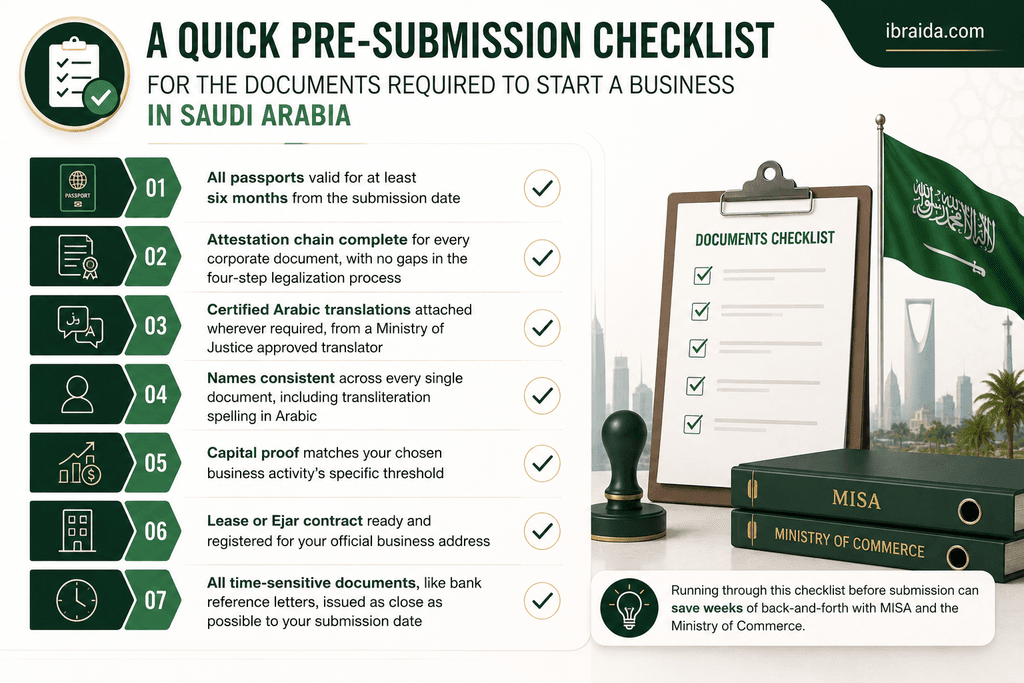
Before you submit anything to MISA or the Ministry of Commerce, it’s worth running through this final check to catch the most common issues before they cost you time:
- All passports valid for at least six months from the submission date
- Attestation chain complete for every corporate document, with no gaps in the four-step legalization process
- Certified Arabic translations attached wherever required, from a Ministry of Justice approved translator
- Names consistent across every single document, including transliteration spelling in Arabic
- Capital proof matches your chosen business activity’s specific threshold
- Lease or Ejar contract ready and registered for your official business address
- All time-sensitive documents, like bank reference letters, issued as close as possible to your submission date
Working through this list of documents required to start a business in Saudi Arabia before you submit anything can realistically save weeks of back-and-forth with MISA and the Ministry of Commerce, and it’s the same process most experienced legal consultants run through before filing on a client’s behalf.
if you want to see some real example of business model read this
AI Business OS — Notion Dashboard
A complete 12-module Notion system to run your entire business from one place — clients, projects, finances, and content, fully linked and ready to use.
- Clients CRM & Projects tracker
- Finance, Invoices & Subscriptions Tracker
- AI Prompt Vault & SOP Library
- Goals, OKRs & Content Planner
- Instant Gumroad delivery — duplicate and start today
Documents Required for Visa and Iqama Processing
Once your commercial registration is complete, the next practical step for most foreign investors is arranging residency, since running the business day-to-day from inside Saudi Arabia requires an Iqama rather than repeated short business visits. This stage brings its own set of documents required to start a business in Saudi Arabia and reside there long-term, layered on top of everything already submitted for MISA and commercial registration:
- Valid passport with at least six months validity remaining at the time of visa application
- Medical fitness certificate from an approved medical center, confirming the applicant is fit to reside and work in Saudi Arabia
- Employment contract or investor sponsorship documentation, linking the individual to the newly registered entity
- Passport-size photographs meeting Saudi visa photo specifications, which differ slightly from MISA’s own photo requirements
- Educational and professional certificates, attested through the same four-step legalization chain, particularly for regulated professions
Because these documents go through Saudi immigration authorities rather than MISA or the Ministry of Commerce, processing timelines and specific requirements can shift independently of your company registration status. It’s worth starting the medical fitness and educational attestation process in parallel with commercial registration rather than waiting until the CR certificate is in hand, simply because attestation queues for these documents required to start a business in Saudi Arabia and stay long-term tend to move slower than investors expect.
How the Documents Required to Start a Business in Saudi Arabia Differ by Activity
Not every business activity in Saudi Arabia carries the same documentation burden. Trading, industrial, and contracting licenses generally require heavier capital proof and more detailed business plans than service-based or consulting activities, since these sectors carry additional regulatory oversight from bodies beyond MISA alone. A trading license, for instance, often adds extra items to the documents required to start a business in Saudi Arabia in the form of a detailed supplier and distribution plan, while an industrial license may require environmental or zoning approvals depending on the nature of the manufacturing activity involved.
Professional and consulting services, by contrast, tend to have a lighter documentary load, particularly where the applicant’s own CV and professional certifications substitute for some of the capital and operational documentation required in trading or industrial sectors. If you’re unsure which category your planned activity falls under, it’s worth confirming the exact MISA activity code and its associated list of documents required to start a business in Saudi Arabia before beginning attestation, since preparing the wrong set of supporting documents is a common and entirely avoidable source of delay.
Real estate and construction-related activities sit at the heavier end of the spectrum for documents required to start a business in Saudi Arabia, often requiring additional technical certifications, proof of prior project experience, and sometimes local partnership agreements depending on the specific sub-activity. If your business plan touches on any regulated sector — healthcare, education, financial services, or media — expect an additional layer of documents required to start a business in Saudi Arabia within that specific sector, usually requiring approval from the relevant ministry alongside MISA.
“`htmlMake Your Business Setup Smarter
Use Ibraida’s free tools and calculators to validate ideas, plan your setup, and make better business decisions.
Free Zone or Mainland Dubai — Which Is Right for You?
Answer a few simple questions and discover which Dubai business setup option may better match your goals.
AI Business Idea Validator
Test your business idea and get AI-powered insights.
AI Prompt Optimizer
Turn basic prompts into clearer, more effective AI prompts.
Dubai Business Setup Cost Calculator
Estimate the potential cost of setting up a business in Dubai.
AI Tool Stack Builder
Find AI tools that fit your business workflow and needs.
AI Blog Outline Generator
Create structured blog outlines faster with AI.
Explore Ibraida Tools
More practical tools are available to help you plan smarter.
Working With a Local Consultant vs Handling Documentation Yourself
Given how many moving parts are involved in gathering the documents required to start a business in Saudi Arabia — attestation chains, certified translations, activity-specific requirements, and bank compliance checks — many foreign investors weigh whether to handle documentation independently or bring in a local legal consultant or PRO service. Handling the documents required to start a business in Saudi Arabia yourself can save on consultant fees, but it generally requires more time, more back-and-forth communication with embassies and ministries, and a higher tolerance for administrative troubleshooting when something doesn’t go as expected.
A local consultant, on the other hand, typically already knows the current documents required to start a business in Saudi Arabia, has existing relationships with translation offices and government liaison points, and can often catch documentation errors before submission rather than after a rejection. For first-time investors unfamiliar with the documents required to start a business in Saudi Arabia and how Saudi bureaucratic processes actually work, this can meaningfully shorten the overall timeline, even after accounting for consultant fees. A middle-ground approach that many investors take is handling document collection themselves while using a consultant specifically for the attestation and submission stages, where local knowledge tends to matter most.
Frequently Asked Questions
What is the most important document among the documents required to start a business in Saudi Arabia?
The MISA investment license is the single most critical document, since almost every subsequent step — commercial registration, bank account opening, and visa issuance — depends on it being approved first.
How long does document attestation usually take?
For applicants from Pakistan and similar countries, the full attestation chain typically takes two to three weeks, though it can extend further during peak embassy periods or around public holidays.
Do all documents need to be translated into Arabic?
Yes, any document not originally issued in Arabic generally needs a certified Arabic translation before Saudi authorities will accept it, particularly for commercial registration and bank account opening.
Can I submit documents without visiting Saudi Arabia?
In most cases yes, especially with a Power of Attorney authorizing a local representative or legal consultant to submit and follow up with authorities on your behalf.
What happens if my attested documents expire before approval?
You’ll need to redo the attestation for the expired document, which is why it’s best to complete document preparation as close as possible to your actual submission date rather than months in advance.
References
- Ministry of Investment Saudi Arabia (MISA)
- Ministry of Commerce, Saudi Arabia
- Ministry of Foreign Affairs, Saudi Arabia
- Ministry of Foreign Affairs, Pakistan
- Ministry of Justice, Saudi Arabia
Last updated: August 2026. Saudi business registration requirements are periodically revised by MISA and the Ministry of Commerce, so figures and steps should always be cross-checked against official sources before submission.
Disclaimer
This article is for general informational purposes only and does not constitute legal, financial, or immigration advice. Requirements and procedures may change; always verify current document requirements directly with MISA, the Ministry of Commerce, or a licensed legal consultant before proceeding.
About the Author
This guide was researched and written by the Ibraida team, who work directly with Pakistani entrepreneurs and small businesses navigating UAE and Saudi Arabia market-entry processes, including MISA licensing, commercial registration, and freelance visa pathways. Ibraida draws on hands-on client casework across the UAE and Saudi business-setup cluster, including real questions from clients about the documents required to start a business in Saudi Arabia, to keep this content grounded in what actually happens during the process, not just what’s written in official guidelines.

- Publix Business Model: 5 Lessons Entrepreneurs Can Learn
- 75 Easiest Startup Businesses to Launch in AI World
- YCombinator Companies: The Complete Guide to YC Startups, Unicorns, and Success Stories
- Documents Required to Start a Business in Saudi Arabia (7 Easy & Proven Steps)
- How to Get a Freelance License in Saudi Arabia (2026-2027 Guide)