
Saudi Arabia is no longer just the world’s largest oil exporter — it’s fast becoming one of the most active investment destinations in the Middle East, and Pakistanis are increasingly part of that story. Between Vision 2030’s push to diversify the economy, new 100% foreign ownership rules, and a Pakistani community that already numbers in the millions, the opportunity for entrepreneurs back home has never looked better. This guide breaks down exactly what it takes to go from idea to a fully registered, operating business in the Kingdom.
Table of Contents
Starting a Business in Saudi Arabia from Pakistan — Is It Really Possible?
If you’re sitting in Pakistan wondering how Pakistanis can start a business in Saudi Arabia, let’s clear this up right away — yes, it’s absolutely possible, and it’s become significantly easier than it used to be. Saudi Arabia’s government has been pushing hard under Vision 2030 to diversify its economy away from oil, and as part of that push, the doors have opened wide for foreign investors — including the large and hardworking Pakistani community.
In the past, setting up a business in Saudi Arabia meant you needed a local sponsor or “kafeel,” without whom a foreigner couldn’t register an independent business. But under the newer MISA (Ministry of Investment Saudi Arabia) regulations, foreigners — Pakistanis included — can now register a company with 100% ownership, with no local partner required. That’s a genuine game changer for anyone looking to expand into the GCC region.
In this guide, we’ll walk through exactly how a Pakistani individual or company can start a business in Saudi Arabia, what the legal requirements are, how much it costs, what visa you’ll need, and which business ideas tend to work best for Pakistani entrepreneurs.
Why Is Saudi Arabia So Attractive for Pakistanis?
Before we get into the process, it’s worth understanding why Pakistanis are increasingly choosing Saudi Arabia over destinations like Dubai, the UK, or Canada.
- Cultural and religious connection: Saudi Arabia holds deep spiritual significance for Muslims, and the Pakistani community there is already large and well-established — millions of Pakistanis already call it home.
- Geographic proximity: A flight from Pakistan to Saudi Arabia takes just 3 to 4 hours, far more convenient than travelling to Europe or North America.
- Vision 2030 opportunities: Tourism, entertainment, tech, logistics, and retail are sectors the Saudi government is actively inviting investment into.
- Tax advantages: There’s no personal income tax in Saudi Arabia, and corporate tax is competitive compared to Western countries.
- Purchasing power: The Saudi Riyal is a strong currency, and the local market has healthy purchasing power — a good sign for any new business.
- Existing Pakistani workforce: If your business is labour-intensive, skilled and semi-skilled Pakistani workers are already there, which makes hiring considerably easier.
For all these reasons, Saudi Arabia is fast becoming a natural choice for Pakistani entrepreneurs who want to expand into the Middle East or start fresh altogether.
How Pakistanis Can Start a Business in Saudi Arabia — Understanding the Legal Structures
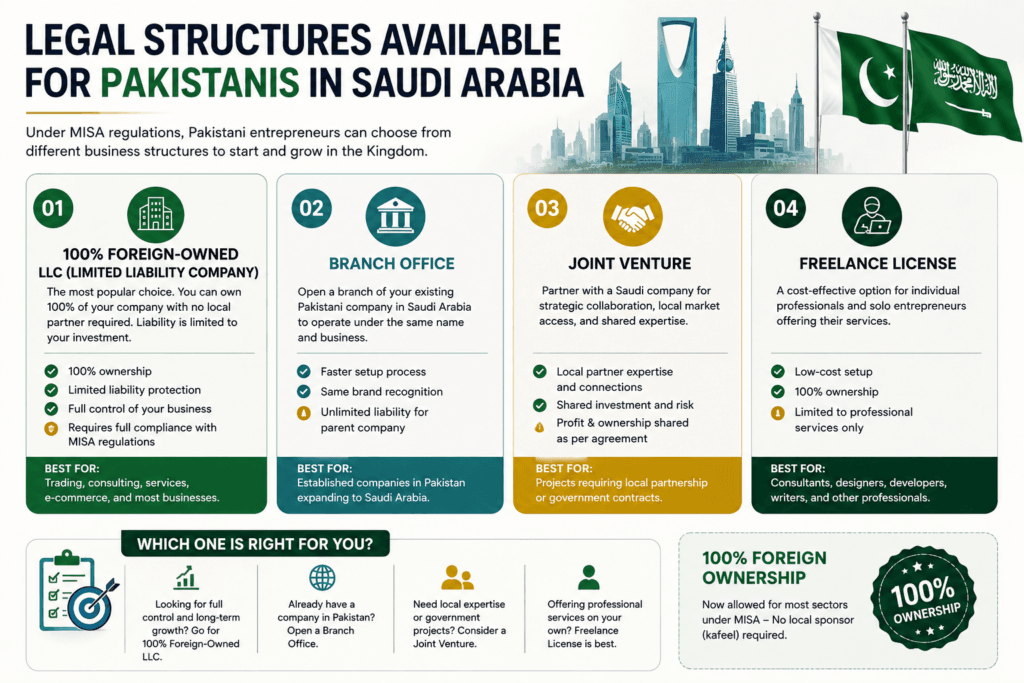
The very first thing you need to understand is which legal structures are available to foreigners under MISA. When registering, you’ll need to choose one of the following:
1. 100% Foreign-Owned LLC (Limited Liability Company)
This is the most common structure Pakistanis choose. You can own 100% of your company with no Saudi partner required. Liability is limited, meaning your personal assets stay protected if the business runs into losses. Most trading, consulting, and service businesses go with this structure.
2. Branch Office
If your company already exists and is established in Pakistan, and you simply want to open a branch of it in Saudi Arabia, this is the better route. Liability for the parent company is unlimited here, but setup can be faster since you’re not creating a brand-new legal entity.
3. Joint Venture
If you want to partner with a local Saudi company — whether for strategic reasons or market access — a joint venture structure is worth considering. Ownership percentages are negotiated between partners.
4. Freelance License
If you’re a solo professional — a graphic designer, developer, consultant, or content writer — Saudi Arabia’s freelance license is a lower-cost option specifically designed for individual professionals.
For most Pakistani entrepreneurs looking to start trading, e-commerce, or service-based businesses, the 100% Foreign-Owned LLC remains the most practical and flexible option, which is why this guide focuses mostly on that structure. If you’re still weighing this decision, our detailed LLC vs Branch Office in Saudi Arabia comparison breaks down the pros and cons of each in more depth.
Step-by-Step Process: How to Register a Business in Saudi Arabia
Now for the real question — practically, how Pakistanis can start a business in Saudi Arabia, step by step:
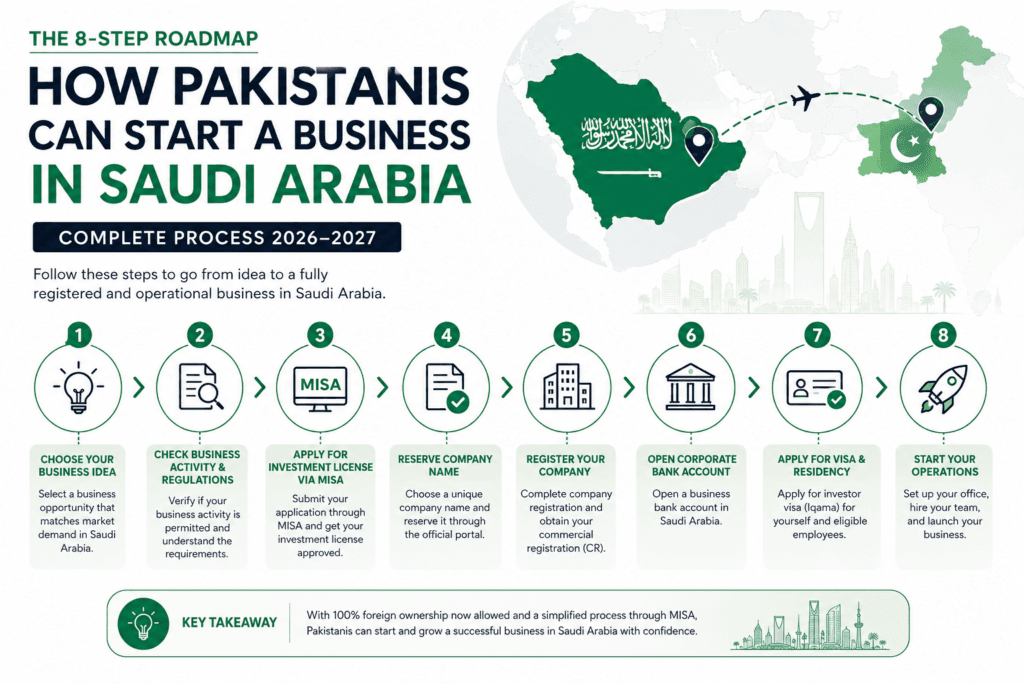
Step 1: Decide Your Business Activity and Structure
First, decide what business activity you want to carry out — trading, services, manufacturing, consulting, or something else. MISA’s website has a list of activities from which you must select your exact category, since your license is issued based on this.
Step 2: Apply for the MISA Investment License
This is the most crucial step. MISA (formerly known as SAGIA) issues investment licenses to foreign investors. The application is submitted online and requires basic company details, your business activity, and financial information. Approval typically takes anywhere from a few days to 2-3 weeks, depending on the business type and how complete your documentation is.
Step 3: Reserve Your Company Name
You’ll need to reserve your trade name through the Ministry of Commerce (MC). The name is registered in both Arabic and English, and it must be confirmed that it doesn’t clash with any existing registered company.
Step 4: Draft the Articles of Association
This is the legal document that defines your company’s structure, shareholders, and operational rules. It needs to be notarized through the Ministry of Commerce.
Step 5: Obtain Your Commercial Registration (CR)
Once your MISA license and Articles of Association are approved, the next step is obtaining a Commercial Registration certificate from the Ministry of Commerce. This certificate is what legally allows your company to operate.
Step 6: Chamber of Commerce Membership
Every registered business in Saudi Arabia is required to become a member of the local Chamber of Commerce. This membership renews annually and also helps with business networking and official documentation.
Step 7: Open a Corporate Bank Account
Once you have your Commercial Registration, you can open a corporate bank account with any Saudi bank. Most banks have minimum deposit requirements, and the documentation process is fairly detailed — we’ll cover this in more depth below.
Step 8: Employee Visas and Iqama Processing
If you’re bringing a team over from Pakistan or hiring locally, you’ll also need to complete the employment visa and Iqama (residency permit) process. This step begins once your company is officially registered.
Step 9: GOSI (General Organization for Social Insurance) Registration
If you’re hiring employees, GOSI registration is also mandatory, as it covers employees’ social insurance and benefits.
Step 10: Municipality License (Baladiya)
Depending on your business type, you may also need an operational license from the local municipality, especially if your business operates from a physical location such as a restaurant, retail store, or warehouse.
If all your documents are in order, this entire process typically takes 4 to 8 weeks. But if a document is missing or there’s a discrepancy in the application, the timeline can stretch out further.
Required Documents — Checklist
Documentation tends to be more detailed for Pakistani entrepreneurs since documents from Pakistan need to be attested and legalized. Here’s what’s generally required:
- Valid Pakistani passport (with at least 6 months validity)
- Existing company registration documents (if you already run a business in Pakistan)
- Bank statements (personal or company, last 6 months)
- Business plan or feasibility study
- Educational and professional certificates (attested)
- No Objection Certificate, if you’re currently employed by a Saudi company
- Memorandum and Articles of Association (draft form)
- Passport-size photographs
- Proof of address (from Pakistan)
All these documents need to be attested through Pakistan’s Ministry of Foreign Affairs and then the Saudi Embassy in Islamabad — a process that can take 2-3 weeks on its own, so it’s worth starting this well before you begin the rest of the process.
Cost of Setting Up a Business in Saudi Arabia — How Much Budget Do You Need?
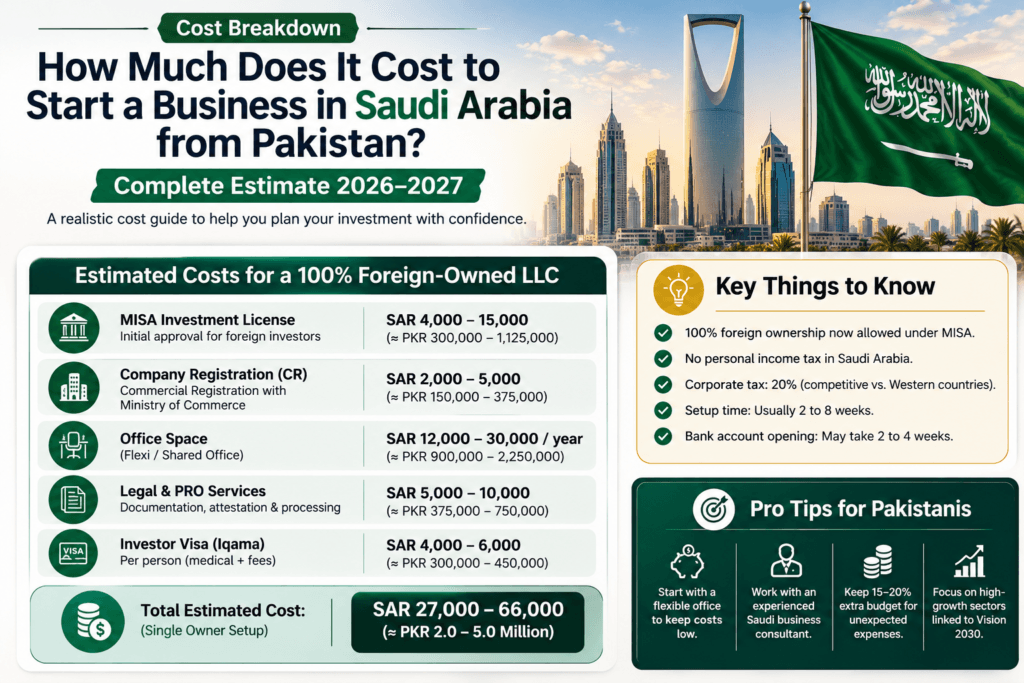
This is probably the most commonly asked question. The exact cost depends on your business type, city, and company structure, but here’s a rough estimate:
| Expense | Approximate Cost (SAR) |
|---|---|
| MISA Investment License | 2,000 – 12,000 |
| Commercial Registration | 1,200 – 3,000 |
| Chamber of Commerce Membership | 800 – 2,500 (annual) |
| Office Space / Virtual Office | 5,000 – 30,000 (annual) |
| Legal & Consultancy Fees | 3,000 – 10,000 |
| Employee Visa (per person) | 2,000 – 5,000 |
| Bank Account Setup | Usually free, minimum balance required |
Overall, setting up a small to medium-sized business will roughly require a budget of 15,000 to 40,000 SAR (approximately PKR 11 lakh to 30 lakh), which covers licensing, registration, legal fees, and basic operational costs for the first year. Larger businesses or manufacturing setups can go well beyond this.
One important thing to understand — the MISA license fee varies depending on business activity. A trading license is generally more expensive than a consulting or services license. For a more detailed, line-by-line breakdown, check out our full Saudi Arabia business setup cost guide.
Visa and Residency (Iqama) — What’s the Process?
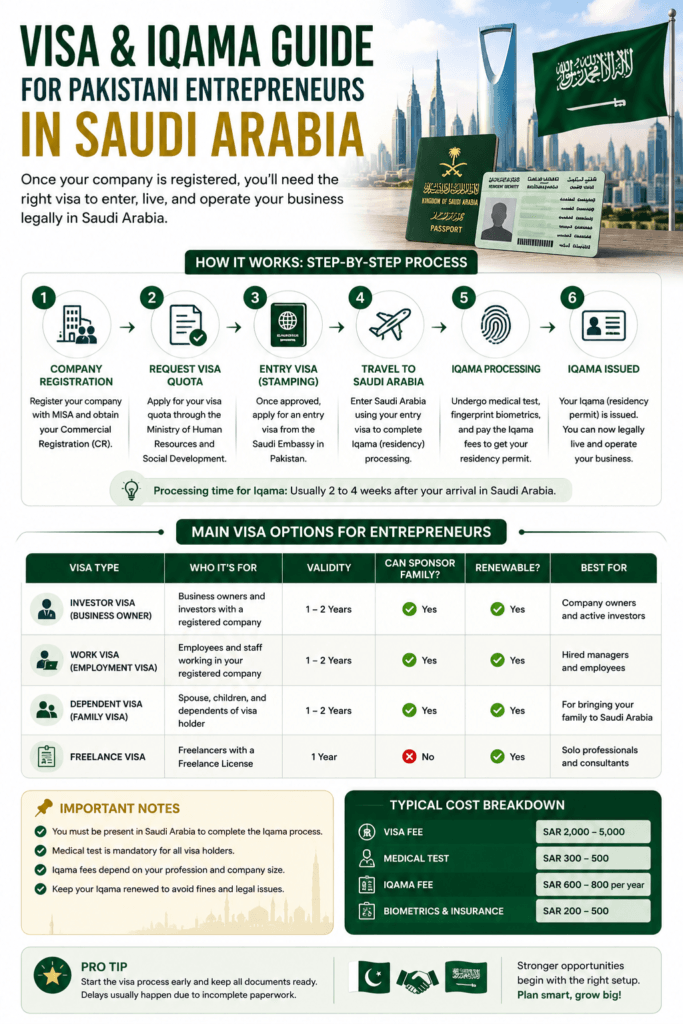
Once your business is registered, if you want to live in Saudi Arabia yourself to run your business, you’ll need to apply for either an Investor Visa or an Iqama.
Investor Visa
This is specifically designed for people setting up a business in Saudi Arabia. With an investor visa, you can also sponsor your family, and it’s multiple-entry, giving you the flexibility to travel back and forth between Pakistan and Saudi Arabia.
Iqama (Residency Permit)
If you plan to live in Saudi Arabia long-term to manage your business, you’ll need an Iqama. It grants you legal resident status, and with it, you can access services like a driving license and a local bank account. An Iqama is typically valid for 1 to 2 years and is renewable.
Employees you bring over from Pakistan will also need a separate work visa and Iqama process, which your company generally sponsors.
Banking — How to Open a Corporate Bank Account
Opening a corporate bank account in Saudi Arabia is a detailed process. Major banks like Al Rajhi Bank, SNB (Saudi National Bank), Riyad Bank, and SABB handle accounts for foreign-owned companies. Generally, you’ll need the following documents:
- Commercial Registration certificate
- MISA investment license
- Articles of Association
- Passports and Iqamas of company owners/directors (if available)
- Proof of company’s official address
Some banks also require a minimum initial deposit, typically between 5,000 and 25,000 SAR, depending on the bank and account type. The process usually takes 2 to 4 weeks.
Saudi Arabia Business Setup Cluster
Not Sure Where to Start? Read the Complete Guide First
This article is part of our full Saudi Arabia business setup series. If you haven’t already, start with our complete step-by-step pillar guide covering MISA licensing, costs, entity types, documents, and everything else you need to launch in 2026-2027.
Read the Full Step-by-Step Guide →Best Business Ideas for Pakistanis in Saudi Arabia
If you’re not sure exactly what business to start, here are a few sectors currently in high demand in Saudi Arabia that tend to be particularly profitable for Pakistanis:
1. Import-Export Trading
Exporting textiles, surgical goods, sports items, or food products from Pakistan, while importing construction materials or electronics from Saudi Arabia — this is an established and profitable model already run successfully by many Pakistanis.
2. Construction and Contracting
Thanks to giga-projects like NEOM under Vision 2030, demand in the construction sector is extremely high. Pakistani contractors and skilled labour already have a strong reputation in Saudi Arabia.
3. Food and Restaurant Business
Pakistani cuisine is already popular in Saudi Arabia, particularly in cities with a large Pakistani community like Jeddah, Riyadh, and Dammam.
4. Digital Marketing and IT Services
Saudi companies are rapidly investing in building their digital presence, creating strong scope for web development, SEO, and digital marketing agencies — and this can even be managed remotely.
5. Logistics and Freight Forwarding
With e-commerce growth accelerating, demand for logistics and last-mile delivery services is rising fast.
6. Recruitment Agency
Since thousands of Pakistanis travel to Saudi Arabia for work every year, opening a licensed recruitment agency can be a successful manpower supply business.
7. E-commerce and Retail
Online shopping is trending strongly upward in Saudi Arabia, and selling niche products — handicrafts, fashion items, or specialty foods — presents a solid opportunity.
Best Saudi Cities for Pakistani Entrepreneurs
Every city has its own business environment, so it’s worth thinking about location based on your business activity:
Riyadh
As the capital, Riyadh is ideal for corporate offices, consulting, IT, and government-related contracts. Major multinational companies and government ministries are based here, making it the go-to location for B2B businesses.
Jeddah
Jeddah is the hub for trading and import-export businesses, home to Saudi Arabia’s largest commercial port. If your business involves importing or exporting goods, Jeddah is the most practical choice.
Dammam / Khobar (Eastern Province)
This region is the centre of the oil and gas industry, making Dammam and Khobar excellent locations for engineering, industrial supplies, and contracting businesses.
Makkah and Madinah
If your business focuses on Hajj and Umrah-related services — travel agencies, hospitality, or food services — both holy cities see year-round demand, especially during Hajj season.
Financing and Capital Raising Options
Many Pakistani entrepreneurs ask how they can start a business in Saudi Arabia without the full capital upfront. Here are some practical routes:
- Personal savings and family investment: The most common route for smaller businesses among Pakistanis.
- Business loans from Saudi banks: Some banks offer financing to foreign-owned companies, though this usually requires at least 1-2 years of operational track record.
- Joint venture partnerships: Partnering with an established Saudi partner can bring both local expertise and capital.
- Venture capital and angel investors: Saudi Arabia’s VC ecosystem is growing rapidly for tech and innovative startups, especially in Riyadh and Jeddah.
- Government incentive programs: Under Vision 2030, some sectors — like tourism and entertainment — offer government subsidies and incentives specifically designed to attract new investors.
Business Culture and Etiquette — What to Keep in Mind
Doing business in Saudi Arabia relies heavily on relationships and trust, so understanding local culture and etiquette matters:
- Personal relationships: Casual conversation over tea or coffee before meetings is common — don’t skip it, it’s part of building trust.
- Prayer timings: Keep prayer timings in mind when scheduling meetings, as business activity is generally structured around them.
- Formal dressing: Formal, modest attire is expected at business meetings.
- Patience matters: Decisions can take time in Saudi business culture — rushing the process can negatively affect the relationship.
- Adjusted hours during Ramadan: Working hours are reduced during Ramadan, so factor this into your planning.
Tax System and Zakat — What Pakistanis Should Know
Saudi Arabia’s tax system is somewhat unique and different from Pakistan’s, so foreign investors should understand the basics:
- Corporate Income Tax: Foreign-owned companies pay a flat 20% corporate tax on net profits.
- Zakat: If the company also has Saudi or GCC national ownership (as in a joint venture), zakat is calculated on that portion, roughly 2.5%.
- VAT (Value Added Tax): The standard VAT rate in Saudi Arabia is currently 15%, applicable to most goods and services.
- Withholding Tax: Payments to foreign entities can attract withholding tax in certain cases, depending on the transaction type.
- No Personal Income Tax: This is a major advantage — there’s no income tax on employee salaries or business owner profit withdrawals.
Hiring a local accountant or tax consultant is highly recommended for tax filing and compliance, since ZATCA (Zakat, Tax and Customs Authority) regulations are updated fairly regularly.
Timeline — How Long Does the Whole Process Take?
| Stage | Approximate Time |
|---|---|
| Document attestation (Pakistan side) | 2 – 3 weeks |
| MISA Investment License | 1 – 2 weeks |
| Company name reservation | 2 – 5 days |
| Commercial Registration | 1 – 2 weeks |
| Bank account opening | 2 – 4 weeks |
| Visa and Iqama processing | 2 – 4 weeks |
If these stages are managed in parallel wherever possible, the entire process can be completed in roughly 2 to 3 months. If you’re working with a professional business setup consultant, this timeline often shortens further since they’re already familiar with the local processes.
Saudi Arabia vs UAE — Which Is Better for Pakistanis?
Many people also wonder whether Saudi Arabia or Dubai (UAE) is the better option. The short answer — both have their own advantages. If your priority is an established consumer market and business ecosystem, UAE’s setup process is faster and more streamlined — you can get a full sense of what that looks like in our Dubai Business Setup Cost Calculator. But if you want to ride the growth wave of Vision 2030, enter less competitive sectors, or are interested in construction, logistics, or manpower businesses, Saudi Arabia offers more opportunity simply because the market is still relatively less saturated. For Pakistanis specifically weighing both markets, our Dubai business setup guide for Pakistani entrepreneurs is a useful side-by-side reference.
Common Mistakes Pakistani Entrepreneurs Make
Because this process is fairly complex, many Pakistanis end up making mistakes that cost them both time and money. Here’s what to avoid:
- Underestimating documentation: Attestation and legalization take longer than most people expect — start early.
- Selecting the wrong business activity: An incorrect activity selection means license restrictions could legally prevent you from doing what you actually intended to do.
- Not hiring a local consultant: Handling the process entirely on your own without a local legal or business setup consultant can be risky, especially since regulations are updated frequently.
- Underestimating the total budget: Looking only at license cost is a mistake — factor in office rent, visas, and operational costs too.
- Skipping market research: The Saudi market is quite different from Pakistan’s, so understanding local pricing and consumer behaviour is essential for success.
Working With a Local Sponsor or Business Setup Consultant
Even though 100% foreign ownership is now allowed, a lot of Pakistani entrepreneurs still choose to work with a local business setup consultant during their first year in Saudi Arabia — and there’s good reason for this. Regulations can vary slightly by region, government portals are primarily in Arabic, and knowing which office to visit for which stamp can save weeks of back-and-forth.
A good consultant typically handles:
- Preparing and submitting your MISA application correctly the first time
- Liaising with the Ministry of Commerce for name reservation and Commercial Registration
- Coordinating document attestation between Pakistan and Saudi Arabia
- Helping you choose the right bank based on your business activity and expected transaction volume
- Advising on the correct business activity code so your license isn’t unnecessarily restrictive
Consultant fees usually range from 3,000 to 10,000 SAR depending on the scope of service, but for a first-time investor, this cost is often worth it simply in terms of time saved and mistakes avoided. Once your business is established and you’re familiar with the local systems, many entrepreneurs switch to handling renewals and compliance in-house.
Your Saudia Arabia Business Journey Starts Here
From free AI-powered planning tools to everything else we’ve built for entrepreneurs — explore what ibraida.com has to offer.
💚 100% free — no signup required to browse
Remote Work and Hybrid Setup Options
Not every Pakistani entrepreneur wants to relocate to Saudi Arabia full-time, and that’s a fair concern many people raise before starting this process. The good news is that certain business models allow for a hybrid approach:
- Appoint a local manager: You can register the company and appoint a local resident manager to handle day-to-day operations while you oversee strategy remotely from Pakistan.
- Digital-first businesses: Consulting, IT services, digital marketing, and e-commerce businesses can often be managed with periodic visits rather than full-time residence, as long as compliance and banking requirements are met.
- Partner-operated model: In a joint venture, your Saudi partner can manage on-ground operations while you focus on strategic decisions and capital from Pakistan.
That said, it’s worth noting that certain regulatory and banking processes go more smoothly when at least one director or authorized signatory has an Iqama and is physically present when required. Fully remote operation is possible for some models, but it does add friction compared to being on the ground, especially during the first year of setup.
UAE Business Setup Cluster
Thinking About the UAE Instead? Read Our Complete Guide
If you’re comparing Saudi Arabia against the UAE, start with our full step-by-step guide covering free zones, mainland licensing, costs, visas, and everything else you need to launch in Dubai in 2026-2027.
Read the UAE Step-by-Step Guide →More From Our UAE Business Setup Series
- How to Start a Business in UAE: Complete Step-by-Step Guide (Pillar)
- Dubai Free Zones Guide 2026-2027: Complete List & Comparison
- Dubai Mainland License Guide 2026-2027
- Dubai Business Setup Cost Calculator & Comparison 2026-2027
- How to Open a Business Bank Account in Dubai 2026-2027
- UAE Corporate Tax Guide for Small Businesses 2026-2027
- UAE Golden Visa Guide 2026-2027: Requirements & Process
- Dubai Freelance Visa & Permit Guide 2026-2027
- Business Setup in Dubai for Pakistani Citizens: Complete Guide
- How to Start a Business in Dubai from the USA
- Best Business Ideas in Dubai 2026-2027
Renewing Your License and Staying Compliant
Once your business is up and running, ongoing compliance is just as important as the initial setup. Here’s what you’ll need to keep track of annually:
- MISA license renewal: Investment licenses typically need to be renewed annually, along with payment of the renewal fee.
- Commercial Registration renewal: Your CR certificate also requires annual renewal through the Ministry of Commerce.
- Chamber of Commerce membership: This needs to be renewed yearly to keep your business in good standing.
- Zakat and tax filing: Annual filings with ZATCA are mandatory, and late filing can result in penalties.
- GOSI contributions: If you have employees, monthly GOSI contributions must be kept current to avoid fines.
- Municipality license renewal: If applicable to your business type, this also needs periodic renewal.
Missing a renewal deadline can lead to fines or, in more serious cases, suspension of your Commercial Registration — so many businesses set calendar reminders well ahead of each renewal date, or keep a local consultant on retainer specifically to manage compliance.
Not sure what your UAE setup will actually cost?
Use our free calculator to get an instant, itemized breakdown — license, visa, and office fees, in your own currency.
Conclusion — Should You Take This Step?
If you’re seriously considering how Pakistanis can start a business in Saudi Arabia, the timing is very favourable. The Saudi government’s pro-investment stance, tax benefits, and growing economy are creating genuine opportunities for Pakistanis. But success comes down to proper planning, complete documentation, and a solid understanding of local regulations. Follow this process with patience and the right guidance, and establishing your business in Saudi Arabia is absolutely achievable — and one that can prove to be a highly profitable decision in the long run.
References
- Ministry of Investment Saudi Arabia (MISA) — official portal for foreign investment licensing
- Ministry of Commerce, Saudi Arabia — company registration, trade names, and Commercial Registration
- Zakat, Tax and Customs Authority (ZATCA) — corporate tax, VAT, and zakat regulations
- General Organization for Social Insurance (GOSI) — employee social insurance registration
- Saudi Vision 2030 — official economic diversification framework
- Royal Embassy of Saudi Arabia — visa and document attestation guidance
Disclaimer
This article is for general informational purposes only and does not constitute legal, financial, tax, or immigration advice. Business setup regulations, government fees, and licensing requirements in Saudi Arabia can change without notice, and figures mentioned here are estimates based on research at the time of publishing. Before making any business decisions, please verify current requirements directly with MISA, the Ministry of Commerce, ZATCA, or a licensed local legal/financial consultant. ibraida.com and the author accept no liability for actions taken based on the information in this article.
Frequently Asked Questions
Can Pakistanis start a business in Saudi Arabia without a local partner?
Yes. Under MISA’s newer regulations, Pakistanis can register a 100% foreign-owned LLC without needing a local Saudi partner.
How long does the business setup process take in Saudi Arabia?
If all documentation is complete, it typically takes 4 to 8 weeks, though document attestation can extend this timeline somewhat.
Is there corporate tax in Saudi Arabia?
Yes. Foreign-owned companies are subject to a 20% corporate tax, but there’s no personal income tax, which makes the system attractive overall.
Can I manage a Saudi business remotely from Pakistan?
Some business types, such as consulting or digital services, can be managed remotely, but businesses with a physical presence require an Iqama and local presence.
What’s the easiest business structure for Pakistanis?
Most Pakistani entrepreneurs prefer the 100% Foreign-Owned LLC since it offers both flexibility and full ownership control.




Pingback: Documents Required to Start a Business in Saudi Arabia (7 Easy & Proven Steps)