If you’ve been dreaming about working for yourself in Saudi Arabia — writing code, designing logos, consulting, or shooting content for brands — there’s one piece of paper standing between you and doing it legally: a freelance license Saudi Arabia requires before you can invoice clients properly. And honestly, most people overthink this. The Kingdom has actually made it one of the simplest ways for a foreigner to start earning locally, way easier than setting up a full company. But there are still rules, costs, and a few gotchas that trip people up, especially if you’re coming from Pakistan and not familiar with the Saudi system. This guide walks you through exactly what a freelance license is, who can get one, how much it costs in 2026, and the step-by-step process to actually apply for it — no fluff, just what you need to know.
Table of Contents
What Is a Freelance License Saudi Arabia Requires?
A freelance license (sometimes called a “Freelance Permit”) is an official document issued by the Ministry of Human Resources and Social Development (HRSD) through the Saudi platform called Freelance.sa. It legally allows an individual — Saudi national or foreign resident — to offer services independently, invoice clients, and get paid for freelance work, without having to register a full company or find a local sponsor for that specific activity.
Think of it as the middle ground between working a 9-to-5 job under an employer’s sponsorship and setting up a full LLC. It’s built for solo professionals: designers, developers, marketers, photographers, consultants, translators, and similar service providers who just want to bill clients directly and stay compliant with Saudi labor and tax law.
The best part? It doesn’t require you to have a physical office, and in most cases, it doesn’t need a local partner either — which is a big deal compared to how business licensing used to work in the Gulf a decade ago.
Why You Need One in 2026 (And Why It’s Not Optional)
Saudi Arabia has been tightening its labor market monitoring quite a bit as part of Vision 2030’s push toward formalizing the economy. If you’re currently freelancing “under the table” — getting paid via bank transfer or even cash without any registered activity — you’re technically operating outside the law, even if nobody’s knocked on your door yet. This is exactly the gap a freelance license Saudi Arabia issues through Freelance.sa is meant to close.
Here’s why getting licensed properly actually matters, beyond just staying out of trouble:
- You can legally invoice clients and issue proper tax invoices, which most serious Saudi companies now require before they’ll even pay you.
- You become ZATCA (tax authority) compliant, meaning you can register for VAT if your income crosses the threshold, and you won’t run into issues when banks or clients ask for your registration.
- It opens the door to opening a business bank account in your name for freelance income, separate from your personal account.
- It builds a paper trail for residency and visa purposes, which matters a lot if you’re trying to convert your status or apply for other permits down the line.
- Clients trust you more. A lot of companies in Saudi Arabia now specifically ask freelancers for their Freelance.sa certificate before signing a contract.
AI Business OS — Notion Dashboard
A complete 12-module Notion system to run your entire business from one place — clients, projects, finances, and content, fully linked and ready to use.
- Clients CRM & Projects tracker
- Finance, Invoices & Subscriptions Tracker
- AI Prompt Vault & SOP Library
- Goals, OKRs & Content Planner
- Instant Gumroad delivery — duplicate and start today
Basically, if you’re serious about freelancing in the Kingdom long-term, this isn’t a “nice to have” — it’s the foundation everything else builds on. A properly issued freelance license Saudi Arabia certificate is what turns informal side income into a recognized, invoiceable business.
Who Needs a Freelance License Saudi Arabia Requires for Legal Work?
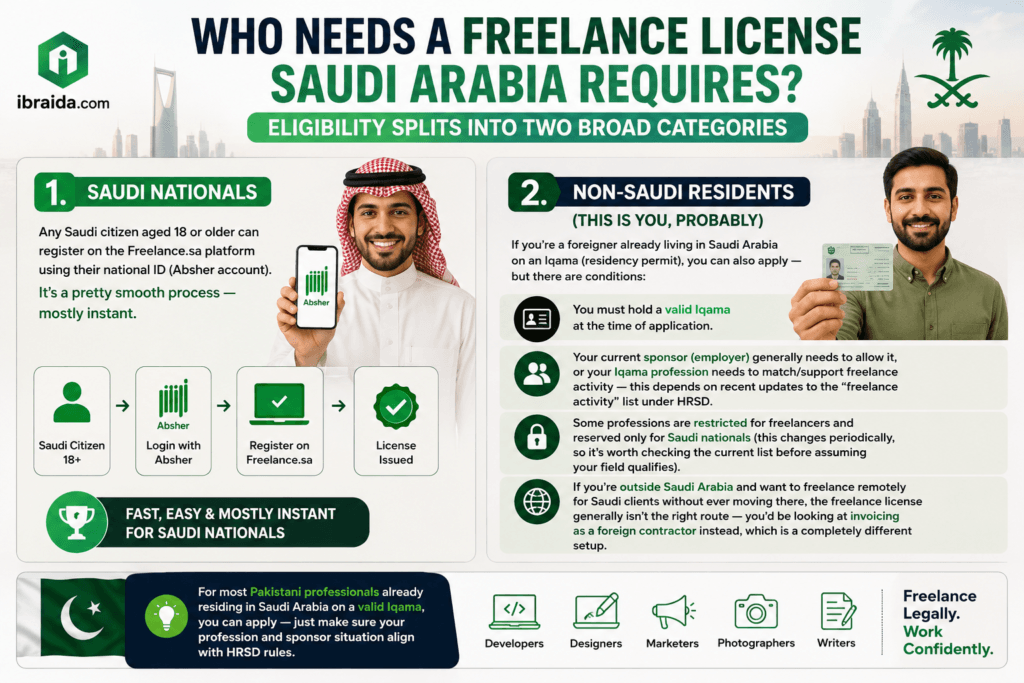
This is where things get a little different depending on your situation. Eligibility splits into two broad categories:
1. Saudi Nationals
Any Saudi citizen aged 18 or older can register on the Freelance.sa platform using their national ID (Absher account). It’s a pretty smooth process for citizens — mostly instant.
2. Non-Saudi Residents (This Is You, Probably)
If you’re a foreigner already living in Saudi Arabia on an Iqama (residency permit), you can also apply — but there are conditions:
- You must hold a valid Iqama at the time of application.
- Your current sponsor (employer) generally needs to allow it, or your Iqama profession needs to match/support freelance activity — this depends on recent updates to the “freelance activity” list under HRSD.
- Some professions are restricted for freelancers and reserved only for Saudi nationals (this changes periodically, so it’s worth checking the current list before assuming your field qualifies).
- If you’re outside Saudi Arabia and want to freelance remotely for Saudi clients without ever moving there, the freelance license generally isn’t the right route — you’d be looking at invoicing as a foreign contractor instead, which is a completely different setup.
For most Pakistani professionals already residing in Saudi Arabia on a work or dependent Iqama, this is very achievable — you just need to pick an eligible activity and confirm it against your Iqama profession category before applying for your freelance license Saudi Arabia certificate.
Types of Freelance License Saudi Arabia Offers
Freelance.sa currently groups activities into over 160 professional categories across multiple sectors. Broadly, they fall into these buckets:
- Technology & Digital: Web development, app development, graphic design, UI/UX design, digital marketing, SEO, content writing.
- Media & Creative: Photography, videography, video editing, voiceover, translation, copywriting.
- Consulting & Business Services: Management consulting, HR consulting, financial consulting, training and coaching.
- Education: Private tutoring, curriculum design, online course creation.
- Engineering & Technical: Certain engineering consultancy roles (though many of these require additional accreditation through the Saudi Council of Engineers).
Each category has its own registration flow, and some (especially engineering, legal, and medical-adjacent fields) require you to attach proof of qualification or professional certification before your license gets approved. Tech, creative, and marketing categories are usually the fastest to get approved since they need minimal documentation.
Here’s a more practical way to think about it: the platform isn’t organized by industry buzzwords, it’s organized by very specific job titles pulled from Saudi Arabia’s national occupation classification. So instead of searching “marketing,” you might need to look under “Digital Marketing Specialist,” “Social Media Manager,” or “Content Creator” depending on what matches your actual work. This is exactly why Step 2 in the application process (choosing your activity) deserves more attention than people give it — picking the wrong sub-category, even within the right general field, can cause friction later when a client’s finance department cross-checks your certificate against the invoice description.
A few examples of how granular this gets: a “Graphic Designer” and a “UI/UX Designer” are treated as separate activities, even though the skill sets overlap heavily in real life. Similarly, “Arabic-English Translator” and “Technical Document Translator” sit under different codes. If your work spans multiple sub-specialties — which is common for freelancers who wear several hats — you’re allowed to register more than one activity under the same freelance license Saudi Arabia account, just know that each additional activity typically comes with its own small fee.
Step-by-Step: How to Get Your Freelance License Saudi Arabia Application Approved
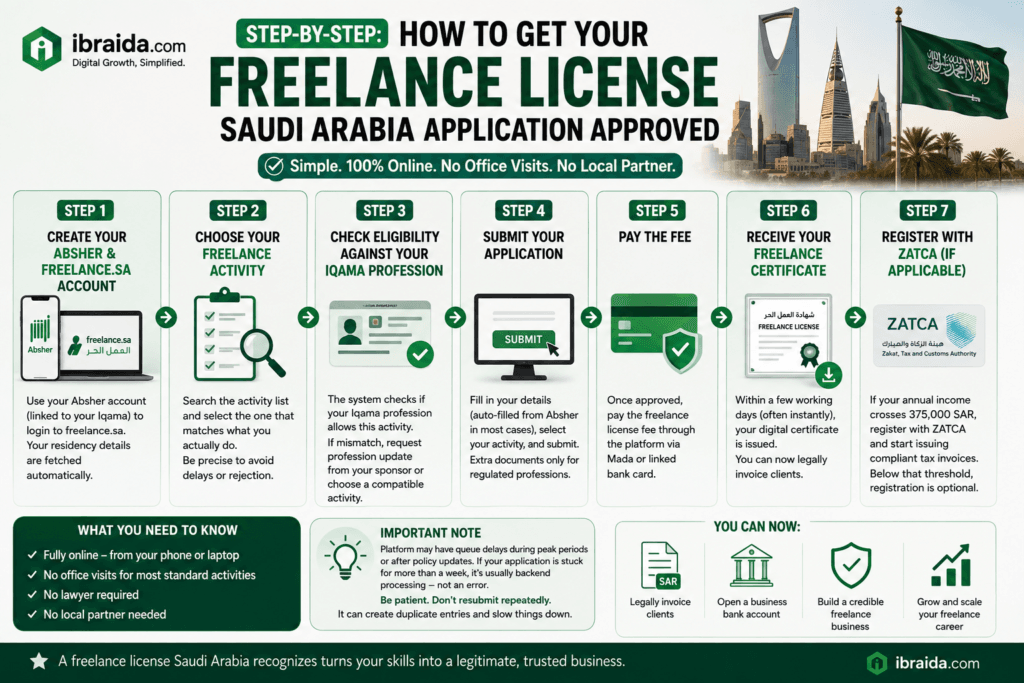
Here’s the actual process, broken down the way it really happens — not the sanitized government brochure version.
Step 1: Create Your Absher and Freelance.sa Account
Everything starts with Absher, the national digital ID platform. If you already have an Absher account tied to your Iqama, you’re halfway there. Log into freelance.sa using your Absher credentials — the platform pulls your Iqama and residency data automatically.
Step 2: Choose Your Freelance Activity
Search the activity list and pick the one that matches what you actually do. Be precise here — if you’re a graphic designer applying under “software development,” it can cause delays or rejection later when you try to invoice under a mismatched category.
Step 3: Check Eligibility Against Your Iqama Profession
The system will flag whether your current Iqama profession allows this freelance activity. If there’s a mismatch, you may need to either request a profession update through your sponsor or apply under a related activity that’s compatible.
Step 4: Submit Your Application
Fill in your personal details (auto-filled from Absher in most cases), select your activity, and submit. For most standard categories, no extra documents are needed. For regulated professions, you’ll be asked to upload certificates or qualification proof.
Step 5: Pay the Fee
Once approved, you’ll be prompted to pay the freelance license Saudi Arabia fee (more on the exact numbers below) through the platform, usually via Mada or a linked bank card.
Step 6: Receive Your Freelance Certificate
Within a few working days (often instantly for straightforward categories), your certificate gets issued digitally. This is your official proof — you can now legally invoice clients under this activity.
Step 7: Register with ZATCA (If Applicable)
If your annual freelance income is expected to cross the VAT registration threshold (currently 375,000 SAR), you’ll need to separately register with ZATCA, the tax authority, and start issuing compliant tax invoices. Below that threshold, VAT registration is optional but still worth considering for credibility with bigger clients.
That’s genuinely it. No office visits, no lawyer required for most standard categories, no local partner. Getting a freelance license Saudi Arabia government platform issues is designed to be done entirely from your phone or laptop.
One thing worth mentioning: the platform occasionally has queue delays during peak periods, especially right after new activity categories get added or when there’s a policy update. If your application seems stuck for more than a week with no movement, it’s usually not an error on your end — it’s just backend processing catching up. Patience helps here more than repeatedly resubmitting, which can sometimes create duplicate entries and slow things down further.
How Much Can You Realistically Earn With a Freelance License Saudi Arabia Certificate?
This varies wildly by field, obviously, but it’s worth setting expectations since a lot of people ask this before even applying. Tech freelancers — developers, designers, and digital marketers — tend to command the highest rates, often billing Saudi clients anywhere from SAR 3,000 to SAR 15,000+ per project depending on scope and complexity. Content writers, translators, and virtual assistants typically see more modest but steady income, often in the SAR 2,000 to SAR 8,000 monthly range if they’re working consistently with two or three clients.
The bigger shift people notice after getting a freelance license Saudi Arabia issues isn’t necessarily the rate itself — it’s the type of client you attract. Unlicensed freelancers usually end up working with smaller businesses or individuals who don’t ask for formal invoicing. Once you’re registered, larger companies, government-adjacent projects, and corporate clients open up, because they need a compliant vendor on their books for accounting purposes. That shift alone often pushes freelancers into a higher income bracket within the first year of being properly licensed.
Renewing Your Freelance License Saudi Arabia Certificate and Staying Compliant
The freelance license isn’t a one-time thing — it needs to be renewed annually, and this is where a surprising number of freelancers slip up. Since the renewal fee is small (SAR 100–140), people tend to forget it exists until a client asks for an updated certificate and they realize it lapsed months ago.
A few habits that make long-term compliance painless:
- Set a calendar reminder 30 days before expiry. The Freelance.sa dashboard shows your renewal date, but it won’t proactively chase you down.
- Keep your Iqama renewal in sync. If your Iqama lapses or changes sponsor, your freelance license Saudi Arabia status can be affected too, so handle these together rather than separately.
- Track your invoices even if you’re under the VAT threshold. If your income grows and you cross the 375,000 SAR mark mid-year, you’ll need clean records to register with ZATCA quickly rather than scrambling retroactively.
- Update your activity if your work evolves. If you started as a content writer and now do social media management too, add that as a second registered activity rather than invoicing outside your licensed scope.
None of this is complicated, but it does require a bit of ongoing attention — treat your freelance license Saudi Arabia renewal the same way you’d treat renewing a domain name or a subscription: small, recurring, easy to forget, annoying to fix if you let it lapse for too long.
Documents You’ll Typically Need
- Valid Iqama (residency permit)
- Absher account linked to your mobile number
- Passport copy (for reference, usually not uploaded unless requested)
- Educational certificate or professional qualification (only for regulated activities like engineering, consulting, or education)
- A recent photograph (for some activity categories)
For most tech, creative, and marketing categories, you honestly won’t need much beyond your Absher login and Iqama — the process of getting a freelance license Saudi Arabia requires is refreshingly light on paperwork compared to starting a full business in Saudi Arabia.
Freelance License Saudi Arabia Cost Breakdown (2026)
Here’s where a lot of people get confused, because the pricing has changed a few times since the platform launched. As of 2026, here’s a realistic breakdown:
| Item | Approximate Cost (SAR) | Notes |
|---|---|---|
| Freelance License (1 year) | SAR 100 – 140 | Waived in early platform years; small fee now applies for most activities. |
| License Renewal (annual) | SAR 100 – 140 | Same as initial cost, billed yearly. |
| ZATCA VAT Registration | Free | Only required if income crosses the VAT threshold. |
| Additional Activity (if adding a second category) | SAR 100 – 140 per activity | Each activity is billed separately. |
| Certificate Attestation (for regulated professions) | Varies | Depends on the certifying body — engineering, medical, legal fields mostly. |
Compare that to setting up an actual LLC in Saudi Arabia, where you’re looking at MISA license fees, commercial registration costs, and often a minimum capital requirement — a freelance license Saudi Arabia certificate is genuinely one of the most affordable ways to legally earn in the Kingdom. If you want the full numbers on company formation instead, we’ve broken it all down in our cost of starting a business in Saudi Arabia guide.
Freelance License Saudi Arabia vs. Full Business Setup — Which One Do You Actually Need?
This is the question I get asked the most, so let’s settle it clearly.
Go with a freelance license Saudi Arabia certificate if:
- You’re working solo, not hiring anyone
- You bill clients directly for your own services
- You already have an Iqama through another sponsor or your own status
- You want something fast, cheap, and low-maintenance
Go with a full business setup (LLC or branch office) if:
- You plan to hire employees
- You want to sponsor your own Iqama independently
- You’re building a scalable company, not just personal freelance income
- You need a MISA investment license because you’re a 100% foreign-owned entity
If you’re not sure which path fits your situation, our MISA investment license guide and LLC company registration article both go deep into the company-formation side, so you can compare the full picture before deciding.
Common Challenges Pakistani Freelancers Face Getting a Freelance License Saudi Arabia Certificate
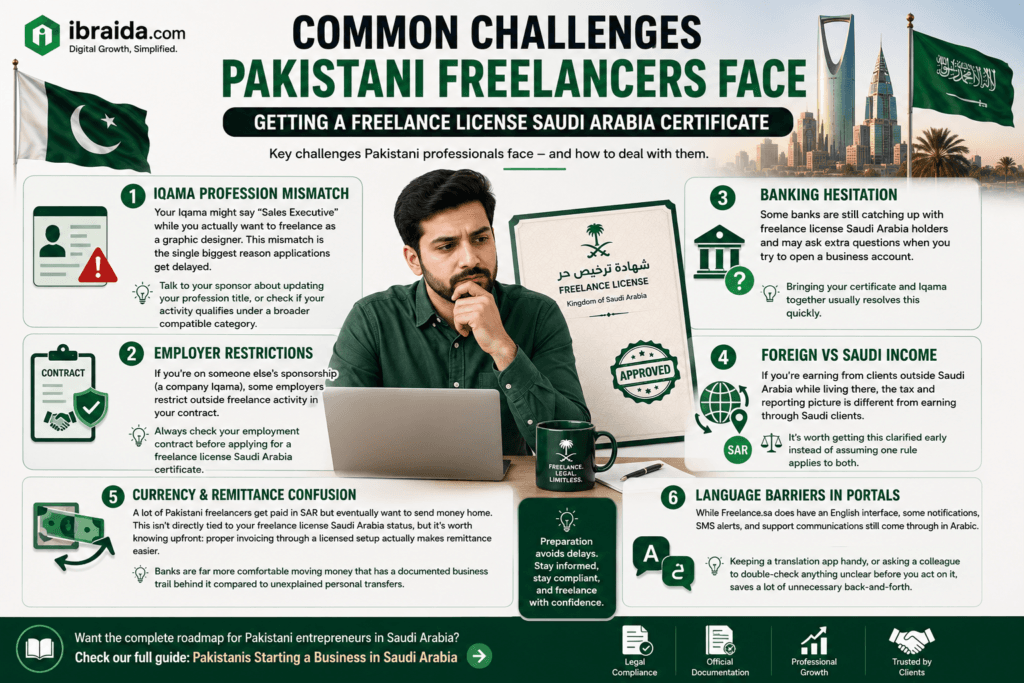
Since a lot of our readers are Pakistani professionals either already in Saudi Arabia or planning to move, here are the specific snags that come up most often:
1. Iqama Profession Mismatch
Your Iqama might say “Sales Executive” while you actually want to freelance as a graphic designer. This mismatch is the single biggest reason applications get delayed. Talk to your sponsor about updating your profession title, or check if your activity qualifies under a broader compatible category.
2. Employer Restrictions
If you’re on someone else’s sponsorship (a company Iqama), some employers restrict outside freelance activity in your contract. Always check your employment contract before applying for a freelance license Saudi Arabia certificate — you don’t want to breach it accidentally.
3. Banking Hesitation
Some banks are still catching up with freelance license Saudi Arabia holders and may ask extra questions when you try to open a business account. Bringing your certificate and Iqama together usually resolves this quickly.
4. Confusing Freelance Income with Remote Foreign Income
If you’re earning from clients outside Saudi Arabia while living there, the tax and reporting picture is different from earning through Saudi clients. It’s worth getting this clarified early instead of assuming one rule applies to both.
If you want a broader look at how Pakistani entrepreneurs are navigating the Saudi market beyond just freelancing, check our full guide for Pakistanis starting a business in Saudi Arabia — it covers a lot of the same groundwork from a slightly different angle.
5. Currency and Remittance Confusion
A lot of Pakistani freelancers get paid in SAR but eventually want to send money home. This isn’t directly tied to your freelance license Saudi Arabia status, but it’s worth knowing upfront: proper invoicing through a licensed setup actually makes remittance easier, because banks are far more comfortable moving money that has a documented business trail behind it compared to unexplained personal transfers.
6. Language Barriers in Government Portals
While Freelance.sa does have an English interface, some notifications, SMS alerts, and support communications still come through in Arabic. Keeping a translation app handy, or asking a colleague to double-check anything unclear before you act on it, saves a lot of unnecessary back-and-forth.
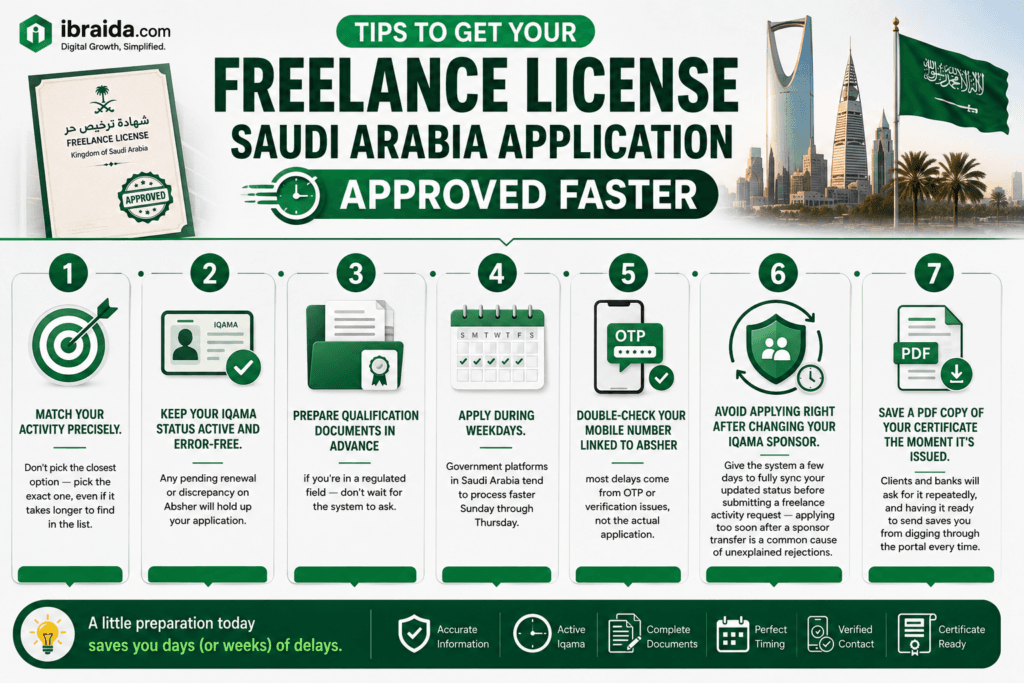
Tips to Get Your Freelance License Saudi Arabia Application Approved Faster
- Match your activity precisely. Don’t pick the closest option — pick the exact one, even if it takes longer to find in the list.
- Keep your Iqama status active and error-free. Any pending renewal or discrepancy on Absher will hold up your application.
- Prepare qualification documents in advance if you’re in a regulated field — don’t wait for the system to ask.
- Apply during weekdays. Government platforms in Saudi Arabia tend to process faster Sunday through Thursday.
- Double-check your mobile number linked to Absher — most delays come from OTP or verification issues, not the actual application.
- Avoid applying right after changing your Iqama sponsor. Give the system a few days to fully sync your updated status before submitting a freelance activity request — applying too soon after a sponsor transfer is a common cause of unexplained rejections.
- Save a PDF copy of your certificate the moment it’s issued. Clients and banks will ask for it repeatedly, and having it ready to send saves you from digging through the portal every time.
One more thing that catches people off guard: approval doesn’t automatically mean you’re free to invoice under every payment method. Some banks require you to specifically flag an account as a “freelance business account” before they’ll process incoming payments tied to your freelance license Saudi Arabia certificate without extra questions. It’s a small administrative step, but skipping it is one of the more common reasons freelancers experience delays with their very first payout after getting licensed.
Freelance License Saudi Arabia vs. UAE Freelance Visa — Quick Comparison
If you’re weighing Saudi Arabia against the UAE for freelancing, here’s the honest comparison: the UAE’s freelance visa route (especially through free zones like Dubai) tends to be a bit more expensive upfront but gives you a standalone residency visa tied to the freelance permit itself — which a freelance license Saudi Arabia certificate currently does not offer on its own (you still need an existing Iqama in Saudi). If you’re exploring both markets side by side, our Freelance Visa Dubai Toolkit walks through the UAE process end-to-end with cost breakdowns and a full application checklist, which pairs nicely with this guide if you’re comparing where to base yourself.
Final Thoughts on Getting Your Freelance License Saudi Arabia
Getting a freelance license Saudi Arabia requires in 2026 is about as straightforward as government paperwork gets — genuinely. The real work isn’t the application itself, it’s making sure your activity category, Iqama profession, and sponsor situation are all aligned before you hit submit. Get that part right, and you’ll likely have your certificate within days, not weeks.
Once you’re licensed, the real advantage kicks in: you can invoice properly, build credibility with bigger clients, and start treating your freelance work as an actual registered business instead of informal side income. If you’re still deciding between freelancing solo or setting up something bigger, it’s worth reading through our broader Saudi Arabia business setup guide for foreigners to see the full range of options before committing.
UAE Business Setup Cluster
Thinking About the UAE Instead? Read Our Complete Guide
If you’re comparing Saudi Arabia against the UAE, start with our full step-by-step guide covering free zones, mainland licensing, costs, visas, and everything else you need to launch in Dubai in 2026-2027.
Read the UAE Step-by-Step Guide →More From Our UAE Business Setup Series
- How to Start a Business in UAE: Complete Step-by-Step Guide (Pillar)
- Dubai Free Zones Guide 2026-2027: Complete List & Comparison
- Dubai Mainland License Guide 2026-2027
- Dubai Business Setup Cost Calculator & Comparison 2026-2027
- How to Open a Business Bank Account in Dubai 2026-2027
- UAE Corporate Tax Guide for Small Businesses 2026-2027
- UAE Golden Visa Guide 2026-2027: Requirements & Process
- Dubai Freelance Visa & Permit Guide 2026-2027
- Business Setup in Dubai for Pakistani Citizens: Complete Guide
- How to Start a Business in Dubai from the USA
- Best Business Ideas in Dubai 2026-2027
References
- Freelance.sa — Official Saudi Freelance Platform
- Ministry of Human Resources and Social Development (HRSD)
- Zakat, Tax and Customs Authority (ZATCA)
- Absher — Saudi National Digital Platform
- Saudi Vision 2030 — Official Program Site
Disclaimer
This article is for informational purposes only and does not constitute legal or financial advice. Regulations in Saudi Arabia change periodically — please verify current requirements with the Ministry of Human Resources and Social Development (HRSD) or a licensed consultant before making decisions.
Frequently Asked Questions About Freelance License Saudi Arabia
Can I get a freelance license Saudi Arabia issues without an Iqama?
No, currently the freelance license is only available to individuals who already hold a valid Iqama (Saudi residency permit). If you’re outside the country, this specific license isn’t the right route for you.
How long does a freelance license Saudi Arabia application take to get approved?
For straightforward, non-regulated categories like design, marketing, or writing, approval can happen within a few days, sometimes instantly. Regulated professions requiring certificate verification can take longer.
Do I need a local sponsor to get a freelance license Saudi Arabia certificate?
No separate sponsor is needed for the freelance license itself, but you do need an active Iqama, which typically comes through an existing employer or dependent sponsorship.
Can I hold a job and freelance at the same time in Saudi Arabia?
It depends on your employer’s policy and your contract terms. Some companies allow it, others restrict outside work explicitly. Always check your employment contract first.
Is a freelance license Saudi Arabia certificate the same as starting a company?
No. A freelance license lets you work independently under your existing Iqama, while starting a company (like an LLC) is a completely separate legal entity with its own registration, sponsorship, and tax obligations.
What happens if I don’t register and freelance informally?
You risk issues with tax compliance, banking, and potentially your residency status if authorities flag unregistered income. Getting a freelance license Saudi Arabia certificate is a fairly low-cost, low-effort process to get compliant, so there’s little reason to skip it.